
Solar Cost in Georgia in 2026: What You’ll Pay, What You’ll Save, and What Still Cuts the Price
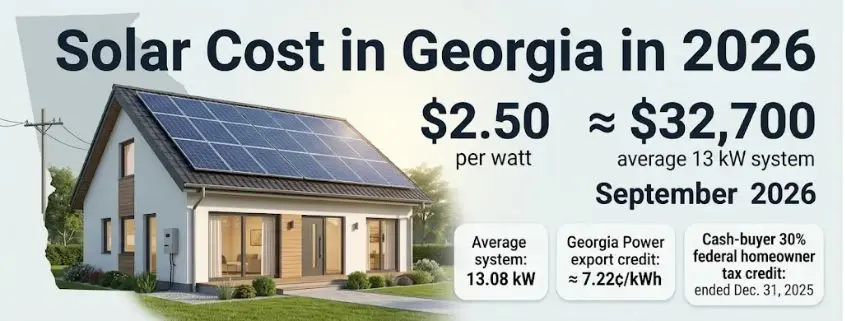
Solar in Georgia costs about $2.50 per watt in September 2026. That puts an average system near $32,700 before incentives. However, price is only half the story. The 30% homeowner tax credit is gone. Georgia Power also pays less for exported power than it charges at retail. As a result, your savings depend on how you use electricity.
Georgia’s solar market is still growing. This month, regulators approved 1,137 MW of new solar contracts for Georgia Power. Therefore, demand remains strong. This guide covers prices, incentives, payback, financing, batteries, EV charging and commercial projects.
How Much Do Solar Panels Cost in Georgia in 2026?
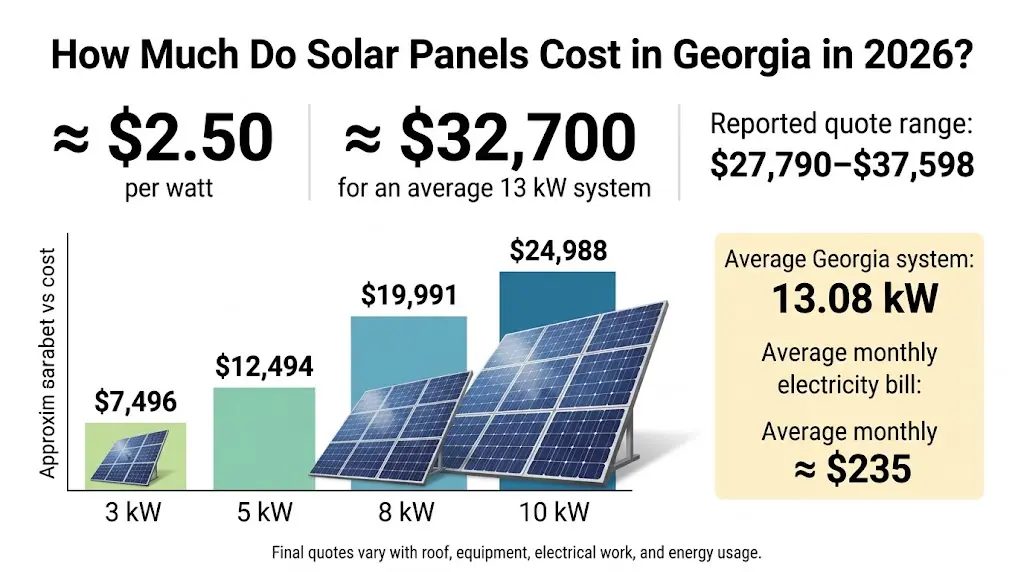
Georgia homeowners pay about $2.50 per watt, or roughly $32,700 for an average 13 kW system before incentives. Quotes range from $27,790 to $37,598. Your final quote will vary with roof, equipment, and energy usage.
The Impact Of System Size On Solar Costs In Georgia
Solar pricing generally increases with system size, with these approximate Georgia costs:
| System Size | Approximate Cost |
| 3 kW | $7,496 |
| 5 kW | $12,494 |
| 8 kW | $19,991 |
| 10 kW | $24,988 |
Therefore, larger systems carry higher costs.
Why Is The Georgia Average System So Large?
The average Georgia system is 13.08 kW, far above the 6 to 7 kW many guides assume. The average bill is about $235 a month. As a result, guides using smaller systems show lower totals.
What Does Solar Cost In Atlanta, Savannah, Augusta And Columbus?
City-level solar costs vary across Georgia, with these reported figures providing a useful comparison:
| Georgia City | Cost Per Watt | System Size | Approx. Cost |
| Metro Atlanta | $2.54 | 12.56 kW | $31,903 |
| Savannah | $2.51 | 13.00 kW | $32,630 |
| Augusta | $2.42 | 13.00 kW | $31,460 |
| Columbus | $2.37 | 13.00 kW | $30,810 |
Savannah averaged $2.51 in July, Augusta averaged $2.42 in May, and Columbus averaged $2.37 in June. Treat the city figures as guides, since they predate the statewide update.
What Makes One Georgia Solar Quote Higher Than Another?
System size, equipment, roof, electrical work and installer overhead explain most price gaps.
Impact Of Equipment Choices On Solar Price
Panel type, inverter type and sourcing rules change the price most. Microinverters cost more than string inverters but can help on shaded roofs. Foreign-entity sourcing limits now affect some projects, as our guide to FEOC-compliant solar panels explains. Meanwhile, module prices fell about 16% in the second quarter. However, tariffs on structural materials and freight costs kept whole-system prices up.
The Impact Of Site And Overhead Costs On A Quote
Roof complexity, panel upgrades, permit fees, sales costs and profit add the rest. Permit rules differ by city and county in Georgia. Consequently, ask every installer for an itemized estimate.
Is The 30% Federal Solar Tax Credit Still Available In Georgia In 2026?
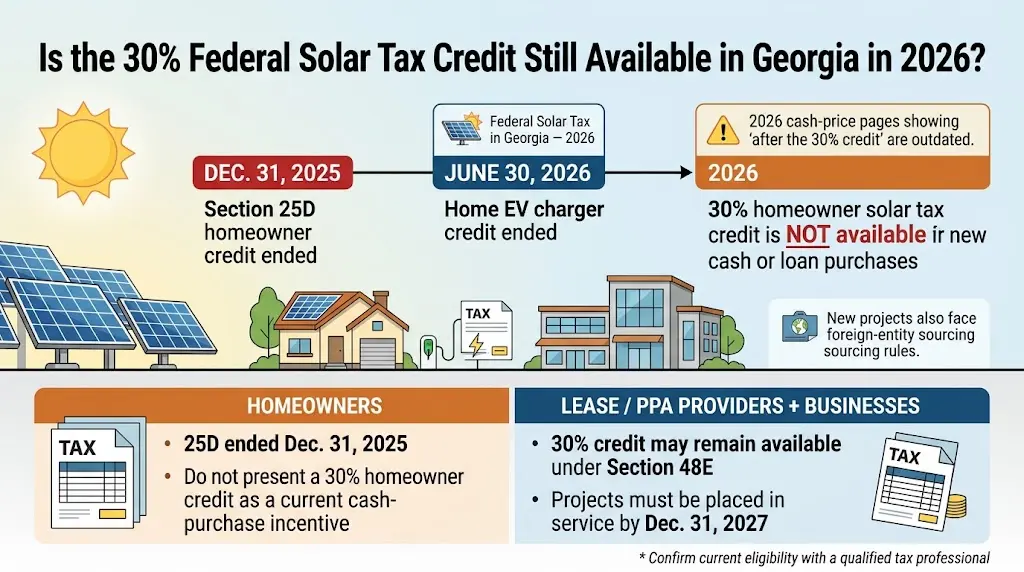
No. The 30% homeowner credit ended for cash and loan purchases on December 31, 2025.
Section 25D ended December 31, 2025, and the home EV charger credit ended June 30, 2026. The 25D credit also covered home batteries.
Read more in our guide to the 30% federal tax credit.
Lease and PPA providers, and businesses, can still claim 30% under Section 48E. Providers may pass savings to you through lower payments.
New projects must be placed in service by December 31, 2027. The July 4, 2026 begin-construction window has closed. Projects that began earlier have a longer timeline. New foreign-entity sourcing rules also apply.
Note: Any page showing a 2026 cash price “after the 30% credit” is outdated. Compare gross prices instead.
What Georgia Solar Incentives Can Still Lower Your Cost?
Georgia has no state solar tax credit, so utility programs and one expiring tax exemption remain.
No. Georgia has no state solar income tax credit, SREC market or statewide sales tax exemption. Ignore pitches promising a Georgia state credit. Some guides claim a sales tax break, so confirm with the Georgia Department of Revenue.
The exemption expires entirely on January 1, 2027. Senate Bill 1 of 2025 already limited it to assessment dates before January 1, 2025. After that, your county assessor decides. Therefore, ask your assessor before you sign.
Georgia Power pays export credits for rooftop solar, not rebates. Sources disagree on whether one co-op rebate is still active. Therefore, call your co-op directly.
How Does Georgia Power Pay You For Excess Solar Power?
Georgia Power credits exports at about 7.22 cents per kWh in 2026, roughly half the retail rate. It combines a 3.2188-cent avoided-cost rate with a 4-cent adder. The avoided-cost part resets yearly. The adder came from the 2022 rate case. Confirm the rate before you sign.
Residential systems are capped at 10 kW AC. Enrollment is first come, first served until capacity hits 0.2% of last year’s peak demand. The one-to-one monthly netting pilot is full and closed.
How Do EMC Credits and Permitting Work?
EMC credits vary by co-op, and permits vary by city. Some EMCs pay very little. Cobb, Jackson and Sawnee EMC publish their own terms. Georgia has no single statewide solar permit code.
Will Georgia Electricity Rates Keep Rising, And How Does That Change Your Savings?
Base rates are frozen through 2028, and a June 2026 decision cut typical bills about $4 a month. On May 28, 2026, the PSC approved a fuel and storm agreement that started lowering bills June 1. Typical customers save about $4.04 monthly. However, fuel and storm charges can still move under a freeze.
Which Rate Does Solar Offset, And Which Plan Fits Best?
Solar offsets your retail rate, which averages about 14.5 cents per kWh statewide. The standard plan charges 8.1 cents in winter, and summer tiers rise from 8.6 to 14.8 cents. An earlier analysis found the standard plan gave the lowest bill with a small system. Still, test each plan against your usage. Our guide on how many kWh a house uses shows how.
What Does It Cost To Own Solar In Georgia After Installation?
Ownership costs are small next to the install price, but they belong in every payback estimate.
How Much Output Do Panels Lose, And When Do Parts Wear Out?
Panels lose about 0.5% of output yearly and keep roughly 87% to 90% after 25 years. Panels typically last 25 to 30 years. However, a 25-year warranty is not the same as a 25-year lifespan. Inverters and batteries often wear out sooner.
Plan for routine solar maintenance, occasional cleaning and possible roof work to keep your system performing efficiently. Pollen and dust can reduce panel output, making regular cleaning, inspections and other solar maintenance services important over time.
How Long Does It Take To Pay Back Solar In Georgia, And Is It Worth It?
Without the 30% federal tax credit, cash purchase payback periods in Georgia average 16 to 18 years, not the 7 to 10 older pages promise. A guide shows 17.2 years statewide and 16.14 years in Atlanta. Another 2026 analysis shows 17.9 years for Georgia Power customers. Older pages assumed the 30% credit, so their paybacks look shorter.
What Factors Do Impact Solar Payback In Georgia?
Self-use share, rate changes and system cost move payback the most. Using more solar power at home shortens payback. As the earlier example showed, self-used power is worth almost twice exported power. Long-term panel output also matters because gradual degradation can slightly extend the payback period, as explained in our solar panel degradation rate guide.
Homes with bills above about $150 a month tend to do best. Heavy daytime use helps too. Treat this as a rule of thumb, and run your own numbers. Moreover, storm resilience and bill stability add non-cash value, especially with a battery.
Want your Georgia payback, not the state average?
Get an itemized NEDES estimate covering equipment, permits, projected export credits and financing. Request a free estimate now!
Should You Pay Cash, Take A Loan, Lease Or Sign A PPA In Georgia?
Cash gives the strongest long-run savings, while loans and leases often cost more than they save. A study’s Georgia quote data shows the split for a 13.08 kW system.
- Cash costs $32,694 upfront and saves $19,722 over 25 years.
- A loan costs about $268 monthly and loses $19,654.
- A lease costs about $212 monthly and loses $37,662.
- A PPA costs about $130 monthly and saves $10,020.
Note: Leases and PPAs often carry escalators up to 3% yearly.
The Key Terms To Check When Choosing Solar Financing In Georgia
The provider owns the system and claims the 48E credit. However, the system must be in service by December 31, 2027. Georgia allows residential leases and PPAs up to 10 kW. Availability can differ by utility territory, so ask early.
Our comparison of solar lease vs cash purchase vs PPA goes deeper.
Check the escalator, term, buyout, liens and transfer rules for leases and PPAs. Add the lease payment to your remaining utility bill. That total is your real monthly cost. For loans, compare the APR, dealer fees and total interest.
Do Your Roof, Shade And Georgia Weather Change What Solar Costs And Produces?
Yes. Roof direction, shade, storms and heat all change what your system costs and produces.
South-facing, unshaded roofs produce the most power. Tall trees can cut output sharply. Ask for a shade analysis, and read our guide to the best roof for solar panels.
Storms, heat and local rules matter, but good design limits the risk. Ask about wind-rated mounting and roof sealing. Heat slightly lowers efficiency, yet panels still perform, as our post on solar panels in extreme heat explains. Critter guards also help. Nesting animals can chew wiring, and one repair can cost $200 to $500. Finally, check HOA covenants before you sign.
Should You Add A Battery To Your Georgia Solar System?
A battery adds backup power, but the 30% credit no longer lowers a homeowner’s battery cost. A battery can cut costs and keep the lights on, in the right setup. One Georgia Power plan charges 29.8 cents per kWh on summer weekday afternoons. A battery can shift solar power into those hours. Also, grid-tied panels shut off during outages unless you have storage.
What Does A Home Battery Cost In 2026?
Installed batteries cost roughly $700 to $1,300 per kWh nationally. A Tesla Powerwall 3 holds 13.5 kWh. Georgia quotes vary, so request itemized pricing.
Can You Pair Solar With An EV Charger, And What Does Home Charging Cost In Georgia?
Yes. The federal charger credit ended June 30, 2026, but Georgia Power still offers a $150 rebate.
Which EV Charger Incentives Remain?
Georgia Power pays $150 per Level 2 charger, up to two per account. Finish installation by December 31, 2026, while funds last, and apply within six months. GreyStone and Tri-County EMC offer $250, and Sawnee EMC offers $200 with a plug-in rate.
How Do Fees And Rates Affect Charging Costs?
Rates and state fees shape your yearly charging cost. The 2025 annual EV fee for personal vehicles was $234.97. A new excise tax on public charging starts January 1, 2027, but home charging is excluded. One estimate puts home charging near $689 yearly for 13,500 miles. Solar can cover part of that load.
What Does Commercial Solar Cost In Georgia In 2026?
Commercial solar runs roughly $1.10 to $2.55 per watt, depending on system size. The national commercial average was $1.77 per watt, up 5.6% in a year. Larger systems cost less per watt. Systems of 25 to 100 kW run $1.80 to $2.55. Systems of 100 to 500 kW run $1.40 to $1.90. Systems from 500 kW to 2 MW run $1.10 to $1.50.
Which Incentives And Payback Apply?
Businesses can claim the 30% 48E credit if systems are in service by December 31, 2027. Larger projects must meet prevailing wage and apprenticeship rules. Bonus depreciation may also apply, so confirm details with a tax adviser. Georgia’s property tax exemption also ends January 1, 2027. One cost index estimates paybacks of 3 to 7 years. Your tariff, roof and tax position decide the real number.
How Do You Choose A Trustworthy Solar Installer In Georgia?
Check licensing, certifications, warranty backing and finances before you compare price.
Which Licenses And Certifications Matter?
Georgia has no solar-specific license, but solar work generally needs a licensed electrical contractor. Verify licenses through the Georgia Secretary of State’s search. NABCEP certification is optional, yet utilities and lenders recognize it.
Which Warranties And Sales Claims Matter?
Get equipment, workmanship and roof-penetration coverage in writing. Ask what happens if the installer closes. One industry report counts more than 100 solar company closures since 2023. Insurance-backed warranties can help in that case. Also, be wary of “free solar” offers. They usually mean loans, leases or PPAs.
What Is The Smartest Next Step For Going Solar In Georgia In 2026?
Start with a bill-based estimate and an itemized quote, since lease, PPA and commercial credit deadlines are close. Expect one to three months overall. Installation itself takes one to five days at NEDES. Some guides quote two to four months. Permits and utility review cause most delays. Last, have a recent bill, your roof age, HOA details and your goals ready. Note whether Georgia Power or an EMC serves you.
Still unsure? Read whether solar is worth it in 2026.
What Else Do Georgia Homeowners Ask About Solar Cost?
Do solar panels increase home value in Georgia, and does it matter if I lease?
Owned systems can raise home value, but leased systems transfer to the buyer as a contract. One 2026 guide cites Berkeley Lab data of $3 to $4 per installed watt. Actual gains vary by market. Therefore, ask a local appraiser.
Can I install solar panels myself in Georgia to save money?
Not practically, because solar work generally needs a licensed electrical contractor. Permits are almost always required too. Your utility must also approve the interconnection. Therefore, hire a licensed installer.
How many solar panels does the average Georgia home need?
The average Georgia system is 13.08 kW, which equals about 33 panels of 400 watts each. Smaller homes need fewer panels.
Can renters or homeowners with shaded roofs still go solar in Georgia?
Often yes, but options depend on your utility and property. Georgia Power’s CARES program lets eligible subscribers buy a share of solar output. Availability varies, so ask your utility. Meanwhile, a ground mount can work when roofs are shaded.
Should I wait for solar prices to fall before going solar in Georgia?
Waiting is a gamble. Module prices fell about 16%, but whole-system prices did not fall with them. Deadlines add pressure. Georgia’s property tax exemption ends January 1, 2027. Lease, PPA and commercial credits also need service by December 31, 2027. Therefore, price your project soon.
Ready To Get A Solar Estimate For Your Georgia Home Or Business?
Yes. Start with an itemized estimate built around your bill, roof and utility.
In short, Georgia solar now costs about $2.50 per watt. The federal credit no longer helps cash buyers. Georgia Power pays about 7.22 cents for exports. Therefore, smart sizing and honest math matter more than ever.
NEDES helps Georgia homeowners and businesses do both. Our team handles residential solar, commercial solar, battery storage and EV charging. Every estimate itemizes equipment, permits and financing, including $0-down lease and PPA options where available. Our crews are NABCEP-trained, and Align Solar Protection adds insurance-backed coverage. Finally, a free estimate is the easiest way to see your real numbers.
Price Solar For Your Georgia Property With NEDES!
With average installation costs at $2.50 per watt and the federal credit expired for cash buyers, evaluating a Georgia solar project requires precise sizing and accurate rate analysis.
Get an itemized proposal covering equipment, local permitting, utility export rates, and flexible financing options to calculate your exact home savings.