
How Much Do Solar Panels Cost in Maryland in 2026?
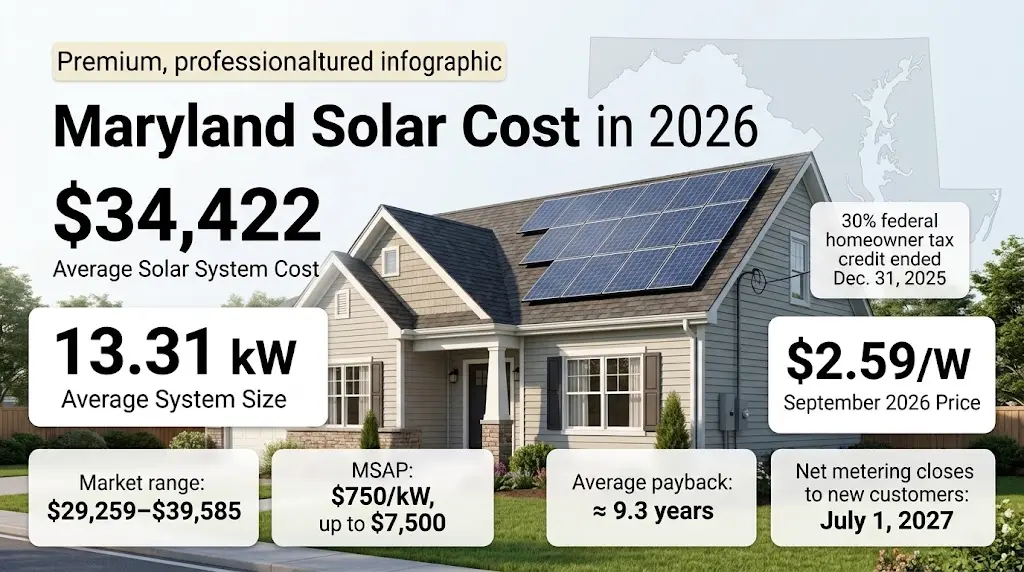
An average Maryland solar system costs about $34,422 before incentives. That is a 13.31 kW system at $2.59 per watt.
Key Takeaways
- Market prices range from $29,259 to $39,585 for the average system size.
- The 30% federal homeowner tax credit ended on December 31, 2025.
- The Maryland Solar Access Program (MSAP) is open for FY27.
- Net metering closes to new customers on July 1, 2027.
- The average payback period is about 9.3 years.
Solar pricing in Maryland shifted a lot this year. The federal tax credit is gone. However, state help is still open. Meanwhile, the clock is running on net metering. This guide explains each cost.
What Is the Average Cost of Solar Panels in Maryland Right Now?
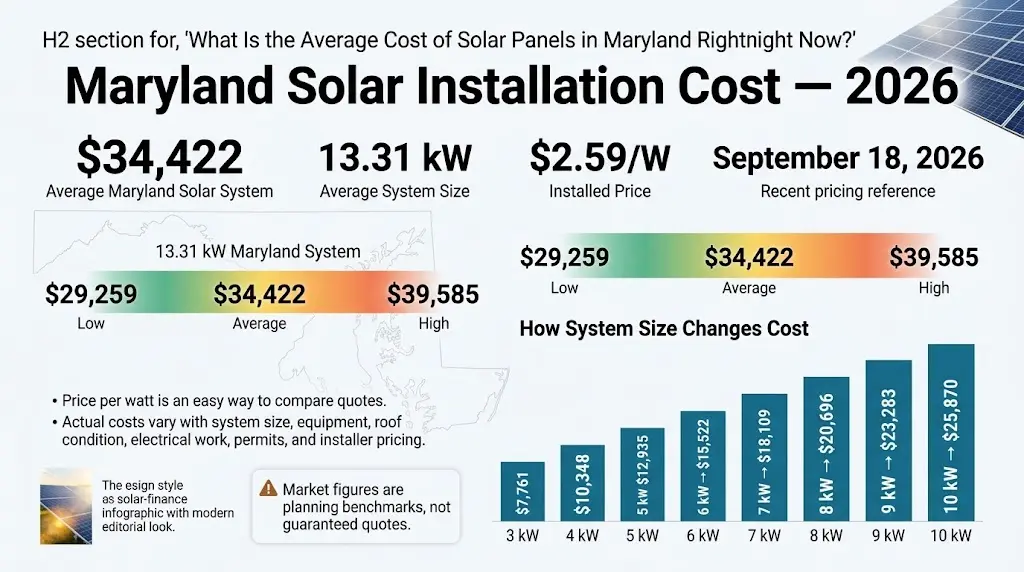
The average Maryland solar system costs $34,422 before incentives. That figure comes from 13.31 kW at $2.59 per watt.
What Is the Average Price Per Watt?
Price per watt is the easiest way to compare quotes. Recent data shows $2.59 per watt as of September 18, 2026. This price includes installation. It does not include any incentives. As a result, your final cost will drop if you qualify for grants.
What Does an Average-Sized System Cost?
A 13.31 kW system is the Maryland average. At $2.59 per watt, it costs $34,422. Market prices range from $29,259 to $39,585. Therefore, a quote near $29,259 is a good price, and a quote near $39,585 is high.
Why Do Different Sources Show Different Prices?
You may see other numbers online. Some sites show $2.85 or $3.01 per watt. These gaps come from different system sizes, dates, and data sets. Some older pages also assume the expired federal credit. So, always check the date on any price you read.
Once you know the price per watt, system size becomes the next big factor.
How Does System Size Change What You Pay?
Bigger systems cost more because they need more panels. Price rises almost in step with size.
| System size | Average cost in Maryland |
| 3 kW | $7,761 |
| 4 kW | $10,348 |
| 5 kW | $12,935 |
| 6 kW | $15,522 |
| 7 kW | $18,109 |
| 8 kW | $20,696 |
| 9 kW | $23,283 |
| 10 kW | $25,870 |
How Do You Size a System for Your Usage?
Your solar system size depends on your electricity use, not your roof size. A home using 900 kWh a month needs a smaller system than one using 1,600 kWh. So, start by gathering 12 months of bills. Next, ask each installer how they sized your system. This step keeps you from paying for panels you do not need.
Size sets your base price. However, other factors can move your quote up or down.
What Else Affects Your Final Solar Cost?
Equipment, roof condition, electrical needs, permits, and installer pricing all shape your final quote.
How Do Panels and Inverters Affect Cost?
High-efficiency panels cost more than standard panels. Efficiency means how much sunlight a panel turns into power.
Standard panels often reach about 20% to 21% efficiency. Premium brands such as Maxeon, REC Group, and Aiko reach about 22% to 24%. For example, a 10 kW system needs about 25 panels rated at 400 watts. The same system needs only about 23 panels rated at 430 watts. As a result, premium panels fit more power on a small roof. However, they usually carry a higher price per watt. Therefore, they make the most sense for small, shaded, or complex roofs. Mainstream brands like Q CELLS, Canadian Solar, and JinkoSolar often cost less. These panels suit roofs with plenty of open space.
Next, consider the inverter. An inverter turns panel power into power your home can use. Brands such as Enphase, SolarEdge, and SMA differ in price and warranty. Also, inverters often carry shorter warranties than panels. Therefore, plan for a possible replacement during your system’s life.
How Do Your Roof and Electrical Panel Change the Price?
Simple roofs cost less to work on. For example, a south-facing asphalt shingle roof is easy to install on. Roofs with many angles, chimneys, or tree shade cost more. Older electrical panels may need an upgrade first. A 100-amp panel may need a swap to 200 amp.
Likewise, replace an aging roof before installation. Otherwise, you may pay to remove and reinstall panels later. Ask your installer to inspect both before quoting. This avoids surprise costs later.
What Do Permits and Upkeep Add?
Permits and grid connection add fees and time. Your county office reviews the permit. Then utilities like BGE, Pepco, or Delmarva Power approve the connection. Some places use SolarAPP+ for faster permit approval. Timelines vary, so ask your installer for a written schedule. Start early to avoid delays before July 2027. After installation, upkeep costs stay small. Panels need occasional cleaning and monitoring. Because upkeep affects long term cost, it helps to understand solar maintenance before you buy.
Even a fair quote looks different today because the federal discount has ended.
Did the Federal Solar Tax Credit End, and What Does That Mean for Your Cost?
Yes, the 30% federal credit for homeowners ended on December 31, 2025. The One Big Beautiful Bill Act moved the end date of the residential credit up to that date. You can read how the 30% federal tax credit worked before it expired.
What Did the Credit Save?
The credit covered 30% of the project cost. On a $34,422 system, that was about $10,300. So, the same system now costs about $10,300 more after taxes. The credit had been scheduled to last through 2034. This early end surprised many homeowners.
Do Leases and PPAs Still Get a Federal Benefit?
Some providers still claim a business version of the credit. Some pass part of that saving to customers. However, this benefit is not guaranteed. So, ask providers to show the savings in your rate, in writing.
Fortunately, Maryland still offers several ways to lower your cost.
Which Maryland Incentives Can Still Lower Your Cost in 2026?
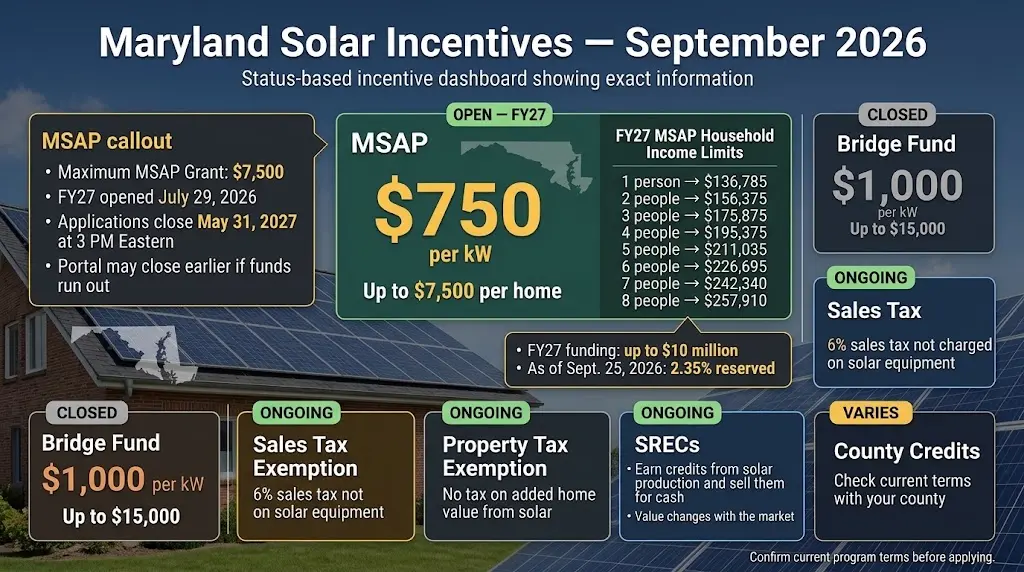
Maryland offers a state grant, a sales tax exemption, a property tax exemption, and SREC income.
| Incentive | Status (Sep 29, 2026) | What it offers |
| MSAP | Open for FY27 | $750 per kW, up to $7,500 |
| Bridge Fund | Closed | $1,000 per kW, up to $15,000 |
| Sales tax exemption | Ongoing | 6% tax not charged |
| Property tax exemption | Ongoing | No tax on added home value |
| SRECs | Ongoing | Sell credits for cash |
| County credits | Varies | Check your county |
Which Programs Are Open and Which Are Closed?
- The Bridge Fund is no longer taking applications.
- The Maryland Energy Administration (MEA) closed its portal to new applicants. It was one time help for people who had applied to MSAP earlier. Therefore, do not plan around it.
- MSAP is the main open grant now.
How Much Do Solar Panels Cost in Maryland in 2026??
Solar in Maryland costs about $34,422 for a 13.31 kW system at $2.59/W in 2026. See prices, MSAP grants, tax savings, net metering, and payback. On a $34,422 system, that spares you about $2,065. Also, the added home value from solar is exempt from property tax. Still, confirm details with your county assessor.
How Much Can SRECs Earn?
SRECs are credits you earn for the power your system makes. You can sell them to utilities through brokers. Prices move with the market. Therefore, check the current price before counting on this income.
Do Counties Offer Extra Help?
Some counties have offered local credits. Examples include Anne Arundel, Baltimore County, Harford, and Prince George’s. However, programs change with each budget year. So, confirm current terms with your county office.
The largest open grant is MSAP, so let us see who can get it.
Who Qualifies for the Maryland Solar Access Program, and How Do You Apply?
Homeowners under set income limits can receive up to $7,500 from MSAP. The FY27 program opened on July 29, 2026, according to MEA.
What Are the FY27 Income Limits?
Your household income must stay under a limit based on household size. The limits are listed below.
| Household size | Maximum gross yearly income |
| 1 | $136,785 |
| 2 | $156,375 |
| 3 | $175,875 |
| 4 | $195,375 |
| 5 | $211,035 |
| 6 | $226,695 |
| 7 | $242,340 |
| 8 | $257,910 |
Note: These limits are higher than many people expect. Check them before assuming you do not qualify.
How Much Is the Grant?
MSAP pays $750 per kilowatt, with a $7,500 cap per home. So, a 10 kW system earns the full $7,500. Smaller systems earn less. Confirm the FY27 rate in MEA’s offer calculator before you apply.
What Are the Application Steps?
The process has the following steps. Follow them in order.
- Choose a participating contractor from the MEA list.
- Apply for an upfront rebate reservation.
- Wait for MEA approval before any installation.
- Install the system and connect it to the grid.
- Request your rebate payment.
Your contractor may apply for you. In some cases, the contractor takes the rebate as a project discount. Either way, you must approve the reservation first.
How Much Budget Is Left?
MEA expects up to $10 million for FY27. As of September 25, 2026, only 2.35% was reserved. Applications close at 3 PM Eastern on May 31, 2027. However, the portal may close sooner if funds run out. Therefore, applying early is wise.
Need help checking your MSAP eligibility?
NEDES can review your bills, your roof, and your grant options. Contact us now!
What Will Solar Cost After Incentives?
A 10 kW system costs about $18,370 after MSAP, if you qualify. This is an example only, so your quote will differ.
How Does a 10 kW Example Add Up?
| Line item | Amount |
| Base price at $2.59 per watt | $25,870 |
| MSAP grant | minus $7,500 |
| Federal credit | $0 (ended) |
| Estimated net cost | $18,370 |
SREC income and county credits could lower this further. Meanwhile, the sales tax exemption already keeps your price lower.
What If You Do Not Qualify for MSAP?
Without MSAP, your cost stays near $25,870. Even so, you still keep the tax exemptions and bill savings. Because of this, financing may matter more for you.
These numbers assume your export credits keep today’s value. Therefore, net metering deserves a close look.
How Does Net Metering Work in Maryland, and What Changes on July 1, 2027?
Net metering credits the extra power you send to the grid. The Utility RELIEF Act ends the current program on July 1, 2027.
Today, your utility credits exports at the retail rate. In effect, the grid works like a free battery. Credits then offset your bill on cloudy days. Fixed fees still apply, so your bill may not reach zero.
What Is the SUNRISE Program?
SUNRISE is the planned successor. The law directs regulators to adopt it by July 1, 2027. It pays for exports based on their value to the grid. Therefore, exports may earn less than they do today.
Who Is Grandfathered?
Existing customers are expected to keep their current terms. However, a statewide cap could close the program sooner. The program ends early if 3,000 megawatts are reached first. So, confirm your status with your utility and the Maryland Public Service Commission.
How Should You Size Your System Under the New Rules?
A system that exports less depends less on export credits. So, size your system near your own usage. Also, ask installers to model both current and future export rates.
Suggestion: Start quotes and utility applications well before mid 2027. Timing may decide which program you land in.
Now we can estimate what these credits mean for your yearly savings.
How Much Will You Save, and How Long Until Solar Pays for Itself?
The average Maryland system pays for itself in about 9.3 years. For homeowners, residential solar savings depend most on your own bill.
What Are Maryland Electricity Rates in 2026?
Rates are a major driver of savings. The Maryland PSC reports that EIA corrected the state rate to 22.2 cents per kWh. That is a 17% increase from the year before. As a result, each kWh your panels make is worth more.
What Is an Actual Payback Period?
According to a recent report, it is a 9.29 year payback for the average system. That estimate assumes a $301 monthly electric bill. Your bill may be lower. Then payback takes longer. However, a higher bill shortens it.
What Are the 25-Year Savings?
A study estimates $74,421 in savings over 25 years for cash buyers. Such estimates rely on assumed rate increases. So, if rates rise slower, savings shrink. Panels also lose a little output each year. The National Renewable Energy Laboratory finds a median loss near 0.5% yearly.
Savings also depend on how you pay, so let us compare payment options.
Should You Buy With Cash, Take a Loan, Lease, or Sign a PPA?
Cash buyers save the most over time. Loans, leases, and PPAs cost less upfront.
| Option | Upfront or monthly | Estimated 25-year savings |
| Cash | $34,422 upfront | $74,421 |
| Loan | About $294 a month | $29,104 |
| Lease (3% yearly increase) | About $180 a month | $17,212 |
| PPA (0 to 1% yearly increase) | About $151 a month | $59,043 |
It is for the 13.31 kW Maryland system.
What Does a Cash Purchase Offer?
You own the system outright. You also keep every incentive. In addition, owned panels add to your home value.
What Are Your Loan Options?
Loans let you own the system with little money upfront. However, interest lowers your savings. Maryland’s BeSMART loan has offered up to $30,000 at 6.99% APR. Confirm current terms before you apply. Montgomery County’s Green Bank also offers solar loans in some areas.
How Do Leases and PPAs Compare?
A lease charges a fixed monthly amount. A PPA charges for each kWh produced. Leases often carry a 3% yearly increase. PPAs often carry 0 to 1%. Therefore, compare the yearly increase, not just the first payment.
What Happens to a Lease or PPA If You Sell Your Home?
These contracts usually transfer to the buyer. This can slow a sale. Owned systems avoid that problem. So, ask about transfer and buyout terms before signing.
Whichever route you choose, the installer matters as much as the price.
How Do You Compare Quotes and Choose an Installer?
Get at least three written quotes. Then compare price per watt, equipment, and terms.
What Should a Good Proposal Include?
A clear proposal answers your key questions. Look for these items:
- System size and how it was sized.
- Expected yearly output.
- Equipment brands and warranties.
- Full financing terms in writing.
- Payback with its assumptions..
How Can You Spot a Bad Quote?
Very low prices can signal weak equipment. Vague terms are another warning. Also, verify each contractor’s license with the Maryland Home Improvement Commission. For MSAP, use only contractors on MEA’s list.
Once you have quotes, you can decide whether solar fits your home.
Is Solar Worth It for Your Home?
Solar is usually worth it for owners with high bills, a good roof, and long term plans.
Who Benefits Most?
- Homes with high electric bills gain the most.
- Sunny, unshaded roofs help too.
- Also, long term owners see the full payback.
Business owners face different rules and prices, so review commercial solar separately.
Who Should Wait or Consider Community Solar?
Renters and shaded homes may not suit rooftop panels. Maryland’s community solar program lets people subscribe to a share of a project and earn bill credits. So, this option can still lower your bill.
What Else Should Maryland Homeowners Know Before Going Solar?
Do you need a new roof first?
Replace roofs near the end of their life before installing. Panels can outlast a worn roof. Removal and reinstallation adds cost. Also, MSAP needs reservation approval before installation, so finish roof work early.
How much does a home battery cost, and does the storage grant apply?
Maryland’s RCES grant pays up to $5,000 for a home battery. However, FY26’s $2 million budget was fully requested, and the portal closed. Check MEA for FY27 timing. Reserve funds before installing.
How much do panels degrade, and what do warranties cover?
Panels lose about 0.5% of output yearly, per NREL research. Most panel makers offer 25 year output warranties. Compare the guaranteed output at year 25 in every quote. Your 25 year savings estimate depends on it.
What does an inverter replacement cost?
Angi’s 2026 national estimate puts inverter replacement at $350 to $3,500, depending on type and count. String inverters last 10 to 15 years. Microinverters cost less to replace individually. Ask your installer for pricing in writing.
Can your HOA block solar?
Maryland law stops HOAs from unreasonably restricting solar. However, they may set reasonable placement rules. Submit your plan in writing and keep the reply. Confirm rules in your HOA documents.
Can you use plug-in balcony solar?
Yes. HB 1532 allows one portable solar system per customer. The limit is 1,200 watts. Utilities cannot require approval or fees. However, you must notify your utility before installing and share the device’s safety certification.
How long do permits and grid connection take?
Timelines vary by county and utility. BGE, Pepco, and Delmarva must approve your grid connection. Expect several weeks to a few months. Ask for a written schedule because the July 1, 2027 net metering deadline is fixed.
Is SREC income taxable?
Often yes. Federal tax rules generally treat SREC sales as income, and Maryland income tax starts from federal income. Keep sales records and ask a tax professional how to report them.
Will solar raise your homeowners insurance?
Tell your insurer before installation. Panels add to your home’s replacement value, so coverage may need to rise. Ask whether storm and hail damage to panels is covered. Then request any policy update in writing.
Should you wait for prices to fall?
Waiting carries risks. MSAP’s FY26 budget ran out when the portal closed on April 17, 2026. FY27 has $10 million, with 2.35% reserved as of September 25. Net metering closes to new customers July 1, 2027. This is not financial advice.
What Should You Do Next?
First, check the MSAP income limits for your household. Second, collect three written quotes. Third, decide well before July 1, 2027. Together, these steps protect your savings.
Ready to go solar in Maryland?
NEDES can help with all three steps. Contact NEDES today to request your quote!