
Pennsylvania Solar Permitting Guide For Homeowners
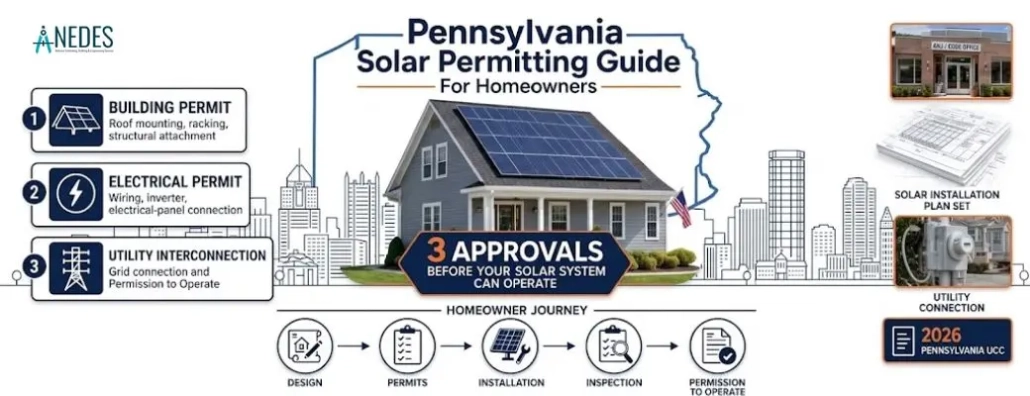
What does it actually take to get a solar permit approved in Pennsylvania? A Pennsylvania solar permit requires two separate local approvals, a building permit and an electrical permit, plus a signed interconnection agreement from your electric utility, before your installer can legally put a single panel on your roof.
Pennsylvania enforces its solar rules through the statewide Uniform Construction Code, but hundreds of individual municipalities administer that code their own way, so what clears in Philadelphia won’t automatically clear in Erie. This guide walks Pennsylvania homeowners through the entire solar permit process, city by city, in plain English.
What Counts as a Solar Permit in Pennsylvania
A Pennsylvania solar permit is really two permits bundled into one project. Both are issued by your Authority Having Jurisdiction, or AHJ, the local code enforcement office responsible for your township, borough, or city.
- Building permit: Covers the racking, roof penetrations, and structural attachment of the array.
- Electrical permit: Covers the wiring, inverter, and connection to your home’s electrical panel.
- Authority Having Jurisdiction (AHJ): The office that reviews your plans, collects your permit fee, and schedules inspections. Some AHJs are run directly by the municipality; others contract the work to a private code agency, which is common across rural Pennsylvania counties.
Pennsylvania’s Building Code Runs Through One Statewide Rulebook
Pennsylvania enforces solar installations through the Pennsylvania Uniform Construction Code, commonly shortened to the UCC, which adopts national model codes on a set schedule rather than writing its own from scratch. Three dates matter for any Pennsylvania solar plan set submitted in 2026:
- The 2020 National Electrical Code became effective statewide on July 13, 2025, with full enforcement beginning January 12, 2026.
- The 2021 International Codes, covering building and residential construction, became effective statewide on January 1, 2026.
- Individual municipalities can lag behind the state’s official adoption date, so confirm your specific AHJ’s adopted edition before your installer finalizes drawings.
An outdated code citation is one of the fastest ways to trigger a plan rejection, which restarts your review clock and pushes your installation date back.
Your Utility Has to Approve the Connection Before You Flip the Switch
Getting a building permit doesn’t automatically connect your system to the grid, that approval comes separately from your electric utility through an interconnection application. Pennsylvania’s investor-owned utilities include:
- PECO, serving Philadelphia and the five-county southeast region.
- PPL Electric, serving the Lehigh Valley, Harrisburg, Lancaster, and Scranton areas.
- Duquesne Light, serving the Pittsburgh metro area.
- Met-Ed, serving south-central Pennsylvania.
- Penelec, serving Erie and north-central Pennsylvania.
- Penn Power and West Penn Power, serving western Pennsylvania.
Some Pennsylvania AHJs won’t issue a building permit until you can show proof the interconnection application is already submitted, so this step often runs parallel to your permit application, not after it. Interconnection approval is also what makes your system eligible for net metering, the billing arrangement that credits exported solar power at the full retail electricity rate under Pennsylvania Public Utility Commission rules.
| Get a Free NEDES Solar Quote
Skip the guesswork on system size, permit fees, and payback timeline. NEDES builds a written, itemized quote for your Pennsylvania home, covering equipment, permitting, and projected net metering credit, before you sign anything. Call +1 (332) 233-7426 or visit nedes.us/contact-us |
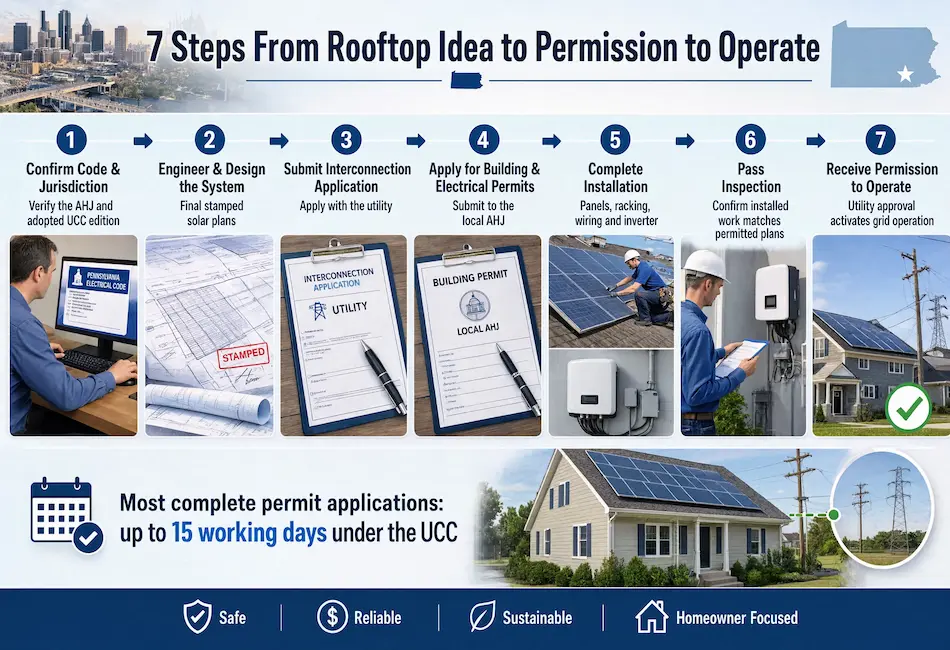
Seven Steps From Rooftop Idea to Permission to Operate
Every Pennsylvania solar project moves through the same core sequence, though local timelines vary by AHJ and utility.
| Step | What happens | Details |
| 1 | Confirm code and jurisdiction | Verify your AHJ’s adopted UCC edition and whether your municipality handles permitting directly or through a third-party code agency. |
| 2 | Engineer and design the system | A design professional or your installer produces stamped plans sized to your roof, shading pattern, and household electricity usage. |
| 3 | Submit the interconnection application | File with your utility, PECO, PPL Electric, Duquesne Light, or your local provider, before or alongside your permit application. |
| 4 | Apply for building and electrical permits | Submit simultaneously to your AHJ, through Philadelphia’s eCLIPSE portal, Pittsburgh’s OneStopPGH, or your municipality’s process. |
| 5 | Complete installation | Licensed electricians and roofers install racking, panels, wiring, and the inverter to the approved plan set. |
| 6 | Pass inspection | A licensed electrical inspection confirms the completed system matches the permitted plans and meets NEC Articles 690 and 705. |
| 7 | Receive Permission to Operate | Your utility issues PTO, activating net metering and legally allowing the system to feed power back to the grid. |
How Long Does a Pennsylvania Solar Permit Actually Take
Pennsylvania’s Uniform Construction Code requires most AHJs to issue a permit within 15 working days of a complete application, a figure councils of governments across the state cite directly to applicants. That clock only starts once your paperwork is complete, and incomplete applications get sent back for revisions, restarting the wait. A few figures put the real-world timeline in perspective. Let’s start with 2026 solar permitting scorecards.
A 2026 solar permitting scorecard from PennEnvironment gave Pennsylvania an F grade for permitting practices. PennEnvironment says the state’s patchwork of local requirements can add $6,000 to $7,000 to the cost of a typical residential system through delays and duplicated paperwork. Some Pennsylvania jurisdictions have piloted SolarAPP+, automated permit review software that, across five permitting authorities and sixteen solar contractors tested in 2026, cut review times to under a day and saved an estimated 2,067 staff hours, though adoption across the Commonwealth remains uneven.
Permitting Rules by Pennsylvania City
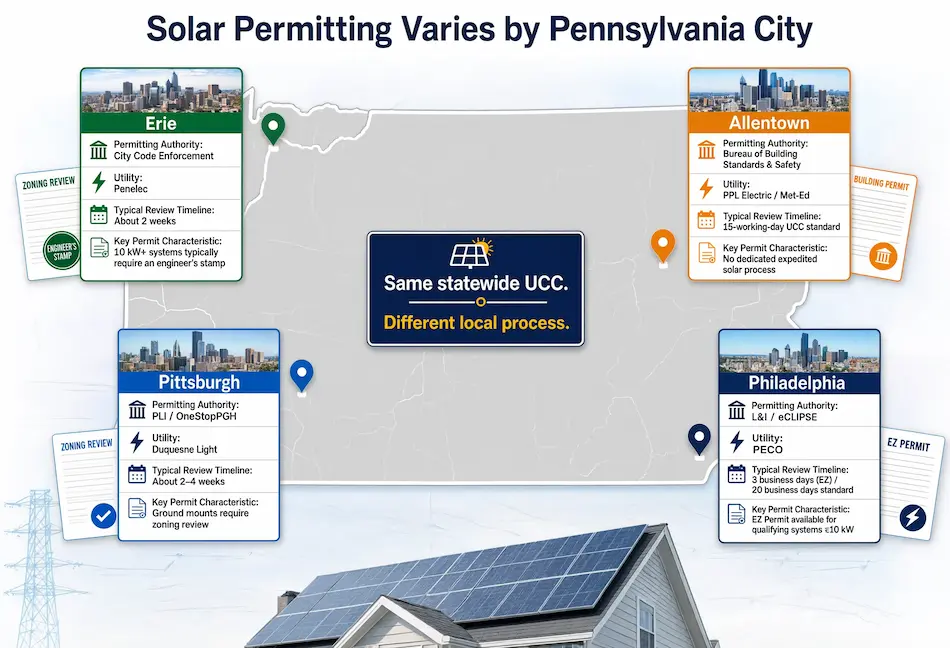
Every Pennsylvania AHJ enforces the same statewide UCC, but the office you deal with, the portal you use, and the fee schedule you pay all change from one city to the next. The table below compares four cities NEDES serves directly, followed by a closer look at each one.
| City | Permit office / portal | Utility | Typical timeline | Fee range |
| Philadelphia | L&I, through the eCLIPSE portal | PECO | 3 business days (EZ) or 20 business days (standard) | $25 filing fee, plus $25 per $1,000 of electrical construction cost |
| Pittsburgh | PLI, through OneStopPGH | Duquesne Light | About 2 to 4 weeks depending on system size and mounting | $150 to $500 |
| Allentown | Bureau of Building Standards and Safety | PPL Electric or Met-Ed | Follows the statewide 15-working-day UCC standard | Set locally; contact BSS for a current schedule |
| Erie | City of Erie Code Enforcement Office | Penelec | About 2 weeks for standard rooftop systems | $150 to $500 |
Philadelphia
Philadelphia runs one of the state’s fastest solar permit tracks, the EZ Permit, for qualifying rooftop projects.
- Eligibility: Systems of 10 kW or less on a one- or two-family dwelling qualify for the EZ Permit, which skips the building permit requirement entirely.
- Still required: An electrical permit and a private solar interconnection application filed with PECO, submitted before you apply for the permit.
- Timeline: The Department of Licenses and Inspections processes EZ Permits within three business days, versus twenty business days for standard applications; an accelerated five-business-day plan review is available for a fee on non-EZ projects.
- Fees: A $25 filing fee for one- or two-family dwellings, credited toward the final permit fee, plus an electrical permit fee of $25 per $1,000 of estimated construction cost, with array and inverter equipment costs deductible from that total.
- Historic properties: Homes inside a designated historic district need an additional Historic Commission review if the array is visible from the street.
Pittsburgh
Pittsburgh routes every solar permit through Permits, Licenses and Inspections, known as PLI, using the city’s OneStopPGH online portal.
- Code baseline: Pittsburgh enforces the Pennsylvania UCC on a 2018 International Residential Code baseline with local amendments.
- Utility: Duquesne Light handles interconnection for most Pittsburgh-area homes.
- Timeline and fees: Standard rooftop systems run about two weeks and $150 to $400; systems of 10 kW or larger, which typically require a professional engineer’s stamp, run closer to three weeks and $200 to $500.
- Ground-mounted systems: These need a building permit, an electrical permit, and a Zoning Development Review, since ground-mounted arrays are treated as accessory structures subject to setback and lot-coverage rules; expect about four weeks.
- Fire review: Pittsburgh’s Bureau of Fire reviews all solar PV array work scopes in addition to PLI’s building and electrical review.
- In person: PLI keeps a walk-in service center at 200 Ross Street for applicants who prefer face-to-face help.
Allentown and the Lehigh Valley
Allentown’s Bureau of Building Standards and Safety reviews plans, issues permits, and inspects solar installations under the same statewide UCC that governs the rest of Pennsylvania.
- Most Allentown-area homes sit in PPL Electric or Met-Ed territory, and both utilities charged residential rates above the Pennsylvania and national averages as of 2023.
- The Bureau maintains a Residential Solar Review Checklist specifically for solar applications, separate from its general residential permit forms.
- Standard residential permit rules require a minimum of two sets of plans submitted for review.
- Unlike Philadelphia’s EZ Permit, Allentown has no dedicated expedited solar process, so most applications follow the statewide 15-working-day UCC standard.
- As for the contact, The Bureau of Building Standards and Safety can be reached at (610) 437-7591 or 7592 for current fee schedules and submission requirements.
Erie
Erie’s Code Enforcement Office issues solar permits under the Pennsylvania UCC on a 2021 International Residential Code baseline with local amendments.
- Penelec serves most Erie-area homes and has posted some of the steeper rate increases in the state in recent years, which sharpens the payback math for solar.
- Timelines and fees are variable. Standard rooftop systems run about two weeks and $150 to $500, in line with Pennsylvania’s statewide average.
- Systems of 10 kW or more typically require a professional engineer’s stamp before Erie will issue a permit.
- Ground-mounted systems require a building permit, electrical permit, and zoning review, and are treated as accessory structures subject to setback and height rules.
- Erie’s lake-effect snow load is a structural factor installers account for in mounting design, separate from the permit process itself.
- The City of Erie Code Enforcement Office sits at 626 State Street, Room 407, and schedules inspections at (814) 870-1313.
Book a Free 15-Minute Consultation
Not sure whether your municipality uses EZ permitting, standard review, or something in between? Talk to a NEDES project advisor for 15 minutes and get a straight answer on your specific Pennsylvania jurisdiction’s process.
What Happens If You Install Solar Without a Permit
Unpermitted solar installations in Pennsylvania carry three concrete risks.
- Fines from your local code office for unpermitted work.
- A forced removal order requiring the system to come down.
- A voided homeowner’s insurance policy, since most carriers exclude unpermitted structural and electrical work from coverage.
Unpermitted systems also typically don’t qualify for Pennsylvania’s Solar Renewable Energy Credit program, since SREC registration through PJM-GATS generally requires proof of a passed inspection. Installing without a permit violates Pennsylvania’s Construction Code Act directly, and Pennsylvania has no statewide Solar Access Law limiting how aggressively a municipality can pursue enforcement, so the financial downside of skipping the paperwork usually outweighs whatever time it saves.
The Money Rules That Live Inside Your Permit Paperwork
Pennsylvania has no statewide property tax exemption for residential solar, unlike neighboring New Jersey and Maryland, which both exempt qualifying systems from added assessed value entirely. Whether your solar system raises your property tax bill depends on your individual county assessor and municipality. The table below rounds up the rules that actually move the numbers on your paperwork.
| Incentive or rule | Status in Pennsylvania as of 2026 |
| Statewide property tax exemption | None. Assessment treatment depends on the county and municipality. |
| Statewide sales tax exemption | None for residential, behind-the-meter systems; the 6% sales tax generally applies. |
| SRECs through PJM-GATS | Active. Trading near $25 to $45 per credit; a 10 kW system earns roughly 12 a year. |
| Federal residential credit, Section 25D | Expired December 31, 2025, for cash and loan purchases. |
| Federal commercial credit, Section 48E | Active for third-party-owned lease and PPA systems through 2027. |
| Net metering | Active statewide at the full retail rate, under PUC rules, for all investor-owned utilities. |
Pennsylvania’s Department of Revenue has clarified, per a 2026 legal analysis, that residential systems generating electricity for a homeowner’s own use don’t qualify for the state’s manufacturing sales-tax exemption, meaning most homeowners still pay Pennsylvania’s 6% sales tax on solar equipment, built into the installer’s contract price.
On the credit side, Pennsylvania homeowners can register completed systems for Solar Renewable Energy Credits through PJM-GATS, and a correctly sized 10 kW system generates roughly 12 SRECs a year. Third-party-owned lease and PPA systems remain the one path that still reaches a 30% federal credit in 2026, since the residential Section 25D credit expired for cash and loan purchases.
Common Questions Pennsylvania Homeowners Ask About Solar Permits
Can I apply for a permit before my installer finalizes the system design
No, a Pennsylvania AHJ needs stamped, final plans before it will accept a permit application, not a preliminary estimate. Reviewers check an exact equipment list, a wiring diagram, and a roof loading calculation against the plans you submit, so a placeholder design gets rejected and sent back for revision. That’s why the interconnection application and the permit application both wait on your installer’s finished engineering, even though both steps can run in parallel once that design is locked.
Does a Pennsylvania solar permit expire if I wait too long to install
Yes, under the International Residential Code that Pennsylvania municipalities enforce, a permit typically becomes invalid if work hasn’t started within 180 days of issuance. Your local AHJ can grant a written extension for justifiable cause, but letting a permit lapse means resubmitting the application and paying the review fee again. Scheduling your installer’s start date before you apply keeps that 180-day clock from becoming a problem.
Do I need a separate permit for a home battery like a Tesla Powerwall
Yes, most Pennsylvania AHJs require a separate electrical permit for battery storage, in addition to whatever permit covers the solar array itself. Battery systems fall under distinct fire code placement, ventilation, and clearance rules, since a lithium-ion battery carries different failure risks than a rooftop panel. Adding a Tesla Powerwall or similar system to an existing solar installation, rather than installing both at once, still triggers this separate electrical permit.
Can my HOA block my Pennsylvania solar installation
Yes, in most cases, since Pennsylvania has no statewide Solar Access Law protecting homeowners from restrictive HOA architectural rules. States like New Jersey and Maryland limit how far an HOA can go in restricting solar; Pennsylvania leaves that entirely to your community’s governing documents. Reviewing your HOA’s architectural guidelines before your installer finalizes panel placement avoids a redesign after your permit is already filed.
How much does a Pennsylvania solar permit actually cost
Most Pennsylvania solar permit fees land between $150 and $500 combined for the building and electrical permits, though Philadelphia calculates its electrical permit fee as a percentage of construction cost rather than a flat range. Ground-mounted systems and installations above 10 kW typically cost more to permit, since they require additional plan review, a zoning check, or a professional engineer’s stamp. Your installer’s written quote should list the permit fee separately from equipment and labor costs, so you can see exactly what your municipality is charging before you sign a contract.
A Quick Permit Readiness Checklist Before You Call an Installer
Gathering these details before your first conversation with an installer shortens your Pennsylvania permit timeline considerably.
| Have this ready | Why it matters |
| Most recent electric bill | Utilities and installers size your system and interconnection application from your actual usage, not a guess. |
| Roof age and material | Municipalities and insurers often require roofs under a certain age before approving penetrating mounts. |
| HOA governing documents, if applicable | Pennsylvania has no statewide Solar Access Law, so HOA rules can still shape panel placement. |
| Homeowner’s insurance policy | Confirms coverage terms before, not after, a permitted structural change. |
| Municipality name and county | Determines which AHJ, code edition, and permit portal applies to your project. |
| Utility account number | Required for the interconnection application filed with PECO, PPL Electric, Duquesne Light, or your provider. |
| Photos of your electrical panel | Helps your installer and the AHJ confirm available capacity before plans are drawn. |
Schedule a Free Site Inspection
A NEDES site inspection checks your roof condition, shading pattern, and electrical panel capacity in person, the exact details your permit application and interconnection filing will need.
The Bottom Line | Why NEDES?
NEDES holds NABCEP certification, the solar industry’s principal competency credential, and has installed residential and commercial solar systems across the Mid-Atlantic, including a regional Pennsylvania office in Pittsburgh, for more than two decades. Every NEDES installation includes Align Solar Protection, a lifetime, no-deductible warranty backed by an AM Best A+-rated insurance carrier, covering panels, inverters, racking, and roof-penetration resealing for as long as you own your home. NEDES is also a certified Tesla Powerwall installer, configuring battery backup for Pennsylvania homeowners who want outage protection layered on top of their solar system.
Handling the Pennsylvania solar permit process alone means tracking your AHJ’s code edition, your utility’s interconnection portal, and your municipality’s inspection schedule, all at once, across whichever city you happen to call home, whether that’s Philadelphia’s eCLIPSE system, Pittsburgh’s OneStopPGH, Allentown’s Bureau of Building Standards and Safety, or Erie’s Code Enforcement Office. That coordination is exactly what NEDES manages on a customer’s behalf, from first application to Permission to Operate, using the same NABCEP-trained project managers who already know each city’s paperwork, portal, and inspector by name.