
FEOC-Compliant vs. Non-FEOC-Compliant Solar Panels: A 2026 Guide
The Foreign Entity of Concern (FEOC) rules arrived through the One Big Beautiful Bill Act (OBBBA), and the Treasury Department finalized interim guidance in February 2026. For anyone installing solar, battery storage, or an EV charger across the Mid-Atlantic and beyond this year, the brand behind your quote now carries real financial weight, not just a warranty length.
This guide breaks down what FEOC status actually changes, what it leaves untouched, and how NEDES screens equipment before it ever reaches your roof.
What Does FEOC-Compliant Mean for a Solar Panel?
A Foreign Entity of Concern is a company that federal rules classify as owned, controlled by, or acting under the direction of China, Russia, North Korea, or Iran. Two sub-categories sit underneath that label.
- A specified foreign entity is directly tied to one of those four governments.
- A foreign-influenced entity is shaped through ownership stakes, debt holdings, or licensing arrangements that fall short of outright control.
Together, these two categories create what the law calls a prohibited foreign entity, or PFE. It is necessary to understand that material assistance from a PFE can disqualify part or all of a solar project’s federal tax credit.
| An Important Note |
| Ownership structure, not manufacturing address, decides FEOC status. |
Legal analysts have pointed to a rough working benchmark: a single Chinese shareholder holding roughly 25% or more of a company, or Chinese lenders holding around 15% of its debt, has been enough to flag a manufacturer as a likely PFE candidate, even when its factory sits inside the United States.
No Panel Carries an Official FEOC-Compliant Stamp
No federal agency issues a certificate labeled FEOC-compliant solar panel. Installers and developers instead calculate a project’s material assistance cost ratio and compare it against Treasury’s threshold for that year.
A manufacturer verified as low-risk this quarter can be reclassified the next if its ownership or supply chain shifts. Treat any blanket compliance claim from a supplier with the same scrutiny you’d apply to an unverified savings estimate.
FEOC-Compliant vs. Non-FEOC-Compliant Panels: The Core Differences
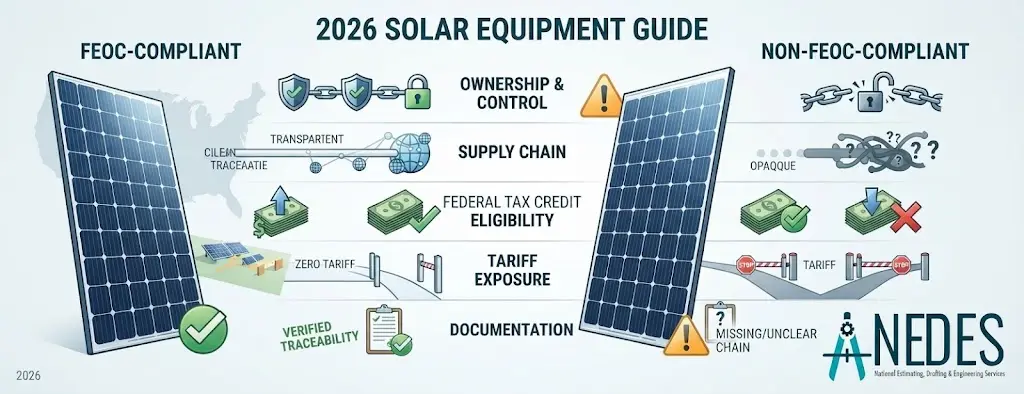
The two categories diverge on five practical points that affect price, paperwork, and eligibility.
| Factor | FEOC-Compliant Panels | Non-FEOC-Compliant Panels |
| Ownership & control | Verified free of Chinese, Russian, North Korean, or Iranian ownership or control | Owned, controlled, or licensed by a prohibited foreign entity |
| 48E / 45Y tax credit | Counts toward the required non-PFE percentage of project cost | Counts against the project and can zero out the credit |
| Import tariffs | Often assembled domestically, avoiding anti-dumping duties | Frequently subject to 30%-250% anti-dumping and countervailing duties on Chinese and Southeast Asian-origin cells |
| Typical price | 5%-15% premium over comparable imported modules | Lower sticker price, offset by tariff and credit risk |
| Documentation | Supplier provides ownership certification and cost-ratio data | Documentation is often incomplete or unavailable |
| Best fit | Commercial, lease, and PPA systems claiming Section 48E or 45Y credits | Cash-purchase residential systems that no longer claim a federal credit |
Why Do FEOC Rules Exist in the First Place?
China manufactures the large majority of the world’s solar cells, wafers, and polysilicon. Congress built the FEOC framework to reduce federal tax dollars flowing back through that supply chain. The OBBBA extended this restriction to Sections 45Y, 48E, and 45X of the tax code, covering the clean electricity production credit, the clean electricity investment credit, and the advanced manufacturing production credit.
Installers who have worked this industry for more than a few years have already adapted to the ITC’s step-downs, the Section 201 safeguard tariffs, and the shift to NEM 3.0-style net metering in some states. FEOC is simply the newest policy shift, and like the others, it rewards the installers who track it closely and penalizes the ones who don’t.
Get Your Free, FEOC-Aware Solar Quote
NEDES prices every quote against current MACR thresholds and available manufacturers, so your estimate reflects real 2026 tax-credit eligibility.
How FEOC Compliance Gets Calculated
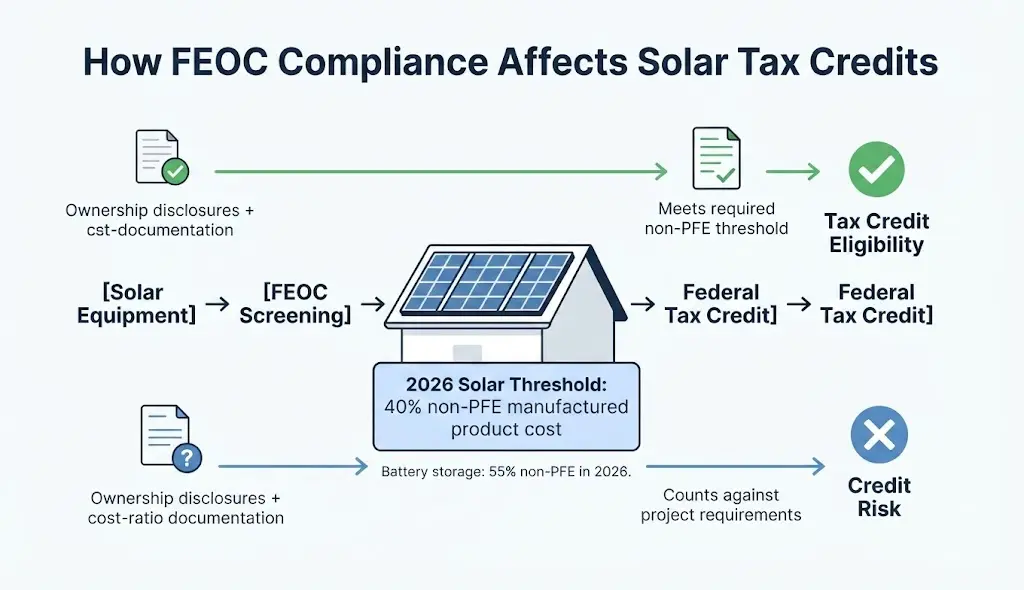
The material assistance cost ratio, or MACR, measures the share of a project’s or component’s cost that traces back to a prohibited foreign entity.
Treasury and the IRS published the first interim rules for this calculation in Notice 2026-15, issued February 12, 2026. The notice set the eligible component MACR for any solar energy component sold during 2026 at no less than 50%, while separately setting project-level thresholds for the percentage of manufactured product cost that must come from non-PFE sources.
2026 Thresholds by Project Type
| Project Type | 2026 Threshold | 2027 Threshold | Governing Section |
| Solar (ITC/PTC) | 40% non-PFE manufactured product cost | 45% | Section 48E / 45Y |
| Battery storage | 55% non-PFE | 60% | Section 48E / 45Y |
| Component MACR (any solar component sold in 2026) | Cannot be less than 50% | Pending Dec. 31, 2026 safe harbor tables | Section 45X |
Notice 2026-15’s Safe Harbors
The February 2026 notice let taxpayers reuse the existing domestic-content safe harbor tables from Notices 2023-38, 2024-41, and 2025-08 rather than build a new calculation from scratch. Those tables cover modules, cells, glass, frames, inverters, and trackers, but they exclude wafers, ingots, and raw polysilicon from the calculation, and they exclude steel and iron from FEOC scoring entirely.
Treasury and the IRS accepted public comment on the framework through March 30, 2026, and owe the industry a fuller, PFE-specific set of safe harbor tables by December 31, 2026.
- Projects safe-harbored before January 1, 2026, generally carry no FEOC compliance burden at all.
- Projects that began construction on or before July 4, 2026, kept the prior four-year completion runway under Section 48E.
- Projects starting after that date face both the shortened completion window and the full FEOC threshold test.
Does FEOC Compliance Affect Residential Solar Buyers?
The answer depends entirely on how you pay for the system. The 30% residential federal tax credit under Section 25D expired December 31, 2025, under the OBBBA, so a homeowner buying a system with cash or a loan no longer claims a federal credit at all, and FEOC status has no direct effect on that homeowner’s tax return.
A leased system or a power purchase agreement (PPA) works differently. The third-party owner claims the 30% Section 48E investment tax credit through 2027, and that credit is directly subject to FEOC screening. If the leasing company installs non-compliant equipment on your roof, the savings built into your lease rate can shrink, because the owner’s tax benefit shrinks first. Commercial systems, regardless of financing structure, are always subject to the same 48E screening.
Important Note
Solar Renewable Energy Certificates continue trading independently of FEOC rules, currently near $25-$45 per credit in Pennsylvania and $27-$33 per credit in Virginia.
None of this touches your state-level incentives. Net metering in Virginia (Dominion Energy, Appalachian Power) and Pennsylvania (all investor-owned utilities, PUC-protected) still credits exported power at the full retail rate.
Non-Compliant Panels Carry Costs Beyond a Lost Tax Credit
Tariff Exposure on Imported Modules
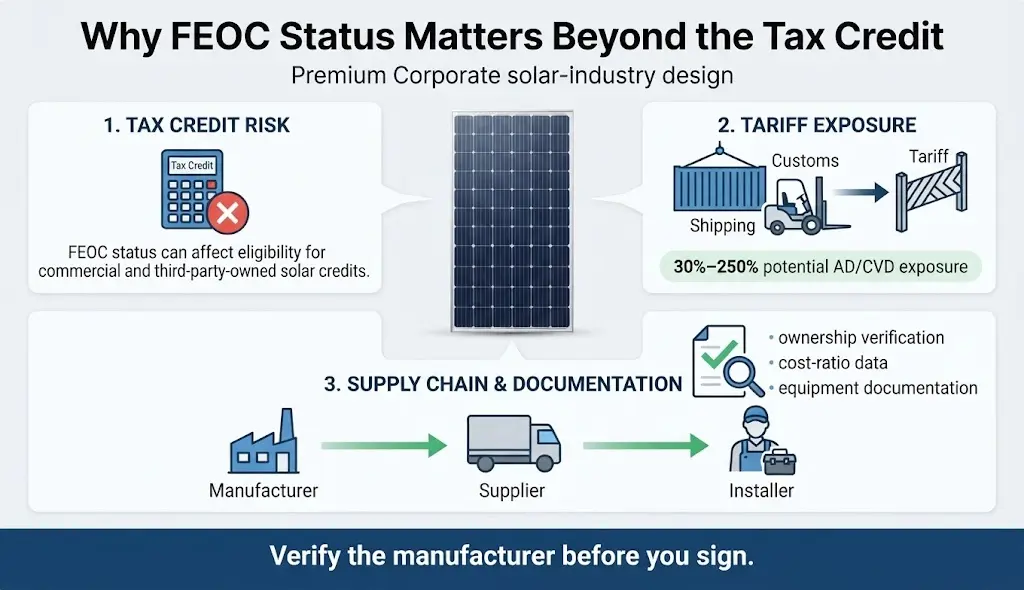
Panels sourced from a prohibited foreign entity often carry anti-dumping and countervailing duties of 30% to 250%, layered on top of a 14.25% Section 201 safeguard tariff. A newer anti-dumping and countervailing duty case now covers panels routed through Indonesia, Laos, and India, and a separate Section 232 case targets imported polysilicon and its derivative products. Even a non-compliant panel with a lower sticker price can end up costing more once these duties land on the invoice.
Supply Chain and Warranty Risk
Verified compliant inventory currently runs on lead times of roughly 18 to 20 weeks, tighter than the market saw before 2026. A project that locks in equipment without documentation risks a mid-project reclassification if a supplier’s ownership structure changes, which can retroactively threaten a claimed credit. Pairing FEOC-screened equipment with a warranty that outlasts the manufacturer itself matters here.
NEDES backs every installed system with Align Solar Protection, a third-party, insurance-backed warranty administered through an AM Best A+-rated carrier, covering panels, inverters, racking, and roof-penetration resealing with no-deductible claims for as long as you own the home, well past the 10- to 25-year terms most manufacturer warranties offer.
| Book a Free 15-Minute Compliance Consultation
Talk through your project’s FEOC exposure, financing structure, and manufacturer options with a NABCEP-trained NEDES advisor before you sign anything. |
Which Solar Equipment Manufacturers Are Considered Lower-Risk for FEOC in 2026?
Industry supply-chain trackers point to a short list of manufacturers whose ownership and production footprint currently place them outside PFE territory. This list moves as ownership changes, so verify current status before signing anything.
| Manufacturer | Product | Manufacturing Location | FEOC Posture (2026) |
| First Solar | Thin-film CdTe modules | Perrysburg, Ohio | Different cell chemistry than silicon panels; frequently cited as lower FEOC exposure |
| Q CELLS | Silicon modules | Dalton, Georgia | US-assembled; commonly used on domestic-content and FEOC-sensitive projects |
| Silfab Solar | Silicon modules (440W series) | Washington State and Ontario facilities | Positioned for domestic-content and FEOC-aligned projects |
| Enphase | Microinverters | US-aligned supply chain | Frequently cited among non-PFE inverter options |
| Tesla | Powerwall 3 battery | US-made | Cited as a US-made storage option; NEDES is a Tesla-certified installer |
How NEDES Verifies FEOC Status Before Your System Goes On the Roof
NEDES pairs NABCEP-trained crews with equipment from Tesla, Enphase, and Align Solar Protection. Every written estimate itemizes equipment cost, permitting fees, and projected net metering credits before a contract is signed.
That same estimate now carries a FEOC review. Our team checks each proposed manufacturer’s ownership disclosures and cost-ratio documentation against the current Treasury thresholds before finalizing a commercial, lease, or PPA proposal.
This screening runs across every service line NEDES handles in-house, not solar panels alone. Battery installations, EV charger circuits, add-on panels, and inverter upgrades all draw from the same vetted supplier list, so a system built in phases doesn’t quietly drift out of compliance between phase one and phase two.
What This Means If You’re Installing Across the Mid-Atlantic and Beyond
Homeowners in Virginia, Pennsylvania, Maryland, Delaware, and DC who buy their system outright can move forward without a FEOC calculation, since Section 25D no longer applies. Anyone considering a lease, a PPA, or a commercial installation in these states, or in Texas, Georgia, or North Carolina, should ask their installer for supplier-level FEOC documentation before signing, the same way they’d ask for a permit timeline or an interconnection estimate.
Virginia adds a further wrinkle worth knowing: solar equipment is exempt from local property tax assessment. It is an incentive that runs independent of FEOC status and stacks on top of whatever federal credit a lease or PPA structure secures.
The Key Takeaway
FEOC-compliant solar panels are no longer a niche procurement detail reserved for utility-scale developers. For anyone financing solar through a lease, a PPA, or a commercial structure in 2026, the manufacturer behind the panel now determines whether the underlying tax credit survives.
Ask for documentation, expect a modest price premium for verified equipment, and work with an installer that treats FEOC screening as a standard part of the estimate, not an afterthought.