
Do Solar Panels Work in Extreme Heat? (The Complete Guide for US Homeowners)
You are looking at your electric bill in the dead of July. The air conditioning is humming constantly, the thermometer outside reads 105°F, and you are wondering if investing in solar panels is actually going to save you money.
There is a massive misconception that because solar panels thrive on sunlight, they must love high temperatures. The truth is slightly more complicated. Solar panels absorb light to generate electricity, but heat acts as an environmental tax on their efficiency.
If you live in a hot-weather state like Texas, Arizona, California, Nevada, or Florida, you do not need to abandon your solar plans. While extreme heat temporarily lowers a panel’s instant power output, hot US states still produce the highest net energy yields and maximum financial savings across the country. You simply need to understand how heat interacts with photovoltaic technology so you can choose the right equipment and the right installation strategies to protect your wallet.
Do Solar Panels Still Produce Electricity When It’s Extremely Hot Outside?
Yes, solar panels continue to generate electricity in extreme heat, but their overall operating efficiency drops.
For every single ℃elcius that a solar panel’s surface temperature rises above 25°C (77°F), the panel loses a tiny fraction of its total power output, usually between 0.3% and 0.45%.
On a punishing 110°F summer afternoon in Phoenix or Las Vegas, a standard residential solar panel might operate at 15% to 25% below its maximum rated capacity.
Even with this temperature penalty, hot-climate solar panel installations consistently outproduce systems located in cooler, cloudier northern states. This happens because the raw volume of daylight hours and intense solar strength in the Sun Belt easily overcomes the minor efficiency loss caused by high thermal conditions.
Think of it like an economy car driving on a flat highway versus an incredibly powerful truck driving up a slight incline. The truck uses a bit more energy to conquer the hill, but it still carries a massive payload much further than the smaller car ever could. In solar terms, the sheer abundance of hot summer sunshine acts as that massive payload.
Why Does Heat Reduce Solar Panel Output? (The Physics Explained Simply)
To understand why high temperatures sap power from a solar panel, you have to look at how electrons behave inside a silicon solar cell. Solar panels do not create energy from the sun’s warmth; they create it from light particles called photons. When these photons strike the semiconductor material inside a photovoltaic cell, they knock electrons loose, forcing them to flow through an internal electrical circuit. This motion creates direct current electricity.
Voltage measures the electrical pressure pushing those electrons through the circuit. When a solar panel gets hot, the atoms inside the silicon semiconductor begin to vibrate rapidly. This thermal agitation makes the electrons highly chaotic. Instead of moving smoothly through the circuit, they collide with each other and the silicon atomic structure.
These microscopic collisions cause the electrical voltage inside the cell to drop sharply. While the overall current (the total volume of moving electrons) increases slightly due to the extra light energy, the massive drop in voltage causes a net loss in total power output.
How Hot Do Solar Panels Actually Get and Is That Different from Air Temperature?
A major mistake homeowners make is assuming their solar panels are the same temperature as the air outside. They are not. Solar panels are dark, heavy pieces of glass and metal sitting directly under intense, unobstructed radiation. Because they absorb massive amounts of thermal energy, panel surface temperatures regularly soar 25°F to 45°F higher than the ambient air temperature reported on the local news.
- Roof-Mounted Systems: Panels mounted flush against a residential roof typically run 35°F to 45°F hotter than the surrounding air due to trapped heat beneath the array.
- Ground-Mounted Systems: Arrays installed on open ground racks usually stay cooler, averaging just 15°F to 25°F above ambient air because wind can circulate freely around the back panels.
- The Desert Reality: If it is a 110°F afternoon in Scottsdale, Arizona, the actual surface temperature of a roof-mounted solar panel can easily reach 145°F to 155°F. In poorly ventilated or tightly packed installations, surface temperatures as high as 185°F have been recorded.
This massive temperature gap is why solar manufacturers do not rely purely on standard air temperatures when they design and test their equipment. Instead, the industry looks at specialized engineering metrics to determine how a panel will behave when real summer weather hits your neighborhood.
What Is Temperature Coefficient
The temperature coefficient is a specific technical metric that tells you exactly how much power a solar panel will lose for every degree its surface temperature climbs above the industry baseline. Every single solar panel manufactured goes through laboratory testing under standard test conditions (STC), which dictates a fixed cell temperature of 25°C (77°F), an artificial solar intensity of 1,000 watts per square meter, and zero wind speed.
How to Read the Temperature Coefficient on a Solar Panel Spec Sheet
When a solar sales representative hands you a multi-page product datasheet, ignore the flashy marketing images on the front page and flip directly to the technical specifications table. Look for a section explicitly titled “Temperature Characteristics” or “Thermal Ratings.”
Inside that specific table, you will see a row labeled “Temperature Coefficient of P_{max}” or “Coefficient of Max Power.” This is the precise number you need to evaluate. It will always look like a negative percentage followed by a Celsius symbol, such as -0.34 ℃ or -0.5 K.
You might also see secondary entries for open-circuit voltage and short-circuit current. While those secondary numbers matter to electrical engineers balancing the system’s wiring layout, you can safely skip them. The P_{max} coefficient is the master number that dictates the direct drop in total wattage leaving the array. If an installation company cannot show you this exact figure or hesitates to walk you through the manufacturer’s datasheet, take it as an immediate red flag regarding their technical competence.
What Is NOCT and Why Is It a Better Real-World Predictor Than STC?
Standard Test Conditions (STC) are completely unrealistic for hot-climate states because they assume the solar cell itself stays at 77°F while absorbing massive amounts of heat. To give buyers a truer sense of field performance, engineers created a secondary rating system called Nominal Operating Cell Temperature (NOCT).
The NOCT protocol tests solar panels under real-world environmental settings: an ambient air temperature of 20°C (68°F), a moderate solar intensity of 800 watts per square meter, and a gentle wind speed of 1 meter per second, with the array mounted at a tilted angle.
| Testing Standard | Cell Temp Baseline | Ambient Air Temp | Wind Speed | Solar Intensity |
| STC (Marketing Standard) | Fixed at 25°C (77°F) | Not Factored | 0 m/s (None) | 1,000 W/m |
| NOCT (Real-World Standard) | Variable (Rises Naturally) | Fixed at 20°C (68°F) | 1 m/s (Gentle) | 800 W/m |
When a panel undergoes NOCT testing, technicians measure how hot the inner cells get without external cooling. Standard budget panels usually climb to an internal NOCT between 45°C and 48°C (113°F to 118°F). Premium, highly engineered panels manage to dissipate heat efficiently, maintaining a lower NOCT between 40°C and 43°C (104°F to 109°F).
When you evaluate different solar brands, a lower NOCT rating is a massive competitive advantage. It means the panel naturally runs cooler on your roof, minimizing your daily temperature losses before the temperature coefficient math even kicks in.
What Actually Happens Inside a Solar Panel During a Heat Wave?
When a sustained heatwave hits your region, the physical components of a solar energy system experience significant environmental stress. This goes beyond a simple drop in afternoon voltage; extreme thermal conditions challenge the structural integrity of the entire module layout.
What Is a Bypass Diode and How Does Extreme Heat Affect It?
Inside the junction box on the back of every solar panel sit small electrical components called bypass diodes. Their job is to protect the panel from damage when a portion of the array gets covered by shade, dirt, or fallen leaves. If one solar cell is covered, it cannot produce power and instead becomes a resistor, blocking the electrical current and heating up intensely. The bypass diode senses this restriction and safely routes the electricity around the underperforming cell string.
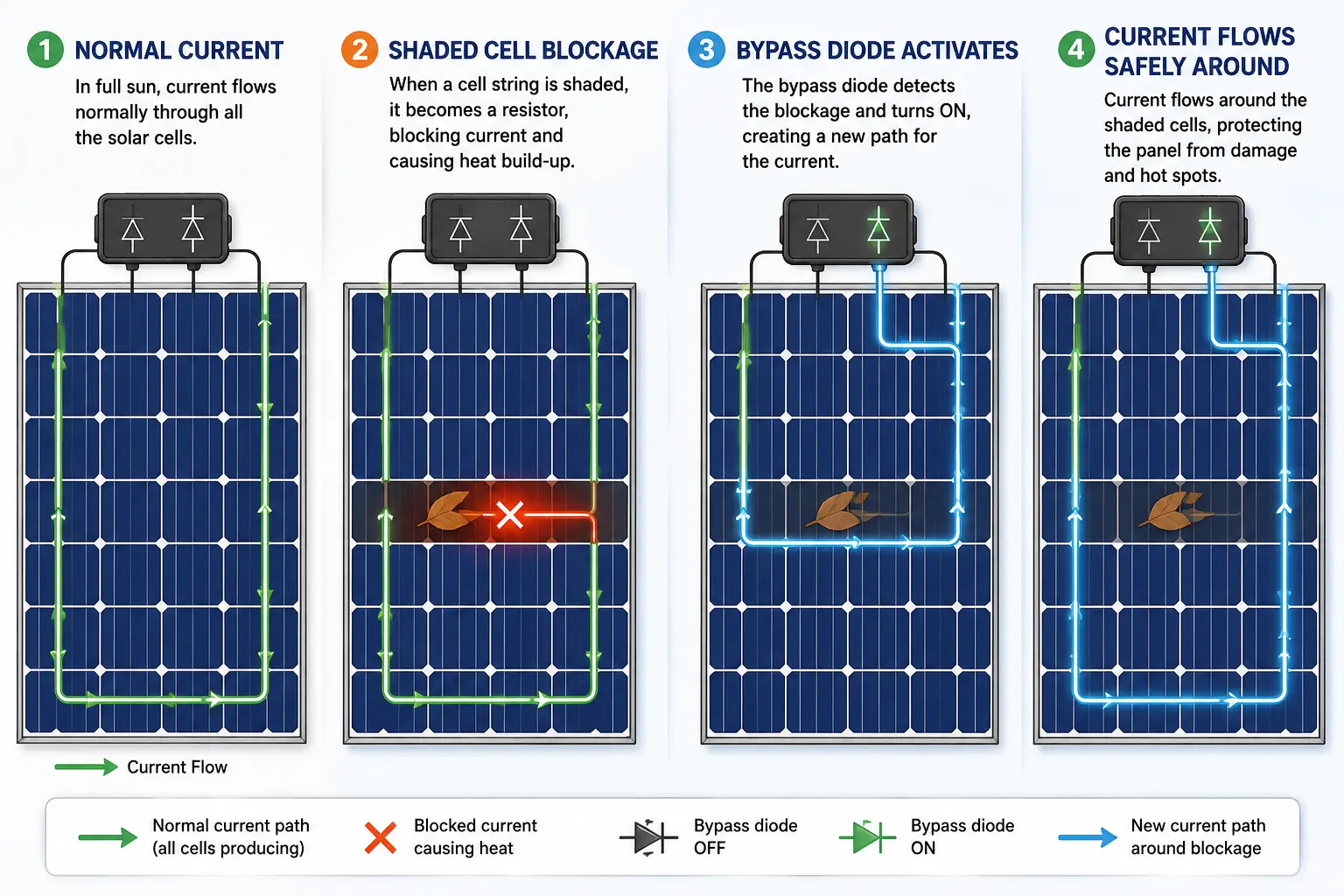
Extreme heat forces these diodes to work under massive thermal stress. If a solar installation lacks proper ventilation, junction box temperatures can exceed 85°C (185°F), which is the threshold where standard diodes begin to fail.
If a bypass diode burns out due to a combination of high heat and cell shading, the panel can develop permanent, destructive “hot spots.” In worst-case scenarios, a failed diode can crack the protective backsheet, permanently destroying an entire string of cells and forcing a complete solar panel replacement.
How Do Solar Installers Design Systems to Minimize Heat Loss?
While you cannot change the weather outside, a highly skilled solar installation contractor can utilize advanced engineering and strategic layout choices to keep your system’s operating temperatures as low as possible. Heat mitigation is handled through intelligent physical design, not marketing gimmicks.
Why the Gap Between Your Roof and Solar Panels Matter for Heat
The space between your roof surface and the back of your solar panels is not just an arbitrary gap required for mounting hardware, it is a critical thermal management tool. When solar panels sit directly under the sun, the air trapped beneath them heats up rapidly. Without proper airflow, this pocket becomes a convective heat trap, driving panel surface temperatures up by an extra 15°F to 25°F.
Professional installers prevent this by maintaining a strict standoff distance of at least 3 to 4 inches (75 to 100 mm) using specialized racking systems. This gap enables a natural engineering phenomenon known as passive convective cooling.
As the sun heats the solar panels, the air directly underneath them warms up, expands, and rises, escaping through the top and sides of the array. This rising hot air creates a natural vacuum that draws cooler ambient air from beneath the lower edge of the system.
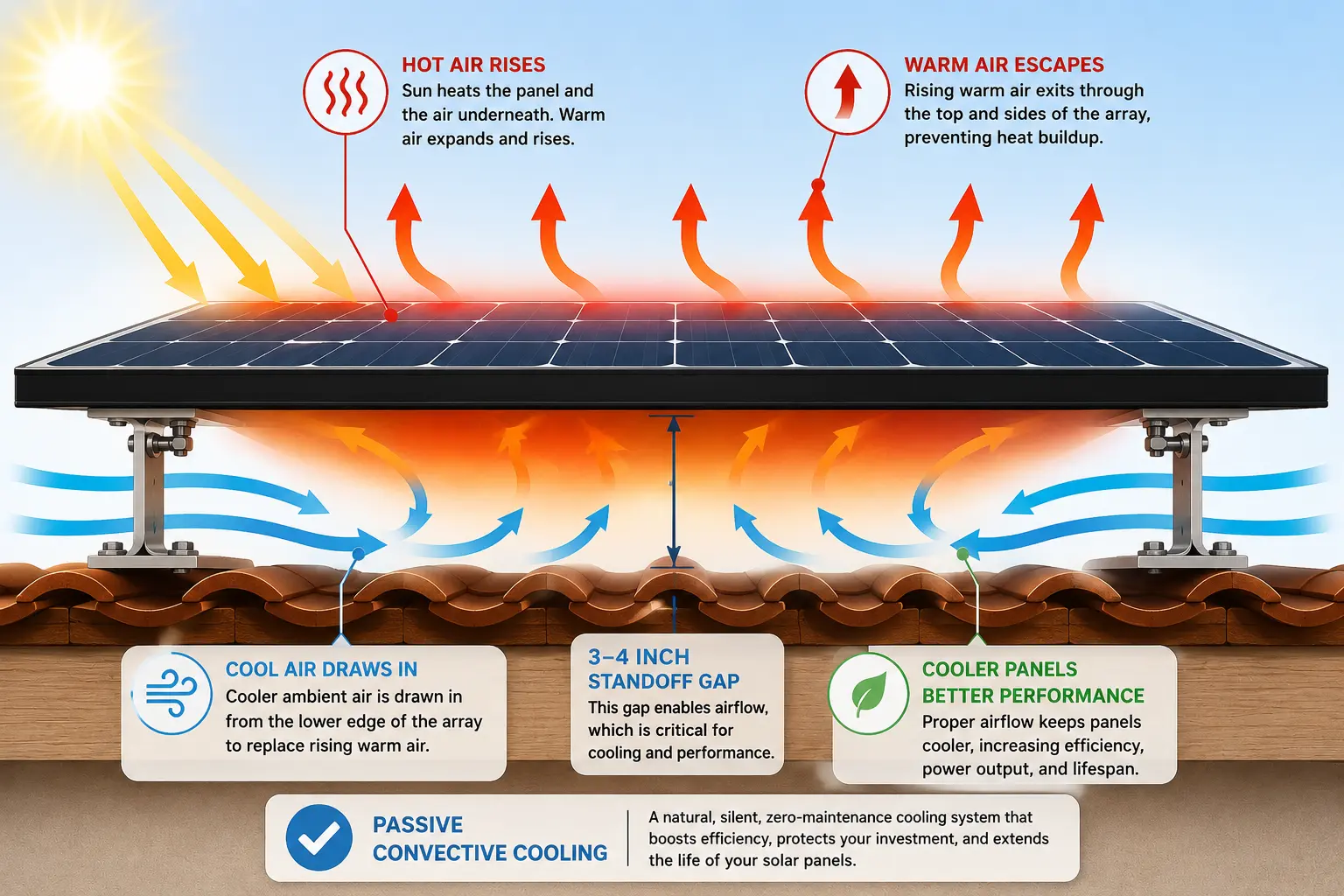
This continuous, passive loop acts as a free, zero-maintenance air conditioning system for your solar cells. If an installer tries to mount panels flush against your roof to improve “aesthetic integration,” they are inadvertently choking the system’s ability to breathe, drastically reducing your daily power output and shortening the lifespan of solar panels.
Does the Color and Material of Your Roof Affect How Hot Your Solar Panels Get?
Your roofing material choice directly dictates the ambient thermal environment your solar array must endure. Different materials possess varying levels of albedo, the measure of how much solar radiation a surface reflects rather than absorbs.
- Dark Asphalt Shingles: The most common residential roofing material is also the worst offender for heat. Dark asphalt shingles act as thermal sponges, regularly reaching scorching temperatures of 150°F to 180°F in peak summer sun. This intense heat radiates directly upward into the underside of your solar panels, compounding the ambient temperature penalty.
- Light-Colored / Cool Roofing: Transitioning to a white, light gray, or highly reflective “cool roof” can drop baseline roof surface temperatures by 20°F to 40°F. This drastically reduces the ambient radiant heat rising beneath the solar array, saving an estimated 3% to 5% in temperature-related panel efficiency losses.
- Metal and Tile Roofs: Clay tiles and concrete tiles offer excellent natural thermal mass and air channels that resist heat transfer. Similarly, light-colored standing-seam metal roofs possess high thermal emissivity, releasing absorbed heat rapidly rather than holding onto it.
If you are planning to replace an aging roof prior to a solar installation, coordinating your roofing material and color choice with your solar layout is a highly effective way to permanently optimize your long-term clean energy yield.
Where Should Inverters Be Installed to Avoid Overheating?
While homeowners spend a lot of time analyzing panel specifications, the solar inverter is actually the hardest-working component of the entire configuration. The inverter converts the raw Direct Current (DC) electricity generated by your panels into usable Alternating Current (AC) power for your home’s appliances. This conversion process generates internal electrical heat.
When an inverter is exposed to extreme external temperatures, it triggers a safety protocol called thermal throttling (or power derating). Most standard string inverters are engineered to operate at peak capacity up to an ambient temperature of 50°C (122°F). Once the surrounding air passes this threshold, the inverter automatically dials back its processing speed to prevent its internal circuitry from melting.
- Ambient Air < 122°F – Peak Inverter Conversion Efficiency
- Ambient Air > 122°F – Automatic Thermal Throttling (Power Derated)
Because of this limitation, placement is everything:
- The Attic Mistake: Installing a string inverter inside an unconditioned attic in a state like Texas or Nevada is a recipe for system failure. Attic temperatures can easily soar to 140°F or higher, forcing the inverter into a permanent derating cycle during the exact hours of peak solar production.
- The Direct Sun Mistake: Mounting an inverter on an exposed south- or west-facing exterior wall exposes the metal housing to direct sunlight, compounding internal conversion heat with extreme external radiant heat.
- The Expert Solution: Qualified installers mount string inverters on a shaded, north-facing exterior wall, inside a well-ventilated garage, or within a dedicated utility room. If your system utilizes microinverters mounted directly underneath each panel, they must be selected from commercial brands with ruggedized thermal casings engineered to withstand the extreme environment of the upper roof deck.
How Does Extreme Heat Affect Solar Battery Storage Systems?
The booming popularity of home energy storage (such as the Tesla Powerwall or Enphase IQ Battery) introduces a brand-new variable to hot-climate solar design. While solar panels can tolerate surface temperatures up to 150°F without sustaining immediate structural damage, lithium-ion battery storage cells are vastly more heat-sensitive.
Lithium-ion batteries operate optimally within a narrow temperature window between 59°F and 77°F (15°C to 25°C). This is the goldilocks zone for safe, efficient chemical energy transfer.
- 59°F – 77°F = Optimal Battery Performance Zone
- 95°F – 113°F = Accelerated Capacity Degradation Zone
- Above 113°F = BMS Throttling / Emergency Thermal Shutdown
When environmental temperatures climb into the 95°F to 113°F range, the internal Battery Management System (BMS) is forced to intervene. To prevent permanent degradation or a dangerous condition known as thermal runaway, the BMS will actively throttle charge and discharge rates. If temperatures breach 113°F, many residential batteries will undergo an emergency shutdown entirely, leaving you without backup power during a peak grid emergency.
Sustained exposure to ambient heat above 95°F accelerates the loss of a battery’s usable capacity, reducing its overall lifespan by an estimated 15% to 20%. To protect this significant investment, smart system design dictates that battery packs should be housed inside a climate-controlled garage, a shaded basement, or an insulated utility closet, never mounted on an exterior wall exposed to the full, unmitigated strength of the summer sun.
Book Your Free Consultation Now
What Is the Long-Term Impact of Extreme Heat on Solar Panel Lifespan and Warranties?
According to long-term data published by the National Renewable Energy Laboratory (NREL), the median annual degradation rate for modern solar panels is roughly 0.5% per year. This means a panel rated for 400 watts at the factory will reliably deliver approximately 350 watts of output after 25 years of continuous operation.
In harsh, high-heat, high-humidity regions, buying low-grade, generic equipment can cause that degradation rate to double to 1.0% or higher per year. Look at how that slight variance fundamentally reshapes the value of your system over a 25-year timeline:
Year 1: 400W Rated Panel
0.5% Premium Degradation Rate = Year 25: 355W Practical Output
1.0% Low-Grade Degradation Rate = Year 25: 300W Practical Output
Over a standard residential array, dropping to a 1.0% degradation rate leaves thousands of dollars of unrealized electricity savings on the table. This is why evaluating manufacturer warranty terms is your single best defense against regional heat risks.
What Should a Solar Panel Warranty Say About Temperature Performance?
When comparing solar estimates, look past the basic 10- or 15-year “workmanship” warranty and demand to see the 25-year Linear Performance Warranty. This is a legally binding guarantee from the manufacturer stating exactly how much power output your panels are promised to maintain over a quarter-century of exposure to the elements.
Top-tier solar brands designed for hot US climates back their products with a performance guarantee of 88% to 92% power retention after 25 years. If a panel brand only guarantees 80% or 85% retention, it is a clear indicator that their internal silicon architecture is highly susceptible to heat-accelerated aging.
How to Choose the Right Solar Installer for a Hot-Climate Installation
The ultimate performance of your solar energy system boils down to engineering execution. A poorly designed system utilizing premium equipment will consistently underperform a perfectly engineered system utilizing mid-tier hardware. When navigating your local solar market, your goal is to locate a practitioner with demonstrated, regional expertise.
What Questions Should You Ask a Solar Installer About Heat Performance?
Before signing an agreement, treat your initial consultation as a vetting interview. Ask the sales representative or project designer these direct, technical questions to verify they possess genuine hot-climate competency:
- What is the exact temperature coefficient of the specific panel model you are quoting for my roof, and how does that compare to alternative models?
- Does your production modeling software account for NOCT data and our specific local summer ambient air peaks, or is it using generic baseline data?
- What specific standoff distance will your racking system provide between my roof deck and the back of the panels to allow for convective cooling?
- Where exactly do you plan to mount the system’s inverter, and how will it be protected from direct solar exposure and high ambient heat?
- If we integrate battery storage, how will the physical placement protect the lithium-ion cells from exceeding their optimal operating thresholds?
- Can you walk me through the manufacturer’s linear performance warranty and show me the exact guaranteed power retention percentage at Year 25?
An experienced, high-caliber installer will answer these questions easily, providing datasheets, engineering diagrams, and localized production metrics. If a contractor brushes off these concerns with generic marketing phrases like “solar panels work great in the sun,” move on to an organization that treats solar installation as a precise electrical science.
Which Type of Solar Panel Performs Best in Extreme Heat?
| Panel Technology | Avg. Temp Coefficient | Typical NOCT | Efficiency Range | Hot-Climate Grade |
| Premium Monocrystalline | -0.29 to -0.34 ℃ | 40°C – 44°C | 20\% – 23\% | Excellent |
| Standard Monocrystalline | -0.35\% to -0.40 ℃ | 44°C – 47°C | 17\% – 20\% | Good |
| Polycrystalline (Legacy) | -0.40\% to -0.45 ℃ | 45°C – 48°C | 15\% – 18\% | Moderate |
| Thin-Film (CdTe / CIGS) | -0.19\% to -0.25 ℃ | 40°C – 44°C | 11\% – 18\% | Best Coefficient |
The Bottom Line
Extreme summer heat is an environmental reality for millions of US homeowners, but it is far from a dealbreaker for solar energy production. While high thermal conditions act as a natural physical tax on daily voltage output, the massive influx of intense, seasonal daylight in the Sun Belt easily balances the equation. You do not need to fear the summer thermometer; you simply need to design around it.
By selecting high-efficiency monocrystalline panels featuring low temperature coefficients, insisting on proper convective standoff mounting distances, and ensuring strategic placement of sensitive inverters and battery storage packs, you can easily neutralize the risks of extreme weather. Partnering with an expert, technically rigorous installer ensures your system is custom-engineered to transform high-heat challenges into a reliable, decade-spanning financial advantage for your home.
Frequently Asked Questions
What temperature is too hot for solar panels?
Solar panels do not have a hard thermal ceiling where they suddenly stop functioning entirely. Most standard modules are safety-certified to operate at internal temperatures ranging from -40 degree Faranheit up to +185 degree Faranheit (-40 ℃ to +85 ℃).
Do solar panels work better in winter or summer?
On a pure efficiency basis, solar panels operate much better during crisp, clear winter days because the cold air keeps the silicon semiconductor at an optimal temperature, maximizing voltage output. However, because summer days provide significantly longer daylight hours and a much higher angle of solar intensity, solar systems still generate a much higher total volume of raw energy (kWh) during the summer months.
Can solar panels get permanent damage from a heatwave?
A standard heatwave will not cause immediate, permanent damage to a reputable, high-quality solar panel. The drop in power output is completely temporary and reverses as the sun goes down. However, decades of sustained, intense summer heat can accelerate long-term degradation if the panels are cheaply manufactured or lack an active certification like IEC 61215.
Is it worth getting solar if I live in a desert state like Arizona or Nevada?
Absolutely. Desert states offer the highest financial returns on solar investments in the entire country. Even though summer heat imposes a temporary efficiency penalty, the sheer abundance of daylight, the high number of clear, cloudless days, and intense local utility rates mean a solar system in a desert climate will easily generate more long-term value than an identical system in a cooler, northern state.