
Why Are My Solar Panels Not Working?
Your solar panels stopped working. Before you call a technician, know this: 73% of solar system underperformance traces back to just seven fixable issues. The most common culprits (inverter failure, shading, soiling, and wiring faults) are identifiable in under 15 minutes. This guide walks you through every cause, every data point, and every fix.
Quick Diagnostic: What Does Your System Show?
Start here. Match your symptom to the most likely cause before diving into any section.
| Symptom | Most Likely Cause | DIY Fix? |
| Zero output on sunny day | Inverter failure or tripped breaker | Check breaker: Yes. Inverter repair: No |
| Output dropped 20–80% | Partial shading or soiling | Yes; inspect & clean |
| One panel producing nothing | Failed bypass diode or micro-crack | Visual check: Yes. Repair: No |
| System off at night, no battery | Normal anti-islanding shutdown | No action needed |
| Error light on inverter | Inverter fault or grid disconnect | Check display code, then call pro |
| Gradual decline over months | Natural degradation or PID | Monitor; professional audit if >0.8%/yr |
| Burn marks or discolouration | Hot spot or junction box fault | Call professional immediately |
What Are the Most Common Reasons Solar Panels Stop Working?
Solar panels stop working due to inverter failure, shading, soiling, wiring faults, hot spots, potential induced degradation (PID), and faulty bypass diodes. According to an analysis of over 15,000 residential solar installations by MyHomeQuoter (2025), 73% of all underperformance cases link directly to these seven categories. Each cause has a different impact on system output and a different fix timeline.
The panels themselves are actually the most durable component. The National Renewable Energy Laboratory (NREL) reports that properly maintained photovoltaic (PV) modules retain 92% efficiency after 20 years, while neglected systems drop to 78%. The real vulnerabilities sit in the supporting hardware (inverters, wiring, and connectors).
Is a Faulty Inverter the Reason My Solar Panels Are Not Working?
Yes! Inverter failure is the single most common cause of total solar system shutdown. When the inverter fails, no usable AC electricity reaches your home, regardless of how much DC power the panels generate.
String inverters carry a failure rate of approximately 1% (10.3 failures per 1,000 units). Microinverters fail at a rate of 0.055% (0.55 failures per 1,000 units). The critical difference: a failed string inverter kills the entire array, while a failed microinverter disables only a single panel.
Inverter lifespan: 10–15 years for string inverters; 25+ years for microinverters. Panels frequently outlive their inverters, making mid-life inverter replacement a predictable expense.
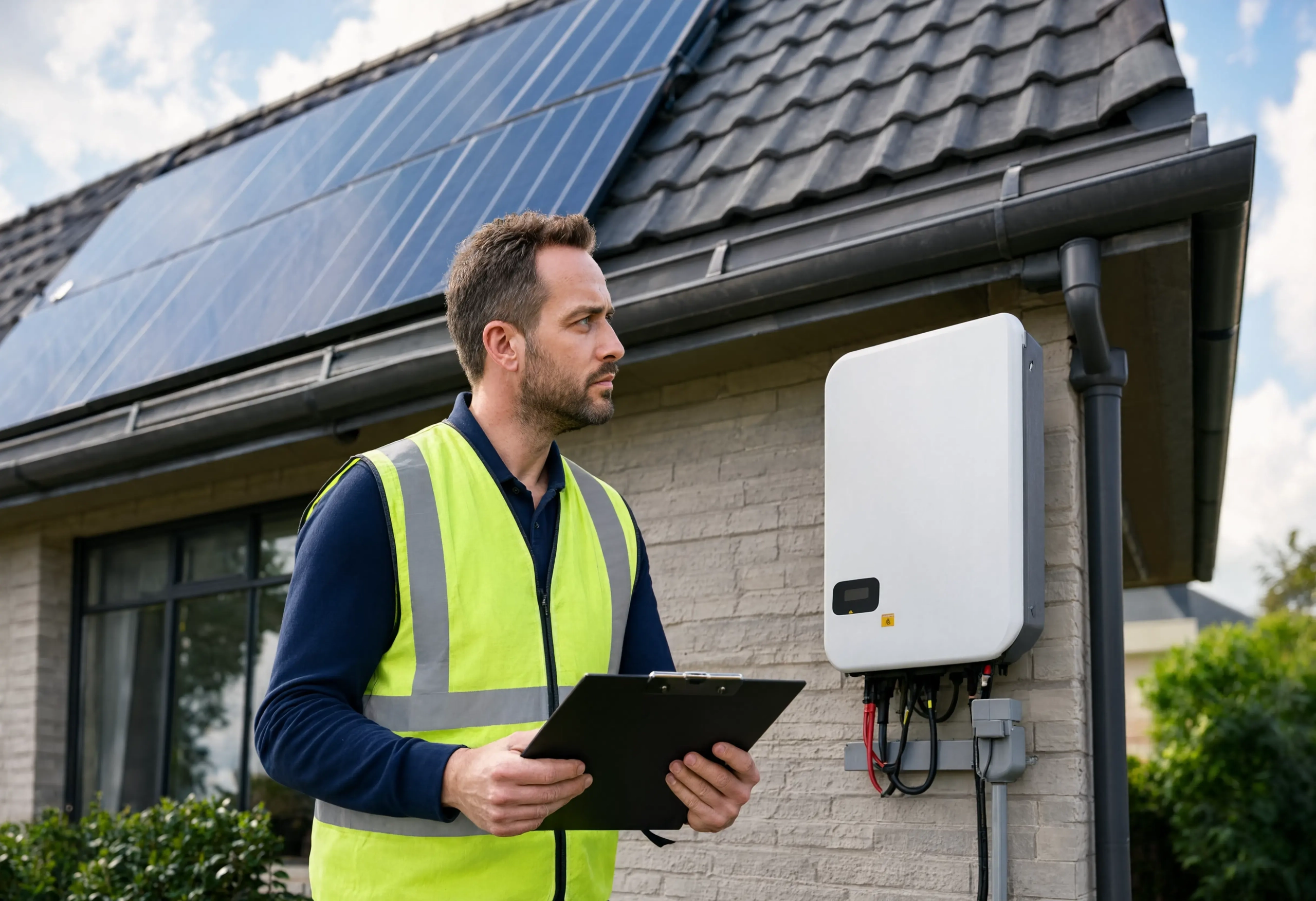
How Do I Know If My Inverter Has Failed?
An inverter fault displays one or more of the following signs:
- Error codes or blinking warning lights on the display screen
- Unusual buzzing, clicking, or humming sounds from the unit
- Zero production shown in your monitoring app on a clear, sunny day
- Frequent grid disconnections without any weather event
- The inverter is warm or hot to the touch with no output
A 2024 study published in NCBI’s PMC database, examining PV inverter reliability across three climate zones (hot/dry, hot/humid, moderate), found that climate-based degradation rates significantly accelerate inverter failure in high-solar-irradiation regions. Systems in hot, dry climates require inverter design parameters elevated above standard specifications to maintain expected lifespan.
Can Shading Stop Solar Panels From Working?
Yes. Shading reduces solar output by 20–80%, depending on which cells are affected. A shaded solar cell acts like a clog in a pipe: the current through the entire string drops when one cell is blocked.
Most modern panels include bypass diodes that route current around shaded cells, but at a cost. The bypass diode skips the shaded cell entirely, forfeiting all potential output from that segment. A Stanford University analysis of shading effects (referenced in pv-magazine, March 2023) confirms that even partial shading of a single panel can cut string-level output by over 50% in series-wired systems.
What Causes New Shading on an Existing Installation?
- Tree growth
- New construction on neighbouring properties
- Satellite dishes, roof additions, or new chimneys
- Seasonal solar angle changes (lower sun in winter = longer shadows)
- Bird nests or accumulated debris in panel gaps
Shading is not always visible from ground level. Monitoring software such as Enphase Enlighten or SolarEdge mySolarEdge provides panel-level production data that flags shading on individual modules without a roof inspection.
Does Dirt and Soiling Stop Solar Panels From Producing Power?
Dirt and soiling reduce solar output by 5–25%, but rarely cause complete shutdown. Soiling almost never produces zero output. It is a leading cause of underperformance, not total failure.
The NREL performance parameters estimate a typical 5% soiling loss across U.S. installations. In dry climates with long seasons between rain, losses reach 5–7%. In areas with high dust deposits or heavy traffic, soiling adds a further 1–2%. Snow accumulation creates losses between 10–30% for fixed-tilt systems during winter months.
| Soiling Source | Typical Output Loss | Removal Method |
| Dust (arid regions) | 5–25% | Water rinse every 60–90 days |
| Pollen (spring) | 2–8% | Gentle water rinse |
| Bird droppings | Up to 2% total soiling | Soft cloth and water; resists rain |
| Snow (fixed-tilt) | 10–30% | Wait or soft brush; no metal tools |
| Traffic soot (urban) | 1–2% additional | Periodic mild soap wash |
An NREL model found that a single annual cleaning reduces a 1.9% soiling loss to 1.5%. Two cleanings per year drop the average to 1.3%, and three annual cleanings reduce it to 1.2%. Dust accumulates at 0.01–0.5% per day in highly arid zones, making a 30–60 day cleaning cycle standard practice for optimal returns.
Can Wiring and Connection Faults Cause Solar Panels to Fail?
Yes. Loose, corroded, or damaged wiring produces partial or total system shutdown and creates fire risk. Wiring faults are the second most dangerous issue after hot spots in residential solar systems.
Wiring degradation comes from age, moisture intrusion, rodent damage, or poor installation. A poor connection between wire and terminal introduces resistance, which converts electrical energy to heat. This accelerates insulation breakdown and, in severe cases, causes arc faults. Visual inspection of exposed conduit can reveal obvious damage, but most wiring runs inside mounting channels and requires a licensed professional to inspect safely.
What Wiring Problems Are DIY-Diagnosable?
- Tripped circuit breaker in your main panel
- Loose DC disconnect switch
- Corroded MC4 connector visible at panel junction box
- Burn marks around conduit or junction boxes
Wiring issues carry high safety stakes. SouthFace Solar & Electric (2026) states explicitly: wiring issues are rarely DIY fixes, and electrical repairs should always be handled by licensed solar professionals.
What Are Hot Spots and How Do They Affect Solar Panel Output?
A hot spot is a localized area of overheating on a solar cell that converts electrical energy to heat instead of electricity. Hot spots reduce panel output and create permanent cell damage and fire risk.
A 2017 U.S. Department of Energy study on PV failure and degradation modes (published via OSTI) identified hot spots as the most important degradation mode in systems installed within the last 15 years, weighted by severity. The study found that modules affected by hot spots show significantly higher power loss than unaffected modules of the same type (p-value < 0.0001 on Mann-Whitney test).
Hot spots form through five primary mechanisms: partial shading, cell mismatch from manufacturing variance, physical damage to the cell, poor solder connections on busbars, and bypass diode failure. Regular thermal imaging (IR scans) identifies hot spots early, before permanent damage occurs.
Learn more if solar panel work efficiently in heat from our detailed guide.
Book Your Free Consultation Now
What Is Potential Induced Degradation (PID) in Solar Panels?
Potential Induced Degradation (PID) reduces solar panel output by 20–30% in affected modules. It is more common in older or lower-quality modules.
PID occurs when voltage disparity between the photovoltaic semiconductor material and the panel frame creates leakage current. This gradually degrades the cells, reducing conversion efficiency. High-humidity environments accelerate PID onset. According to Clean Energy Reviews, PID recovery is possible in early stages using PID recovery devices that apply reverse voltage overnight. But advanced cases require the owner to replace solar panels.
LeTID (Light and elevated Temperature Induced Degradation) is a related phenomenon causing sudden output loss of 3–6% in affected panels. LeTID primarily affects PERC (Passivated Emitter and Rear Cell) technology modules and is distinguishable from standard LID because it worsens with elevated cell temperature rather than resolving after initial stabilisation.
How Do Bypass Diode Failures Cause Solar Panel Problems?
A failed bypass diode cuts the affected panel’s output by up to 33%. Each solar panel contains bypass diodes inside the junction box. Their function: redirect current around shaded or damaged cells to prevent overheating.
According to Kiwa PVEL’s module reliability testing methodology, when a bypass diode fails, it can no longer protect the cells it covers, leading to hot spot formation and a 33% output reduction from that panel. Diode failure typically appears as a sudden production drop in monitoring data, with localised heat visible on infrared thermal imaging. Standard repair: replace the faulty diode or the entire junction box.
Chronic shading is a leading cause of premature bypass diode failure. Regularly activated bypass diodes dissipate electrical energy as heat, which over several years causes the diode to wear out faster than it would under unshaded operation.
What Is the Normal Degradation Rate for Solar Panels?
Solar panels degrade at 0.4–0.5% per year under normal conditions. Degradation above 0.8% per year signals an underlying problem requiring investigation.
In the first year, all silicon solar panels experience Light-Induced Degradation (LID): a 2–3% output loss during the initial few hundred hours of operation as oxygen traces in the silicon wafer stabilise. After this initial phase, degradation reduces to 0.3–0.6% per year for the next 25+ years, per Clean Energy Reviews.
| Degradation Type | Output Loss | Timeline | Reversible? |
| Initial LID (first year) | 2–3% | First 200–500 hours | No, stabilises naturally |
| Standard annual degradation | 0.4–0.5%/year | Ongoing | No; expected |
| Accelerated degradation (fault) | >0.8%/year | Any point | Partially, with repair |
| PID (voltage leakage) | 20–30% | Months to years | Partially (early stage) |
| LeTID (PERC modules) | 3–6% sudden drop | After 1–2 years | Partially |
| Hot spot damage | Varies per cell | Progressive | No — permanent cell damage |
Why Are My Solar Panels Not Working at Night?
Solar panels do not work at night because photovoltaic cells require photons from sunlight to generate electricity. This is normal behaviour, not a fault.
Grid-tied systems use anti-islanding protection to automatically shut down when sunlight drops below the minimum threshold. This prevents the system from backfeeding the grid during an outage, protecting utility workers. Systems with battery storage (lithium-ion, such as Tesla Powerwall or Enphase IQ Battery) continue supplying power after dark by drawing from stored energy, but the panels themselves remain inactive.
Why Are My Solar Panels Not Working on Cloudy Days?
Solar panels produce 10–25% of their peak output on overcast days. Reduced production on cloudy days is expected; zero production is a fault.
Monocrystalline and polycrystalline panels generate electricity from diffuse light, not just direct sunlight. A heavily overcast sky still delivers enough irradiance for measurable output. If your monitoring shows zero generation at 11 AM on a cloudy-but-bright day, that points to a component fault (not weather) as the cause.
How Do I Check If My Solar Panels Are Working Correctly?
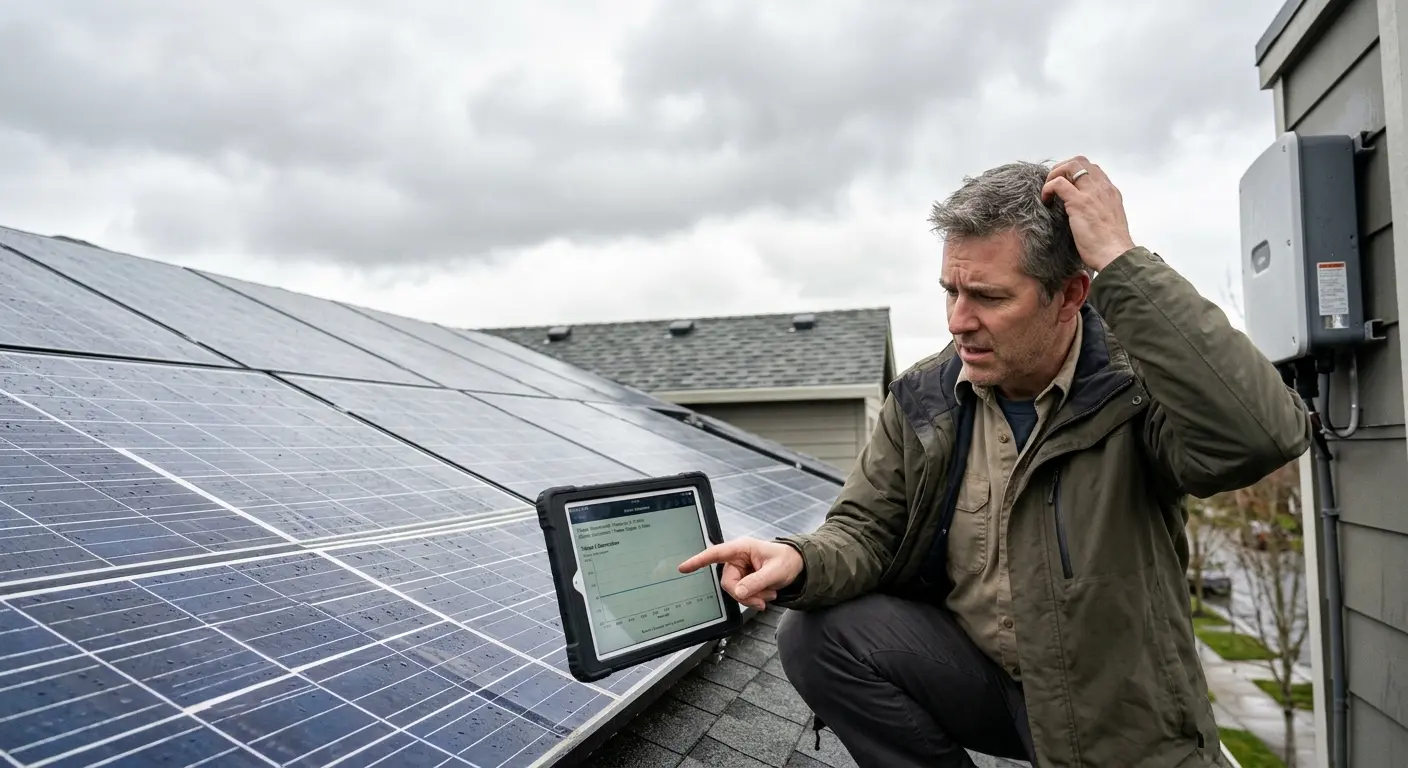
A five-step diagnostic process identifies the cause of solar panel failure without requiring professional tools for the initial check:
Step 1: Check the Monitoring App
Enphase Enlighten, SolarEdge mySolarEdge, SMA Sunny Portal, and most inverter apps display real-time panel-level output. Zero output on a clear day is the first confirmed fault signal. Panel-specific drops isolate the problem to one module.
Step 2: Inspect the Inverter
Check the solar inverter display for error codes and status lights. A green light means operating normally. Red or orange lights indicate fault conditions. Common codes: Grid Fault (utility issue), Isolation Fault (wiring leak to ground), Over-Temperature (ventilation problem).
Step 3: Check the Circuit Breaker
Locate the solar AC disconnect and the main circuit breaker for the solar circuit. A tripped breaker is the simplest fix is to reset it once. If it trips again, stop and call a professional. Repeated tripping signals a persistent electrical fault.
Step 4: Inspect Panels Visually (From Ground Level)
- Look for visible cracks, discolouration, or burn marks on the panel surface
- Check for bird droppings, heavy dust, or debris covering cells
- Look for obvious physical damage from hail, falling branches, or foot traffic
- Assess whether any new shading sources have appeared since installation
Step 5: Compare Historical Production Data
Access 12 months of production history in your monitoring app. A consistent decline of more than 10% from the same month in the prior year (adjusted for weather) indicates a fault. NREL benchmarks for your region provide expected production ranges for comparison.
When Should I Call a Professional for Solar Panel Repairs?
Call a licensed solar professional immediately if you observe:
- Burn marks anywhere on panels, wiring, or the inverter
- Smoke, melted insulation, or burning smell near solar components
- Repeated circuit breaker trips after resetting
- Any arc fault indicator light on the inverter
- Zero output persisting for more than two consecutive sunny days
- Production decline exceeding 20% versus the same period last year
Average annual professional maintenance cost: $150–$400. Average DIY maintenance cost: $50–$150. A professional diagnostic visit typically costs $100–$200 and identifies inverter faults, wiring issues, and panel-level defects that are not visible from ground level.
How Much Does It Cost to Fix Solar Panel Problems?
| Issue | DIY Cost | Professional Repair Cost | Typical Timeframe |
| Panel cleaning (soiling) | $0–$30 (water/soft cloth) | $100–$300 per service | 1–2 hours |
| Tripped circuit breaker | $0 | N/A | Minutes |
| Inverter replacement (string) | N/A; licensed work required | $1,000–$3,000 | Half day |
| Bypass diode replacement | N/A | $150–$400 per panel | 1–3 hours |
| Wiring fault repair | N/A; safety hazard | $200–$600 | Half day to 1 day |
| Panel replacement (cracked) | N/A | $300–$800 per panel | Half day |
| PID recovery device | DIY install: $200–$500 | $300–$700 installed | Continuous overnight cycles |
How Do I Prevent Solar Panels from Stopping Work in the Future?
Preventive maintenance keeps a solar system at peak output and catches faults before they become expensive replacements.
Annual Maintenance Checklist
- Clean panels twice per year (four times in arid or high-traffic areas)
- Inspect inverter ventilation
- Review 12-month production history for decline trends above 0.8% annually
- Check all visible MC4 connectors for corrosion or moisture ingress
- Trim trees and vegetation that have grown into the panel shade zone
- Verify monitoring system connectivity
- Schedule professional thermal imaging (IR scan) every 3–5 years
The NREL reports that properly maintained solar systems maintain 92% efficiency at the 20-year mark. Neglected systems without consistent cleaning, monitoring, and periodic professional inspection drop to 78% efficiency, a $15,000–$25,000 lifetime output difference on a typical residential installation.
Do Solar Panel Warranties Cover Faults and Performance Loss?
Most solar panels carry two warranties: a product warranty (10–25 years) covering manufacturing defects, and a performance warranty guaranteeing 80–90% output retention at 25 years. Inverter warranties run 10–25 years depending on the manufacturer.
Warranty claims for performance loss require documented production data showing decline beyond the guaranteed degradation curve. Monitoring software exports this data automatically. Physical damage from improper cleaning, unauthorised modification, or failure to maintain the system voids most product warranties. Keep all installation records, monitoring exports, and service receipts as evidence for any future warranty claim.
Solar Panel Troubleshooting: Key Facts at a Glance
| Fact | Data Point | Source |
| Inverter failure rate (string) | ~1% (10.3/1,000 units) | Industry reliability testing |
| Microinverter failure rate | 0.055% (0.55/1,000 units) | Industry reliability testing |
| Typical soiling loss (U.S.) | 5% average; up to 25% in arid zones | NREL performance parameters |
| Standard annual panel degradation | 0.4–0.5% per year | Clean Energy Reviews |
| PID performance loss | 20–30% in affected modules | Solar Calculator AU |
| Bypass diode failure output impact | Up to 33% reduction per panel | Kiwa PVEL reliability testing |
| Hot spot severity ranking | Most severe degradation mode (post-2010) | U.S. DOE / OSTI study (2017) |
| System efficiency at 20 years (maintained) | 92% of original output | NREL |
| System efficiency at 20 years (neglected) | 78% of original output | NREL |
| Snow loss (fixed-tilt systems) | 10–30% during winter months | NREL snow-removal model |
The Key Takeaway
Solar panels stop working or underperform due to inverter failure, shading, soiling, wiring faults, hot spots, PID, or bypass diode failure. Inverter failure accounts for the largest single category of total shutdown. Shading and soiling account for the majority of partial output loss cases.
Start your diagnosis with the monitoring app. Move to the inverter display. Check the circuit breaker. Inspect panels visually from ground level. Compare 12-month production history. These five steps resolve or locate the cause of the majority of residential solar faults without a service call.
For burn marks, repeated breaker trips, zero output lasting more than two sunny days, or any suspected electrical fault, stop DIY diagnostics and contact a licensed solar professional. The cost of a diagnostic visit ($100–$200) is a fraction of the cost of damage from a delayed repair.