
How Much Does It Cost to Install Rooftop Solar Panels in 2026?
According to SEIA and Wood Mackenzie’s 2026 US Solar Market Insight, rooftop solar panel installation costs $2.50 to $3.20 per watt in 2026, or roughly $19,950 to $22,800 for a typical 7 to 8 kW home system, before incentives.
The US solar industry installed 43.1 GW of capacity in 2025 and surpassed 6 million cumulative installations by Q1 2026. Solar and battery storage made up 91% of all new US generating capacity added that quarter. Demand stays high even as the federal residential tax credit changed on January 1, 2026. Knowing your real cost, per watt, per state, and per equipment choice, is now the first step before you make the decision.
What is the Average Cost to Install a Rooftop Solar in 2026?
The average cost to install rooftop solar in 2026 is $2.85 per watt, or about $21,375 for a 7.5 kW system, before incentives. System size, panel type, roof condition, and your state’s labor market all push this number up or down. For example, a 3 kW system costs closer to $8,500, and a 12 kW system can exceed $34,000. Your electricity usage, not your home’s square footage, determines the system size you actually need.
| Metric | Value |
| National average solar panel installation cost per watt | $2.85/watt installed |
| Standard home system size | 7–8 kW |
| Average total cost (before incentives) | $19,950–$22,800 |
| Federal tax credit, homeowner-owned system | $0 (Section 25D expired Dec 31, 2025) |
| Federal tax credit, lease/PPA (TPO) | 30%, claimed by provider, passed through as savings |
| Average payback period | 8–12 years |
| Average 25-year electricity savings | $37,000–$154,000 |
Pro tip for homeowners: Ask installers for a per-watt price, not just a total. It’s the only way to compare quotes of different system sizes fairly.
How Rooftop Solar Cost Changed Year Over Year Since 1884?
Rooftop solar cost fell from about $300 per watt in 1956 to $2.85 per watt installed in 2026, a decline of more than 99%. Charles Fritts built the first rooftop solar array in New York City in 1884, using selenium wafers at roughly 1% efficiency. Bell Labs created the first practical silicon solar cell in 1954. The 1973 oil crisis pushed federal solar investment, and the Solar Energy Research Institute opened in 1977. That lab became NREL in 1991 and was renamed the National Laboratory of the Rockies in December 2025. Panel prices fell to $100 per watt by 1975, then near $10 per watt by the late 1990s, as Chinese manufacturing scaled production. Swanson’s Law holds that costs drop 20% with every doubling of shipped volume. By 2010, modules alone cost $2 to $3 per watt.
What is Included in a Complete Rooftop Solar System Cost Breakdown?
A complete rooftop solar system cost includes panels, an inverter, racking, wiring, labor, permits, design, and installer overhead. Equipment makes up roughly a third of the bill. Soft costs, labor, permitting, design, and company overhead make up the other 60–65%, according to SolarInfoPath’s 2026 cost analysis. Here is that breakdown applied to a $21,400 average 7.5 kW project.
| Cost Component | Share of Total | Dollar Amount |
| Solar panels | 12% | $2,568 |
| Inverter | 8% | $1,712 |
| Racking and mounting hardware | 6% | $1,284 |
| Electrical wiring, monitoring, disconnects | 6% | $1,284 |
| Installation labor | 20% | $4,280 |
| Permitting and interconnection | 8% | $1,712 |
| Design and site engineering | 5% | $1,070 |
| Sales, marketing, overhead | 25% | $5,350 |
| Installer profit margin | 10% | $2,140 |
What Factors Affect the Rooftop Solar Installation Cost?
Twelve factors drive rooftop solar installation cost: project type, system size, panel type, inverter technology, batteries, roof condition, roof angle and material, location, labor rates, permits, add-on equipment, and warranties. Each factor moves your price independently.
How Does the Type of Project Affect the Rooftop Solar System Installation Cost?
Residential solar costs $2.50 to $3.20 per watt, while commercial and industrial projects cost $0.99 to $2.55 per watt. Larger projects spread fixed costs, permitting, design, and mobilization, across more panels, lowering the per-watt price. Industrial and utility-scale arrays also use simpler racking and centralized inverters.
| Project Type | Cost per Watt | Total Cost Range |
| Residential | $2.50–$3.20 | $15,000–$35,000 |
| Commercial (25 kW–2 MW) | $1.10–$2.55 | $140,000–$700,000+ |
| Industrial/utility-scale | $0.99–$1.50 | $1,000,000+ |
How Does the Size of the Rooftop Solar System Affect the Installation Cost?
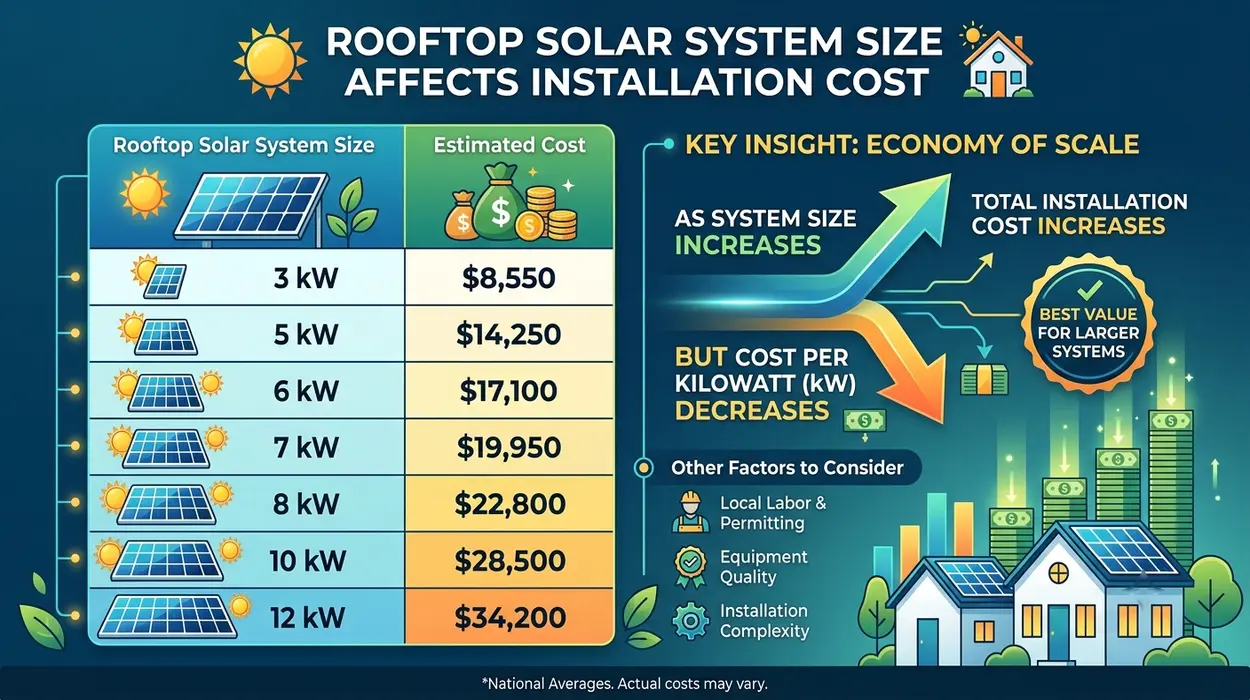
Larger rooftop solar systems cost more in total but less per watt. A typical 2,000 sq ft home needs 20 to 24 panels, around 7.5 kW, to offset average electricity usage of 10,000 kWh a year. Fixed costs like permitting and the site visit stay flat regardless of size, so a 10 kW system rarely costs twice a 5 kW system.
| Rooftop Solar System Size | Estimated Cost |
| 3 kW | $8,550 |
| 5 kW | $14,250 |
| 6 kW | $17,100 |
| 7 kW | $19,950 |
| 8 kW | $22,800 |
| 10 kW | $28,500 |
| 12 kW | $34,200 |
How Does Panel Type Affect the Rooftop Solar Installation Cost?
Monocrystalline panels cost $0.90 to $1.10 per watt and remain the 2026 default for rooftop solar. Polycrystalline panels cost slightly less but need more roof space for equal output. Thin-film panels rarely fit standard rooftop projects because their lower efficiency demands nearly double the surface area.
| Panel Type | Module Cost per Watt | Efficiency | Best For |
| Monocrystalline | $0.90–$1.10 | 19–22% | Limited roof space; 2026 standard choice |
| Polycrystalline | $0.85–$1.00 | 15–17% | Budget projects, larger roofs |
| Thin-film | $1.00–$1.50 | 10–15% | Flexible or niche residential applications |
How Does Inverter Technology Affect the Rooftop Solar Installation Cost?
String inverters cost $0.10 to $0.15 per watt installed, the cheapest inverter option in 2026. Microinverters cost more upfront but last 25 years, matching your panel warranty, while string inverters typically need one replacement over the system’s life. Shaded or multi-facing roofs benefit most from microinverters or power optimizers.
| Inverter Type | Installed Cost per Watt | Lifespan | Best For |
| String inverter | $0.10–$0.15 | 10–15 years | Simple, unshaded roofs |
| String + power optimizer | $0.15–$0.20 | 15–25 years | Partial shading, budget-conscious buyers |
| Microinverter | $0.18–$0.24 | 25 years | Complex roofs, panel-level monitoring |
How Do Solar Batteries Affect the Rooftop Solar Installation Cost?
A home solar battery adds $8,000 to $16,200 to your rooftop solar installation cost in 2026. Battery price depends on usable capacity, chemistry, and brand. Whole-home backup usually needs two to three batteries, since a single 13.5 kWh unit covers only essential loads for 8 to 12 hours.
| Battery | Usable Capacity | Installed Cost | Cost per kWh |
| Tesla Powerwall 3 | 13.5 kWh | $12,000–$16,200 | $900–$1,075 |
| Enphase IQ Battery 5P | 5 kWh (stackable) | $8,000–$11,000 | $1,000–$1,510 |
| FranklinWH | 13.6 kWh | $10,000–$12,500 | $735–$920 |
| Value brands (EG4, Fox ESS) | Varies | $3,000–$5,000 less than premium | $700–$950 |
Book Your Free Consultation Now
How Does Roof Condition Affect the Rooftop Solar Installation Cost?
A roof with fewer than 15 years of remaining life adds $800 to $18,000 to your rooftop solar project. Installers recommend replacing a roof with 10 years of life or less before mounting panels. Installing solar first and re-roofing later forces a costly remove-and-reinstall step.
| Roof Age/Condition | Cost Impact |
| New (0–5 years) | No added cost |
| Mid-life (5–15 years) | Inspection only, $0–$500 |
| Aging (15–20 years) | Repairs likely, $800–$2,500 |
| Needs replacement (20+ years) | Bundle re-roof: $10,000–$18,000, plus solar |
| Mid-life remove and reinstall | $250–$400 per panel, $2,000–$6,000 total |
How Does Roof Angle and Material Affect the Rooftop Solar Installation Cost?
Steep roofs and premium materials like tile or slate add $500 to $3,000 to your rooftop solar installation cost. A 30 to 40 degree pitch is optimal for most US latitudes and needs no extra racking.
| Roof Pitch | Cost Impact |
| Low slope (under 3:12) | +$500–$1,200 for tilt racks |
| Standard (4:12–7:12) | Baseline, no added cost |
| Steep (8:12 or more) | +$500–$1,200 for added labor and safety gear |
Plus, asphalt shingle stays the cost-neutral baseline; metal roofs are actually cheaper to mount than asphalt.
| Roof Material | Cost vs Asphalt Baseline |
| Asphalt shingle | Baseline (cost-neutral) |
| Standing-seam metal | –8% (cheaper rail attachment) |
| Clay or concrete tile | +20%, specialized mounts add $1,000–$2,500 |
| Slate | +$1,500–$3,000+, specialized flashing required |
How Does Location of the Project Affect the Rooftop Solar Installation Cost?
Solar costs $2.30 per watt in Texas and up to $3.66 per watt in New Hampshire, a swing of over $1 per watt. Labor rates, permitting complexity, and installer competition, not sunlight, drive most of this gap.
| State | Cost per Watt |
| Texas | $2.30–$2.95 |
| Arizona | $2.30–$2.60 |
| Nevada / New Mexico | $2.35–$2.70 |
| California | $2.40–$2.55 |
| Florida | $2.40–$2.90 |
| New York | $2.90–$3.30 |
| Massachusetts | $3.20–$3.60 |
| New Hampshire | $3.18–$3.66 |
| Hawaii / Washington, D.C. | $3.10–$3.20 |
How Do Regional Labor Rates Affect the Rooftop Solar Installation Cost?
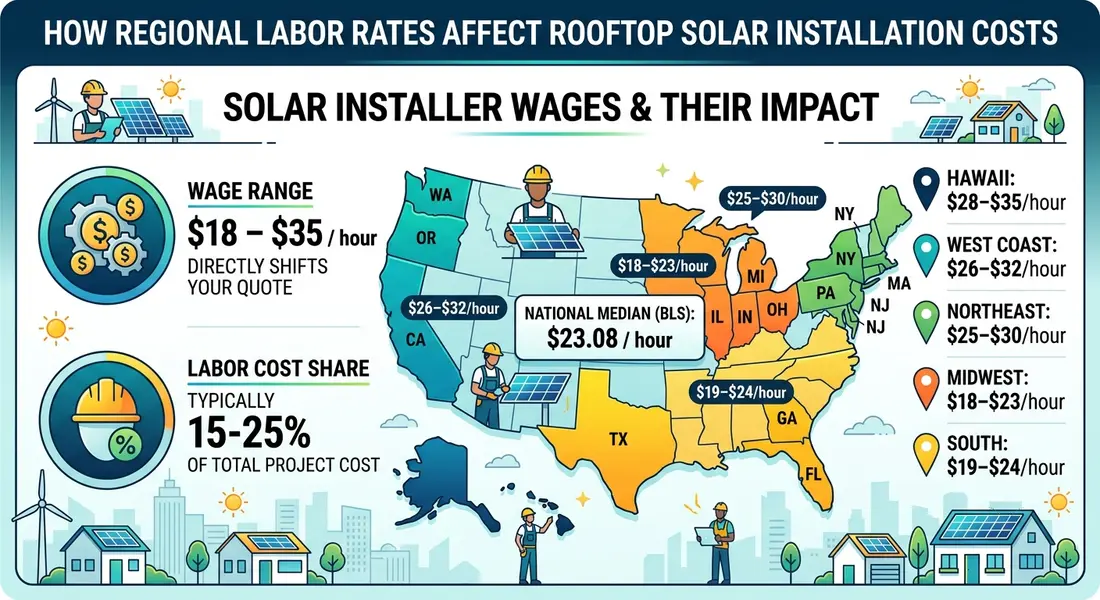
Solar installer wages range from $18 to $35 an hour depending on region, directly shifting your quote. The Bureau of Labor Statistics puts the national median at $23.08 an hour for solar PV installers (SOC 47-2231). Labor typically makes up 15–25% of total project cost.
| Region | Median Installer Wage |
| National (BLS median) | $23.08/hour |
| South (TX, FL, GA) | $19–$24/hour |
| Midwest (OH, MI, IN) | $18–$23/hour |
| West Coast (CA) | $26–$32/hour |
| Northeast (NY, MA, NJ) | $25–$30/hour |
| Hawaii | $28–$35/hour |
How Does Permit and Inspection Fee Affect the Rooftop Solar Installation Cost?
Solar permit and interconnection fees add $200 to $3,000 to your rooftop solar installation cost. Urban jurisdictions with standardized solar programs charge far less than rural counties requiring custom engineering review.
| Fee Type | Cost Range |
| Building permit | $150–$500 |
| Electrical permit | $60–$200 |
| Zoning review | $33–$100 |
| Utility interconnection application | $50–$400 |
| Rural custom engineering review | $1,500–$3,000 |
| Combined urban permit package | $400–$800 |
How Does Additional Equipment and Features Affect the Rooftop Solar Installation Cost?
Add-ons like EV chargers and electrical panel upgrades add $300 to $3,500 to your rooftop solar installation cost. Homes with older 100-amp electrical service almost always need a panel upgrade before installers can safely add solar.
| Add-On | Cost Range |
| EV charger (Level 2) | $600–$2,000 |
| Whole-home monitoring system | $300–$800 |
| Critter guard/pest screening | $300–$600 |
| Electrical panel upgrade (100A to 200A) | $1,500–$3,500 |
| Rapid shutdown devices/power optimizers | $50–$200 per panel |
How Do Maintenance and Warranties Affect the Rooftop Solar Installation Cost?
Rooftop solar maintenance costs $150 to $350 a year, far less than most homeowners expect. Panel warranties run 25 years industry-wide. Inverter and installer workmanship warranties vary the most between companies, so compare warranty length as closely as price.
| Item | Coverage / Cost |
| Panel manufacturer warranty | 25 years |
| String inverter warranty | 10–15 years |
| Microinverter warranty | 25 years |
| Installer workmanship warranty | 10–25 years, varies by company |
| Annual cleaning and inspection | $150–$350/year, optional |
How Can You Control the Rooftop Solar Cost?
You control rooftop solar cost through federal, state, and local incentives, plus your financing choice. These three levers, not the sticker price alone, determine what you actually pay out of pocket in 2026.
What Is the Federal Solar Tax Credit Status in 2026?
Homeowners who buy solar with cash or a loan in 2026 receive a $0 federal tax credit. The One Big Beautiful Bill Act (OBBBA, H.R. 1), signed July 4, 2025, repealed Section 25D, the Residential Clean Energy Credit, effective December 31, 2025. Section 48E and Section 45Y remain active for commercial and third-party-owned systems through 2027, subject to a July 4, 2026 construction-start deadline for full eligibility.
In 2026, homeowners only access a federal credit indirectly, through a lease, PPA, or prepaid third-party-ownership arrangement, since the provider claims the credit and passes savings through at a lower rate.
What State and Local Solar Incentives Are Active in 2026?
36 states exempt solar from added property tax, and 26 states waive sales tax on solar equipment. Net metering or net billing remains active in roughly 34 states plus Washington, D.C., though credit structures vary sharply; California’s NEM 3.0 cut export credits by about 75% for new systems. New York offers a 25% state tax credit up to $5,000, plus a New York City property tax abatement worth up to $62,500 a year. Solar Renewable Energy Credit (SREC) markets remain active in New Jersey, Massachusetts, Pennsylvania, and Washington, D.C. Check DSIRE.org for your state’s current program list before signing a contract.
Which Solar Financing Option Costs the Least Over 25 Years?
Cash purchase delivers the highest 25-year return since you avoid interest and dealer fees entirely. Solar loans run 6–8% APR, with dealer fees of 15–30% that can quietly inflate your financed balance; expect $100–$300 a month. Leases and PPAs need $0 down and let the provider claim the 30% Section 48E credit, passing savings through as $80–$250 monthly payments. Prepaid TPO plans let you pay roughly 70% of the cash price upfront, with an ownership option after the six-year tax recapture period.
| Financing Option | Upfront Cost | Who Claims Federal Credit | Best For |
| Cash purchase | Full price | No credit available | Highest 25-year savings |
| Solar loan | $0 down | No credit available | Ownership without high upfront cost |
| Lease | $0 down | Provider (Section 48E) | Predictable monthly bill |
| PPA | $0 down | Provider (Section 48E) | Pay only for energy produced |
Read more here: Solar Lease vs Cash Purchase vs PPA in 2026
Your final rooftop solar cost also depends heavily on which installer you choose, not financing alone. Equipment quality, workmanship warranties, and regional engineering experience affect your total price and your system’s 25-year output just as much as any incentive. And it is where NEDES stands out with its trusted rooftop solar installation services in all 50 states in the US.
Why Do US People Choose NEDES for Rooftop Solar Installation Services?
NEDES designs, permits, and installs rooftop solar for residential, commercial, and industrial customers across the US, backed by 25-year and lifetime warranties. The process runs from consultation and system design through permitting, inspection, and installation, with post-installation maintenance included. The team engineers systems by region rather than using one national template: coastal homes get wind- and corrosion-rated mounting hardware, hot-climate states, like Arizona and Texas, get higher thermal-tolerance panels and inverters, and northern states get steeper tilt angles for snow load.
Our expert solar team also integrates battery storage, including Tesla Powerwall, and EV charger installation into new or existing solar systems. For homeowners comparing quotes on rooftop solar panel installation cost in 2026, we offer competitively priced, regionally engineered systems with a single point of contact from design to maintenance. Contact us for more information!
Frequently Asked Questions
What is the difference between monocrystalline and polycrystalline rooftop solar panels?
Monocrystalline panels use single-crystal silicon, which is more efficient, space-saving, longer-lasting, pricier, and black-colored. Polycrystalline panels use multiple silicon fragments, and they are less efficient, bulkier, cheaper, and blue-tinted. Choose monocrystalline for limited roof space; polycrystalline for tighter budgets with ample space.
Is it worth it to go solar in 2026?
Yes, for most homeowners. Even without the expired federal tax credit, rooftop solar typically pays back in 8 to 12 years and can save $37,000 to $154,000 over 25 years in high-rate states.
Does solar installation increase my home value?
Yes. Homes with owned solar systems sell for about 4.1% more on average than comparable homes without one, per Zillow research, though leased or financed systems add less resale value.
How long does it take to install a rooftop solar system?
Physical installation takes 1 to 3 days for most homes. Including permitting, inspection, and utility interconnection approval, the full process typically runs 4 to 12 weeks depending on your jurisdiction.
Is net metering still active in the US?
Yes. Roughly 34 states plus Washington, D.C. mandate net metering or net billing in 2026, though California’s NEM 3.0 cut export credits by about 75% for systems installed after April 2023.
How much will I save with rooftop solar in 2026?
Savings range from $37,000 to $154,000 over 25 years, averaging around $61,000, based on system size, local electricity rates, and whether you buy in cash, loan, lease, or PPA.
What new technologies are emerging in the solar world?
TOPCon and heterojunction (HJT) cells, bifacial panels, AI-driven production monitoring, and modular batteries like the Enphase IQ and Tesla Powerwall 3 are gaining share in 2026 residential installations nationwide.
What is the maintenance cost of a rooftop solar system?
Rooftop solar needs little upkeep. Budget $150 to $350 a year for optional cleaning and inspection; most systems run 20-plus years with no major repairs beyond occasional inverter replacement work.