
Monocrystalline vs Polycrystalline Solar Panels: Which Is Right for You in 2026?
Which Solar Panel Is Better in 2026: Monocrystalline or Polycrystalline?
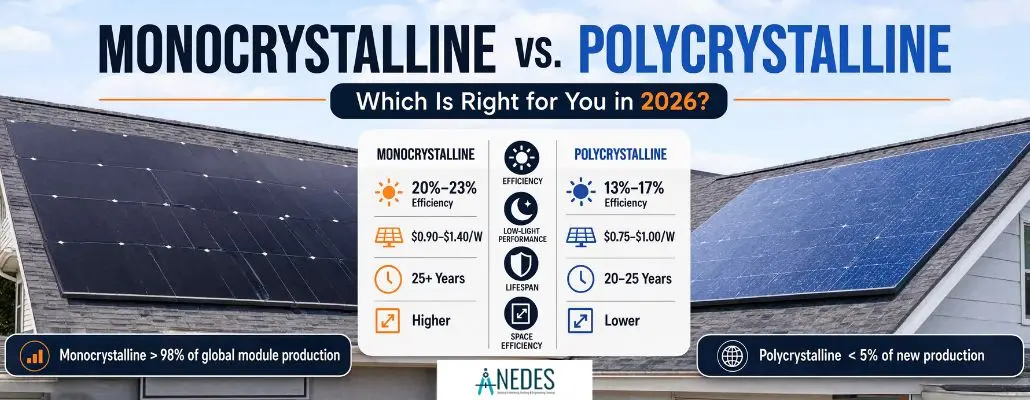
Monocrystalline panels are the better pick for nearly every US home in 2026, not because of one factor, but three that now point in the same direction.
- Major manufacturers, including LONGi, JA Solar, Trina Solar, and Canadian Solar, have shifted production almost entirely to monocrystalline cells.
- The price gap between the two technologies has narrowed sharply since 2020.
- Monocrystalline panels also hold a measurable edge in low-light and shaded conditions, something older comparisons rarely mentioned.
A decade ago, cost alone decided this debate, and polycrystalline’s lower price won for budget buyers. That trade-off has mostly disappeared in 2026. It now takes all three points together to explain the verdict, not price or market share alone. The full comparison below breaks down each factor, plus the few cases where polycrystalline still makes sense.
What’s the Actual Difference Between Monocrystalline and Polycrystalline Solar Panels?
The core difference between monocrystalline and polycrystalline panels is crystal structure: monocrystalline cells come from a single silicon crystal, while polycrystalline cells come from many fused fragments.
Both panel types are silicon-based and work the same basic way. Understanding how solar panels work explains why that structural difference matters so much. A single, uniform crystal lets electrons move with less resistance. Fused fragments create boundaries that slow electrons down. That one manufacturing choice drives almost every performance gap covered in this guide.
How Are Monocrystalline Solar Panels Made?
Manufacturers grow a single, continuous silicon crystal using the Czochralski process (a standard industrial method for growing high-purity single-crystal silicon ingots for monocrystalline solar panels). A machine slowly pulls a seed crystal from molten silicon, forming a cylindrical ingot. That ingot gets sliced into thin wafers, and each wafer becomes one solar cell.
The process demands high heat, tight quality control, and significant energy input. That precision is exactly why monocrystalline panels cost more to manufacture than polycrystalline ones. It’s also why the resulting cells conduct electricity so efficiently; there are no internal crystal boundaries interrupting electron flow.
How Are Polycrystalline Solar Panels Made?
Polycrystalline panels start differently. Manufacturers melt multiple fragments of silicon together in a mold, then let the mixture cool and solidify. There’s no single crystal to grow, so the process runs faster and uses less energy. That speed is exactly where polycrystalline’s traditional price edge comes from. The trade-off shows up at the microscopic level: where silicon fragments meet, tiny grain boundaries form. Those boundaries slightly slow electron movement, which is the root cause of polycrystalline materials’ lower efficiency ratings.
How Can You Tell Monocrystalline and Polycrystalline Panels Apart?
Monocrystalline cells look uniformly black with rounded corners; polycrystalline cells look blue and speckled with square edges.
The color difference comes directly from the manufacturing process above. High-purity single-crystal silicon absorbs light almost uniformly, producing that solid black look. Fragmented polycrystalline silicon reflects light unevenly, creating the blue, speckled appearance and a visible grid pattern. Rounded cell corners are another mono giveaway; they’re cut from cylindrical ingots.
Polycrystalline cells stay square, cast straight from a rectangular mold. This is the fastest way to identify which type is already on your roof, or listed on a quote, without opening a spec sheet.
How Do Monocrystalline and Polycrystalline Panels Compare at a Glance?
Monocrystalline wins on efficiency, low-light output, lifespan, and heat tolerance; polycrystalline still wins on panel-only upfront price.
Here’s the same comparison in one place.
| Factor | Monocrystalline | Polycrystalline |
| Efficiency | 20%–23% | 13%–17% |
| Low-light / shade performance | Stronger output in diffuse light | Noticeably lower in shade or haze |
| Lifespan & degradation | 25–30+ yrs; median ~0.5%/yr decline | 25–30 yrs; typically at the higher end of that range |
| Temperature coefficient | About -0.3% to -0.4% per °C | About -0.37% to -0.5% per °C |
| Cost per watt (panel only) | Higher, but gap narrowing | Lower, still a modest discount |
| Space efficiency | More power per square foot | Needs more roof space for the same output |
Which Panel Type Is More Efficient, and How Much Does It Actually Matter?
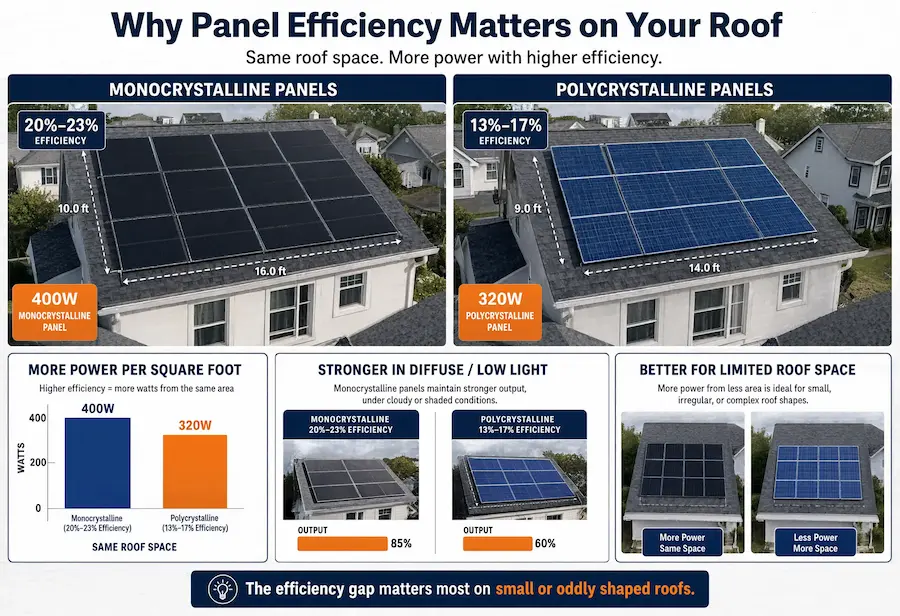
Monocrystalline panels convert about 20%–23% of sunlight into electricity, versus 13%–17% for polycrystalline, but the gap matters more on small roofs.
Efficiency Ranges Compared
- Monocrystalline panels sold in the US in 2026 typically range from 20% to 23% efficiency, with premium PERC and TOPCon models reaching higher levels.
- Polycrystalline panels top out between 13% and 17%.
These ranges reflect current manufacturer datasheets and 2026 market listings. The gap has actually widened since 2020, as monocrystalline technology has continued to improve while polycrystalline development has largely stalled.
What Does the Efficiency Gap Mean for Your Roof?
Translate that percentage into panel count, and it gets concrete. A 400-watt monocrystalline panel and a 320-watt polycrystalline panel can take the same physical space. Hitting the same system size means installing more polycrystalline panels overall. On a small or oddly shaped roof, that extra count can decide whether your target system even fits. On a large, unshaded roof, the gap matters far less.
Not sure how many you’d need either way? Our guide on how many solar panels you need walks through the math. If your energy needs grow later, it’s often easier to add one solar panel to a monocrystalline array than to redesign an already-maxed polycrystalline layout.
Which Panel Performs Better in Cloudy or Low-Light Conditions?
Monocrystalline panels generally produce more power than polycrystalline panels under cloudy, hazy, or diffuse light.
The same uniform crystal structure that boosts efficiency in direct sun also helps under weak light. Electrons move through a single crystal lattice with fewer obstacles, even when there’s less energy pushing them. The internal grain boundaries of polycrystalline panels become a greater bottleneck exactly when light is scarce.
Researchers at Ghana’s KNUST Brew Hammond Energy Center compared both panel types and found monocrystalline panels consistently delivered higher power output than polycrystalline ones at lower sunlight levels. A separate IEEE Access study found polycrystalline cells developed damaging hotspots under smaller shaded areas than monocrystalline cells needed to trigger the same effect.
For a shaded backyard, a north-facing array, or a cloudier climate, that gap is a practical advantage, not just a lab result. Regular solar maintenance or cleaning also protects output on hazy, dust-heavy days, regardless of panel type.
Is Polycrystalline Still Cheaper Than Monocrystalline in 2026?
Polycrystalline panels are still cheaper per watt, but the gap has narrowed enough that most homeowners come out ahead choosing monocrystalline.
Cost Per Watt: Monocrystalline vs. Polycrystalline in 2026
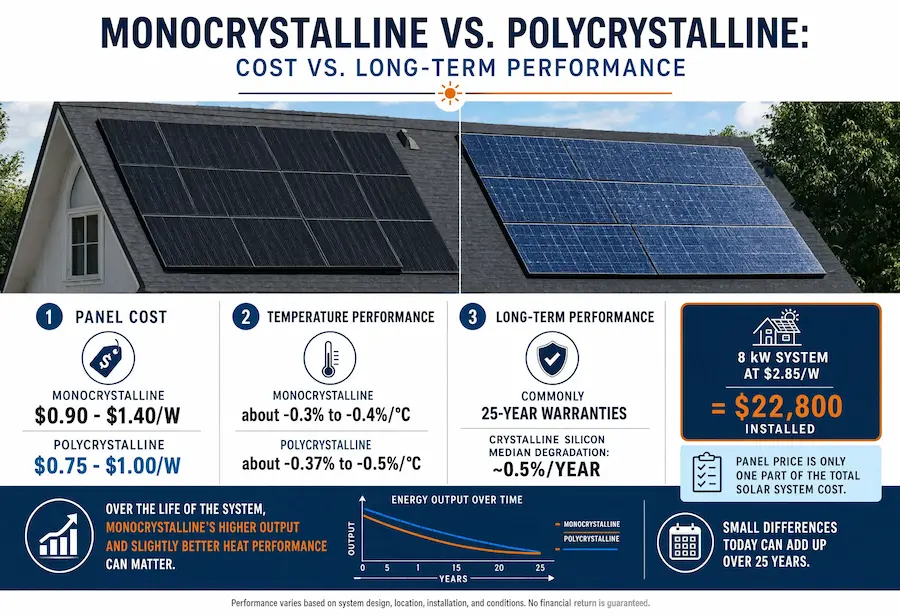
At the panel level, monocrystalline modules run roughly $0.90 to $1.40 per watt in 2026. Polycrystalline modules run roughly $0.75 to $1.00 per watt. That’s a real gap, but smaller than it was five years ago. Panels are also a smaller slice of your bill than most people assume, often just 25% to 30% of total installed cost. Labor, inverters, racking, and permitting make up the rest.
For the full picture, see the 2026 cost of solar across different system sizes and states.
How Long Does Each Type Take to Pay for Itself?
The payback of monocrystalline and polycrystalline solar depends on the whole system, not just the panel price. A typical US residential system in 2026 costs roughly $2.50 to $3.50 per watt installed, averaging about $2.85 per watt nationally, according to Lawrence Berkeley National Laboratory’s Tracking the Sun report.
Most homeowners now see payback in about 8 to 14 years. That timeline depends on your state’s electricity rates and remaining incentives. Because monocrystalline panels produce more energy per square foot, they typically shave months off that window versus a polycrystalline system sized for the same roof.
Worked Example: Typical Residential System Break-Even
Take an 8 kW system priced at $2.85 per watt: about $22,800 installed before incentives. At a US average residential rate near $0.17 per kWh, that system might offset roughly $1,300 to $1,600 in electricity costs per year. Divide the cost by the annual savings, and the payback period comes out to around 14 to 17 years for that example. It runs shorter in high-rate states, longer in low-rate ones. A monocrystalline system of the same size typically produces 10% to 20% more energy than a polycrystalline system on the same footprint, further shortening that break-even window.
Do SRECs or Other Performance-Based Incentives Favor One Type?
Yes, indirectly. In SREC programs, a system earns one certificate for every 1,000 kilowatt-hours it produces, and these programs exist in states including Delaware, Illinois, Maryland, Massachusetts, New Jersey, Ohio, Pennsylvania, Virginia, and Washington, DC. Higher-output monocrystalline systems generate more credits over time in these markets. It’s a secondary factor, not a reason to pick panel type on its own.
Which Panel Type Lasts Longer and Degrades More Slowly?
Both panel types commonly carry 25-year warranties, but monocrystalline panels tend to degrade more slowly year over year.
Warranty length alone doesn’t tell the full story. Both technologies are usually backed for 25 years. What differs is the degradation rate underneath that warranty. NREL’s field research puts the median degradation rate for crystalline silicon panels at about 0.5% per year. Hotter climates average about 0.88% per year, while cooler climates average about 0.48% per year.
Monocrystalline’s more uniform crystal structure generally holds up better against that heat-driven decline than polycrystalline’s grain-boundary structure does. Over 25 years, even a small yearly gap compounds into a real difference in total energy produced. If your roof needs repairs mid-lifespan and a solar panel needs to be unmounted, a remount service can safely take the array down without voiding your warranty.
Which Panel Type Handles Heat Better: Monocrystalline or Polycrystalline?
Monocrystalline panels typically lose slightly less output per degree of heat than polycrystalline panels do.
Every solar panel loses some efficiency as it heats up past 77°F; this is measured as the temperature coefficient.
- Monocrystalline panels typically experience about 0.3% to 0.4% output loss per degree Celsius above that baseline.
- Polycrystalline panels typically run between -0.37% and -0.5%.
That gap sounds small, but rooftop panels routinely reach 120°F to 150°F on summer afternoons. In Arizona, Texas, or Florida, it adds up to real energy over a cooling season. If you live somewhere with mild summers and steady cloud cover, this factor matters far less than efficiency or low-light performance.
Is Polycrystalline Still Available for Residential Solar in 2026?
Yes, but barely; polycrystalline now makes up under 5% of new production, and most installers no longer stock it for homes.
What the Current Production and Installation Data Shows
By 2023, monocrystalline modules already made up about 98% of global solar module production, with polycrystalline nearly gone from manufacturer lineups. That share has kept climbing since major producers like LONGi, JA Solar, Trina Solar, and Canadian Solar have shifted their factories almost entirely to monocrystalline, PERC, and TOPCon cells.
Sourcing matters for a different reason in 2026: China still supplies most global solar components, which is exactly why Foreign Entity of Concern rules now affect tax-credit eligibility. Under the One Big Beautiful Bill Act, signed in July 2025, new Foreign Entity of Concern rules and IRS guidance now limit which projects can claim federal renewable energy credits based on equipment sourcing.
If you’re weighing a lease or power-purchase agreement, our breakdown of FEOC-compliant vs. non-FEOC-compliant solar panels explains what that means for your contract.
What This Means for Your Quote Today
Most solar installation services in the US default to monocrystalline panels in 2026, whether you ask for them by name or not. Polycrystalline still shows up occasionally in bulk commercial jobs or closeout inventory. For a typical single-family home, a rooftop is rarely offered anymore.
So, Which Solar Panel Should You Actually Choose?
Choose monocrystalline if you have a typical residential roof; polycrystalline only makes sense for large, low-cost, space-abundant installs.
For most homeowners, this decision is largely made already, and that’s a genuinely useful shortcut. The framework below confirms your quote matches what actually fits your roof, whether you’re planning a grid-tied system or exploring solar panel use without a battery for a simpler setup.
Choose Monocrystalline If…
- Your roof has limited space, and every square foot needs to count.
- You live somewhere hot, where heat tolerance affects output.
- You want a uniform black, low-profile look.
- You’re getting a standard residential quote in 2026.
Note: Premium panel lines like TeslaPower now build exclusively on monocrystalline cells, reinforcing that direction.
Choose Polycrystalline If…
- You have abundant roof or ground-mount space with no shading concerns.
- You’re pricing a large-scale, price-sensitive bulk installation, not a single home.
Even then, expect to search harder for stock and installer expertise. A typical single-family rooftop quote in 2026 usually won’t offer this option at all.
What About Other Solar Panel Types Like Thin-Film, PERC, or TOPCon?
PERC and TOPCon are improved monocrystalline cells, not separate technologies; thin-film is a distinct, less common option.
PERC and TOPCon: Improved Monocrystalline, Not a New Category
PERC and TOPCon panels start with the same single-crystal silicon base as standard monocrystalline. Added layers and coatings capture more light and reduce energy loss. Think of them as a premium tier within monocrystalline, not a third category competing with mono and poly.
Thin-Film Panels in Brief
Thin-film panels use a completely different material, often cadmium telluride, applied in thin layers. They’re lighter, flexible, and cheaper per panel, but far less efficient per square foot.
When Thin-Film Might Make Sense
Thin-film suits RVs, marine use, and portable off-grid setups where weight and flexibility matter more than efficiency. For a standard rooftop, it’s rarely the right fit.
Including a project-specific assessment, system sizing, and pricing based on your property and local solar conditions.
What Do Homeowners Most Often Ask About Monocrystalline vs. Polycrystalline Panels?
Which is better, monocrystalline or polycrystalline?
Monocrystalline is better for almost every US homeowner in 2026. It’s more efficient, performs better in low light, and costs only slightly more per watt. Polycrystalline only makes sense for large, space-abundant, budget-driven installs.
What is the difference between monocrystalline and polycrystalline solar cells?
Monocrystalline cells come from a single silicon crystal, giving them a uniform black look and higher efficiency. Polycrystalline cells are made from multiple fused silicon fragments, resulting in a blue, speckled appearance and lower efficiency.
Are monocrystalline solar panels worth the extra cost?
Usually, yes. The panel-level price gap has narrowed to roughly $0.15-$0.40 per watt. Monocrystalline’s higher output typically shortens payback within a typical 8-to-14-year timeline. On most roofs, lifetime energy gain outweighs the small upfront difference.
Can you mix monocrystalline and polycrystalline panels?
Technically yes, but it’s not recommended. Mixing panels with different voltage and current characteristics can reduce overall system efficiency. Most installers strongly advise against combining them on one array.
Are polycrystalline solar panels still made in 2026?
Yes, but barely. Polycrystalline now accounts for under 5% of new global production. Most residential installers no longer stock it as a standard option for homes.
Which solar panel type lasts longer, monocrystalline or polycrystalline?
Both commonly carry 25-year warranties. Monocrystalline panels tend to degrade more slowly year over year, thanks to a more uniform crystal structure and generally better heat tolerance.
Why are some solar panels black and others blue?
Color comes from the silicon structure. Monocrystalline panels’ single, high-purity crystal absorbs light uniformly, producing a solid black look. Polycrystalline panels’ fragmented crystals reflect light unevenly, creating a blue, speckled appearance.
Is efficiency the most important factor when choosing solar panels?
Not always. Efficiency matters most on small or shaded roofs, where every square foot counts. On large, unshaded roofs, cost per watt and long-term degradation often matter just as much.
Do monocrystalline panels still work without direct sunlight?
Yes. Monocrystalline panels generate power from diffuse, indirect light on cloudy days, just at reduced output. Research shows they hold output better than polycrystalline panels in low-light, hazy conditions.
Do monocrystalline or polycrystalline panels handle snow and cold climates differently?
Both work fine in cold weather. Panels are actually slightly more efficient in cooler temperatures. Dark monocrystalline panels absorb more heat, which can help snow slide off and melt faster than on lighter polycrystalline panels.
Summary of Key Differences
Monocrystalline panels win on efficiency, low-light output, lifespan, and heat tolerance, and the cost gap no longer justifies choosing polycrystalline for most homes. Polycrystalline still has a narrow place in large, budget-driven, space-abundant projects, just not on a typical US rooftop.
Once you know which panel type fits your roof, the next step is getting project-specific numbers instead of relying on averages. NEDES provides solar system design and installation, including system sizing, equipment selection, and FEOC-aware sourcing for financed projects. We also provide follow-on services such as panel cleaning, unmounting and remounting for roof repairs, and solar array expansions.
Request a free, no-obligation quote from NEDES to see what a monocrystalline solar system could cost for your specific roof in 2026!