
How Many Solar Panels Do I Need to Run a House?
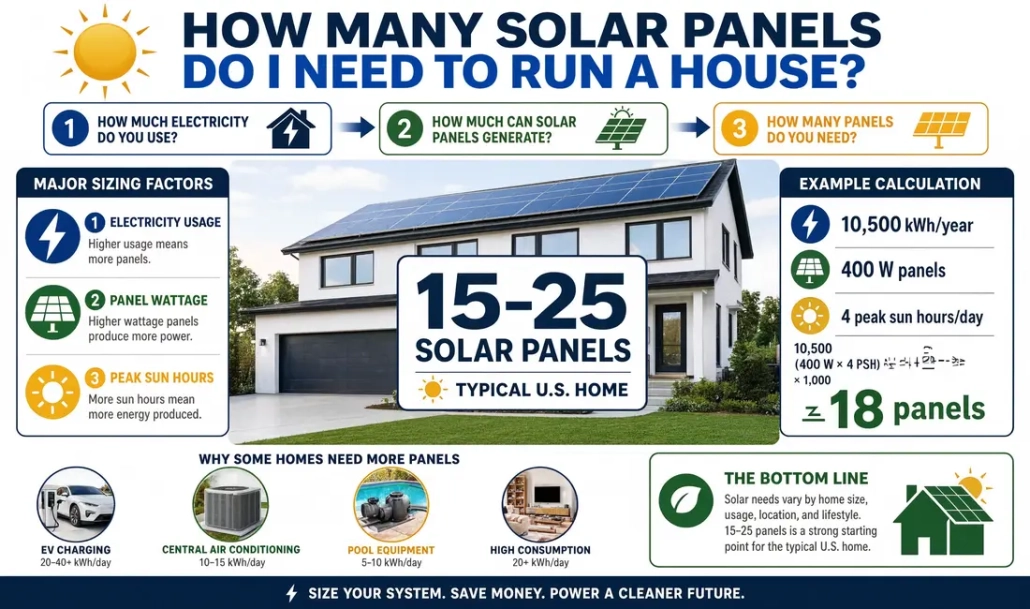
Most homes need 15 to 25 solar panels to cover their electricity use. That’s the honest, unqualified starting point. But your real number depends on three things: how much electricity you use, how much sun your roof gets, and which panels your installer puts on your roof.Homeowners in Virginia, Maryland, Pennsylvania, Delaware, Georgia and Texas each face a different sun budget and a different set of utility rules, so a 20-panel system in Richmond doesn’t produce the same power as a 20-panel system in Philadelphia.This guide gives you the exact formula installers use, broken down step by step, plus the real-world numbers for the Mid-Atlantic and Texas markets. No sales pitch, just the math.
Quick Answer: Most Homes Need 15-25 Solar Panels
A typical U.S. household uses about 10,500 kilowatt-hours (kWh) of electricity per year, according to the U.S. Energy Information Administration. At a standard 400-watt panel and 4 peak sun hours a day, that works out to roughly 18 to 20 panels. Homes with electric heat, a pool, or an EV charger climb toward 25 or more. Homes in sunnier states, or homes that pair solar with strong efficiency habits, can land closer to 15.
That range exists because three variables move independently: your annual usage, the wattage of the panel your installer selects, and the peak sun hours your specific roof receives. Two neighbors with identical houses can need a different panel count if one runs central air nonstop and the other doesn’t. Here’s the exact formula behind that range, and why your number might be different.
How to Calculate How Many Solar Panels You Need (Step-by-Step)
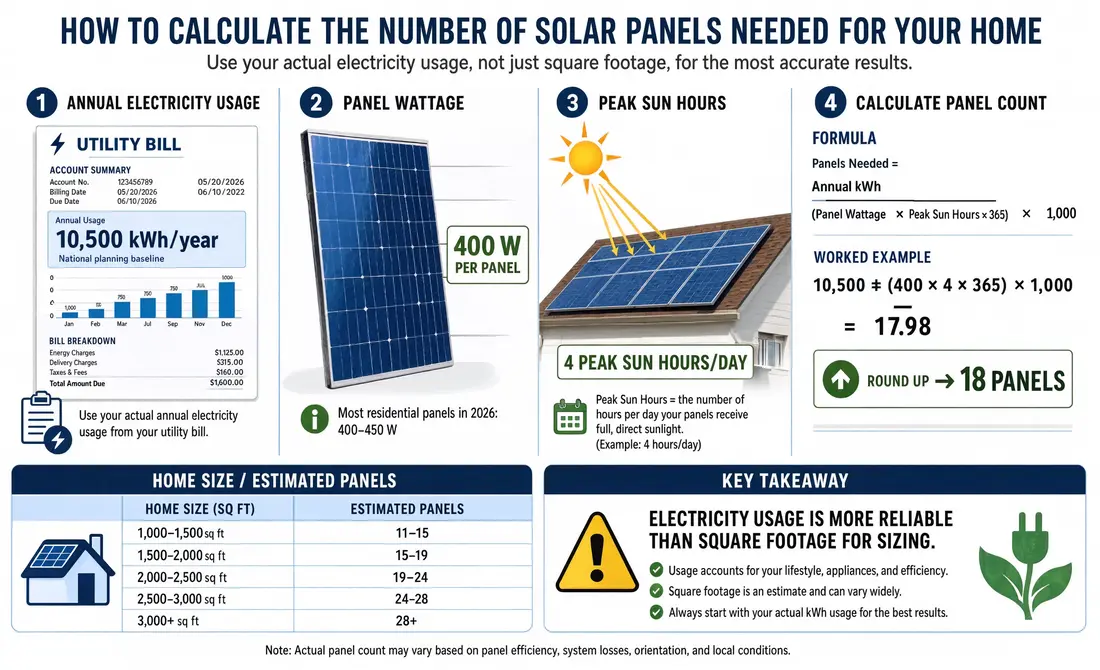
Learn how to estimate the number of solar panels your home needs using annual electricity consumption, panel wattage, and peak sun hours.
The formula solar installers use isn’t complicated. It has four inputs, and once you have them, the math takes about thirty seconds.
Solar panels needed = Annual kWh usage ÷ (Panel wattage × Peak sun hours × 365) × 1,000
That single line is the whole formula. Every solar sizing calculator online, including EnergySage’s and SolarReviews’, is a version of this equation with different assumptions plugged in. Once you have a number, here’s how home size, appliances, and usage levels compare against it.
Step 1: Find Your Annual Electricity Usage
Your electric bill is the fastest way to find this number. Most utilities show a “kWh used” figure on every monthly statement, and many post a rolling 12-month usage history online. Pull the most recent 12 months and add them together rather than relying on a single month, since usage swings hard between a mild April and a brutal August.
If you don’t have a bill handy, the EIA’s most recent national estimate for average annual household electricity consumption is about 10,500 kWh per year, or roughly 875 kWh per month. That figure varies by source and year (some datasets show 10,332 kWh, others closer to 10,791 kWh depending on the exact 12-month window measured), so treat it as a planning baseline, not your actual number. Your own bill will always beat a national average.
Next, decide what size panel you’re planning around.
Step 2: Choose a Solar Panel Wattage
Panel wattage is the maximum power a single panel produces under lab test conditions. Most residential panels installed in 2026 fall in the 400 to 450-watt range, up from the 300 to 350-watt panels common a decade ago. Higher-wattage panels cost slightly more per watt, but they produce more electricity per square foot of roof, which matters if your usable roof space is limited.
For consistency, this guide uses 400 watts as the standard calculation panel across every table below. If your installer quotes 450W panels instead, you’ll need slightly fewer of them for the same output.
The other big variable is how much sun your roof actually gets.
Step 3: Determine Your Peak Sun Hours or Production Ratio
This is where two of the most-cited solar sites in the country use different vocabulary for the same thing, and it trips readers up when they compare quotes. Peak sun hours measure the number of hours per day your location receives sunlight intense enough to generate 1,000 watts per square meter.
A Texas roof might average 5 to 6 peak sun hours in summer, while a Pennsylvania roof might average 3 to 4. Production ratio measures something related but distinct: the ratio between your system’s actual annual output in kWh and its rated DC capacity in watts, usually expressed as a decimal between 1.3 and 1.6 for most U.S. climates.
They aren’t identical formulas, but they describe the same underlying reality: how much your specific location and system design convert into usable electricity, and installers use whichever variable their software is built around. If you’re comparing calculators from different solar companies and the numbers don’t match, this is usually why.
Nationally, peak sun hours range from about 3 hours per day in parts of the Northeast to over 6 hours in the desert Southwest. Now plug all three numbers into the formula.
Step 4: Do the Math (Worked Example)
Take a household using the national average of 10,500 kWh per year, with standard 400-watt panels, in a location averaging 4 peak sun hours per day, a reasonable mid-range figure for Virginia, Maryland, and Pennsylvania.
| Variable | Value |
| Annual usage | 10,500 kWh |
| Panel wattage | 400 W |
| Peak sun hours | 4 hours/day |
| Daily output per panel | 1.6 kWh (400W × 4 hours ÷ 1,000) |
| Annual output per panel | 584 kWh (1.6 kWh × 365 days) |
| Panels needed | 10,500 ÷ 584 = 17.98, rounded up to 18 panels |
That’s an 18-panel, roughly 7.2 kW system. Always round up: a fractional panel doesn’t exist, and installers build in a small buffer anyway to offset production losses from inverter inefficiency, wiring, dust, and panel degradation over time. Your own roof and usage will move that number. Here’s how, broken down by home size.
Solar Panels Needed by Home Size (Square Footage)
Square footage is a starting point, not the real driver. Your actual electric bill is the more accurate answer, covered in the next section. But if you’re early in your research and don’t have a bill in hand yet, home size gives a rough range.
| Home Size (sq ft) | Estimated Monthly Usage | Estimated Panel Count (400W, 4 PSH) |
| 1,000-1,500 | 500-700 kWh | 11-15 panels |
| 1,500-2,000 | 700-900 kWh | 15-19 panels |
| 2,000-2,500 | 900-1,100 kWh | 19-24 panels |
| 2,500-3,000 | 1,100-1,300 kWh | 24-28 panels |
| 3,000+ | 1,300+ kWh | 28+ panels |
A 2,000-square-foot house lands in the 15-19 panel range using this method. But square footage is a weak proxy on its own. It is an insulated, energy-efficient 2,800-square-foot home can use less electricity than a drafty 1,600-square-foot home with an old HVAC system and electric baseboard heat. Household habits, appliance age, and occupant count move the number more than the walls do.
Solar Panels Needed by Electricity Usage (kWh)
This is the more accurate version of the table above, because usage is the real driver of system size, not square footage. If you have a real kWh number from your bill, use this table instead.
| Monthly Usage | Annual Usage | Panel Count (400W, 4 PSH) |
| 500 kWh | 6,000 kWh | 11 panels |
| 800 kWh | 9,600 kWh | 17 panels |
| 900 kWh | 10,800 kWh | 19 panels |
| 1,100 kWh | 13,200 kWh | 23 panels |
| 1,400 kWh | 16,800 kWh | 29 panels |
| 1,800 kWh | 21,600 kWh | 37 panels |
Notice how a household using 1,800 kWh a month needs more than triple the panels of one using 500 kWh a month, even if both live in identically sized houses. That gap is almost always driven by heating type, air conditioning load, pool equipment, or EV charging.
Certain appliances can shift your usage more than home size ever will. Here’s how much.
Solar Panels Needed for Common Appliances
Big-ticket electric loads add up fast, and knowing their individual weight helps you decide whether to size your system for them now or add capacity later.
| Appliance / Load | Approx. Annual kWh | Approx. Panels Needed |
| Refrigerator | 300-600 kWh | 1-2 panels |
| Window AC unit | 400-900 kWh | 1-2 panels |
| Central air conditioning | 2,000-4,000 kWh | 4-7 panels |
| Electric water heater | 3,000-4,500 kWh | 6-8 panels |
| Pool pump (standard) | 1,500-2,500 kWh | 3-5 panels |
| Heated pool | 2,000-5,000+ kWh | 4-9 panels |
| Hot tub | 1,500-3,000 kWh | 3-6 panels |
| EV charging (12,000 mi/yr) | 3,000-4,000 kWh | 6-7 panels |
Central air conditioning alone can add 4 to 7 panels to a system in a hot-summer state like Texas or Maryland. Adding an EV charger or a heated pool after your system is already installed is possible, but it’s almost always more expensive per panel than sizing for it upfront, since a second installation means a second service call, permit, and possibly a new inverter.
Even with appliances accounted for, your roof still has to physically fit the panels.
How Much Roof Space Do You Need for Solar Panels?
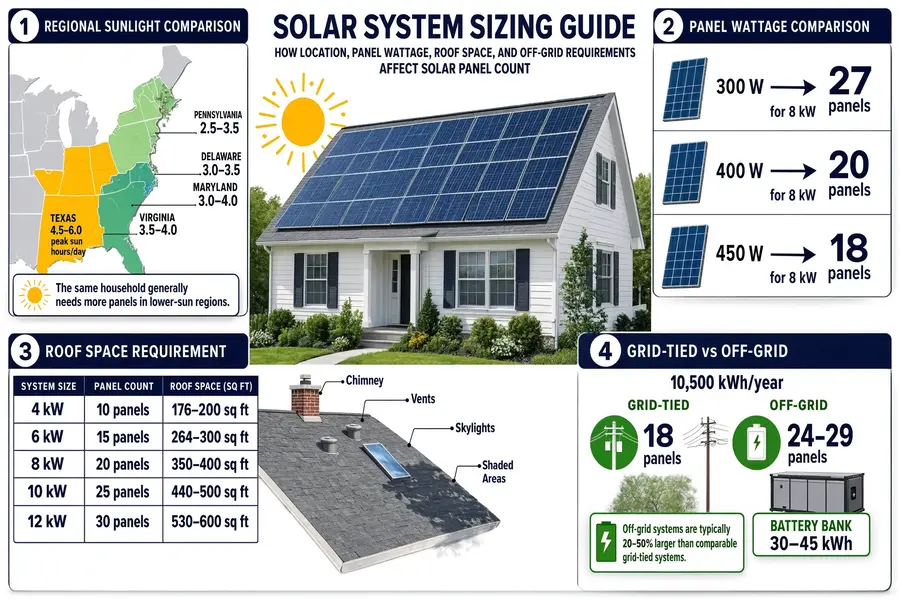
Solar system sizing depends on sunlight, panel wattage, available roof space, and whether the system is grid-tied or off-grid.
A standard residential solar panel measures roughly 65 by 39 inches, or about 17.6 square feet, though this varies slightly by manufacturer and wattage.
| System Size | Panel Count (400W) | Estimated Roof Space Needed |
| 4 kW | 10 panels | 176-200 sq ft |
| 6 kW | 15 panels | 264-300 sq ft |
| 8 kW | 20 panels | 350-400 sq ft |
| 10 kW | 25 panels | 440-500 sq ft |
| 12 kW | 30 panels | 530-600 sq ft |
As a rule of thumb, a typical solar system uses about 20% of an average home’s total roof area. Not every square foot of roof counts as usable space, either. Vents, chimneys, skylights, and roof valleys all subtract from the buildable area, and panels generally need to sit at least 18 inches from roof edges to meet fire code setback requirements in most jurisdictions.
Roof space is one limiting factor. Sunlight and shading are the others.
What Affects How Many Solar Panels You Need?
Usage is the primary driver, covered above. But four secondary factors can shift your panel count by 30% or more even if your electricity usage stays exactly the same.
Sunlight and Location: Peak Sun Hours by Region
Location is the single biggest secondary factor. The same household, with the same usage, needs more panels meaningfully in a low-sun region than in a high-sun one.
| Region / State | Approx. Peak Sun Hours/Day |
| Texas (most of state) | 4.5-6.0 |
| Virginia | 3.5-4.0 |
| Maryland | 3.0-4.0 |
| Delaware | 3.0-3.5 |
| Pennsylvania | 2.5-3.5 |
Texas homeowners, sitting near the top of this range, generally need fewer panels than Pennsylvania homeowners to produce the same annual output. That doesn’t make solar a bad investment in Pennsylvania; it just means the system is sized larger, and the region’s cold, clear winter air actually helps panel efficiency, since panels perform closer to their rated output in cool conditions than in scorching summer heat.
The next lever is what panels you actually choose.
Panel Wattage and Efficiency
Higher-wattage panels mean fewer panels for the same total output, which matters most on a constrained roof.
| Panel Wattage | Panels for an 8 kW System | Approx. Roof Space |
| 300W | 27 panels | ~475 sq ft |
| 400W | 20 panels | ~400 sq ft |
| 450W | 18 panels | ~360 sq ft |
Higher-efficiency panels cost more per panel but less per watt of usable roof space, which is why installers often recommend them for smaller roofs, steep dormers, or homes with heavy tree shading that already limits placement options.
None of this matters if your roof can’t physically hold the panels. That’s the next question.
Roof Size, Shape, and Shading
South-facing roof sections with a 30 to 45-degree pitch generally produce the most energy in the Northern Hemisphere, though east- and west-facing roofs still work well and simply produce slightly less. Physical obstructions (vents, chimneys, skylights, HVAC equipment) reduce usable space beyond raw square footage. Shading from mature trees or neighboring structures can cut a section’s output substantially even if the roof itself is large enough on paper, which is why installers do a shading analysis before finalizing a design rather than relying on square footage alone.
The last lever isn’t physical at all. It’s what your utility allows.
Utility Net Metering Rules
Some utilities cap the size of the solar system you’re allowed to install, commonly around 100% to 120% of your prior 12 months of usage, so oversizing “just in case” isn’t always possible even if your roof has the room. Whether your utility offers full-retail net metering or a reduced export rate also changes whether oversizing your system makes financial sense in the first place. Check your local utility’s interconnection rules before finalizing a system size, since these rules vary by state and are actively changing in 2026.
If your goal is full energy independence rather than bill offset, the math changes again.
How Many Solar Panels Do You Need to Go Off-Grid?
Going off-grid means designing a system with no utility connection to fall back on, which requires both a larger panel array and a battery bank sized to carry the home through nighttime and multi-day cloudy stretches. Off-grid systems are typically sized 20% to 50% larger than a comparable grid-tied system to account for battery charging losses and days with little sun.
| Usage Level | Grid-Tied Panels | Off-Grid Panels | Battery Bank (approx.) |
| 6,000 kWh/yr | 11 panels | 14-17 panels | 20-30 kWh |
| 10,500 kWh/yr | 18 panels | 24-29 panels | 30-45 kWh |
| 15,000 kWh/yr | 26 panels | 34-41 panels | 45-65 kWh |
An off-grid system is a meaningfully bigger and more expensive project than a standard grid-tied one, since it requires enough stored capacity to run a home through several consecutive low-sun days without any grid backup, not just enough panels to cover average daily use.
If you’re staying grid-connected, there’s one more common misconception worth clearing up.
Does a Bigger House Always Need More Solar Panels? (Common Misconception)
No, not necessarily. Electricity usage, not square footage, predicts panel count more reliably. A well-insulated, efficiently built 2,800-square-foot home with a modern heat pump and LED lighting throughout can use less electricity annually than a poorly insulated 1,600-square-foot home running electric baseboard heat and an aging central AC unit.
Household habits matter as much as the building itself: the number of occupants, thermostat settings, whether the home has a pool or EV, and how often major appliances run all move the usage number independently of square footage. Two homes of identical size on the same street can need a 30% different panel count based purely on how the people inside them live.
Once you have a real number in mind, a personalized quote confirms it fast.
Solar Incentives and Costs for Mid-Atlantic and Texas Homeowners in 2026
The financial picture for solar changed significantly heading into 2026, and it’s worth stating plainly rather than repeating outdated numbers still circulating on older solar sites.
The federal residential solar tax credit (Section 25D of the tax code, worth 30% of system cost for over a decade) expired for homeowners on December 31, 2025 under the One Big Beautiful Bill Act, and there is no federal residential credit available for systems installed in 2026. Homeowners who fully paid for and completed installation before that date can still claim it on their 2025 taxes; homeowners installing in 2026 cannot. This makes state-level incentives and net metering policy more important to the math than they’ve been in years.
Installed solar costs in 2026 average $2.50 to $3.50 per watt, putting a typical 8 kW residential system at roughly $20,000 to $28,000 before any state incentives, with the panels themselves representing a relatively small share of that total.
Net metering rules also vary sharply by state right now:
- Pennsylvania and Maryland currently maintain retail-rate net metering with monthly credit rollover, which generally produces the strongest and most predictable payback math of the five states covered here.
- Virginia offers full retail net metering up to 25 kW for residential systems under current rules, though Dominion Energy has proposed changes that would reduce export credit value for new customers; homeowners interconnecting before any new order takes effect keep the current terms.
- Delaware offers net metering through its statutory framework, with system-size caps tied to a percentage of utility peak demand.
- Texas has no statewide net metering mandate; compensation for excess solar production depends entirely on the retail electric provider and plan you choose, so comparing buyback rates across providers matters more in Texas than in states with a uniform state policy.
Because these rules shift by state and utility, this is the point where a general formula stops being enough and a site-specific quote becomes the more accurate next step.
Book Your Free Consultation Now
Get Your Personalized Solar Panel Count
The formula above gets you within a few panels of your real number. A site visit gets you the exact one. With the help of accounting for your actual roof angle, shading, local utility rules, and current equipment pricing in your state, you always get accurate values. Request a free, no-obligation solar estimate and get a system size built around your actual electric bill, not a national average.
Frequently Asked Questions
How many solar panels does it take to power an average house?
Most average U.S. households need 15 to 25 solar panels, based on the national average annual usage of about 10,500 kWh, standard 400-watt panels, and 3 to 5 peak sun hours per day depending on region.
How many solar panels do I need for a 2,000 sq. ft. house?
A 2,000-square-foot home typically needs 15 to 19 panels, based on the square-footage estimate table above. Your actual electric bill will give a more accurate number than square footage alone, since usage varies more by household habits than by home size.
How many solar panels do I need to run central air conditioning?
Central air conditioning adds roughly 4 to 7 panels to a system, based on its typical annual load of 2,000 to 4,000 kWh, on top of whatever your system already needs for baseline household usage.
Can one solar panel run a house?
No. A single residential solar panel produces roughly 400 to 600 kWh per year under typical conditions, a small fraction of the 10,500 kWh a typical household consumes annually. Running an entire home requires a full array of panels working together, not a single unit.
How many solar panels do I need to go off-grid?
Off-grid systems need roughly 20% to 50% more panels than an equivalent grid-tied system, plus a properly sized battery bank to cover nighttime and low-sun days, since there’s no utility connection to draw from as backup. See the off-grid table above for panel counts by usage level.
How many solar panels do I need based on my electric bill?
Take your annual kWh usage from your last 12 months of bills, then divide it by your panel wattage multiplied by your local peak sun hours and 365 days, multiplied by 1,000. That’s the same four-step formula covered earlier in this guide, applied to your actual numbers instead of the national average.
How much roof space do I need for solar panels?
A typical residential system needs roughly 350 to 500 square feet of usable, unshaded roof space for a mid-size 8 to 10 kW system, though the exact figure depends on panel wattage and roof obstructions. See the full roof-space table above for system sizes from 4 kW to 12 kW.