
How to Use Solar Panels Without a Battery?
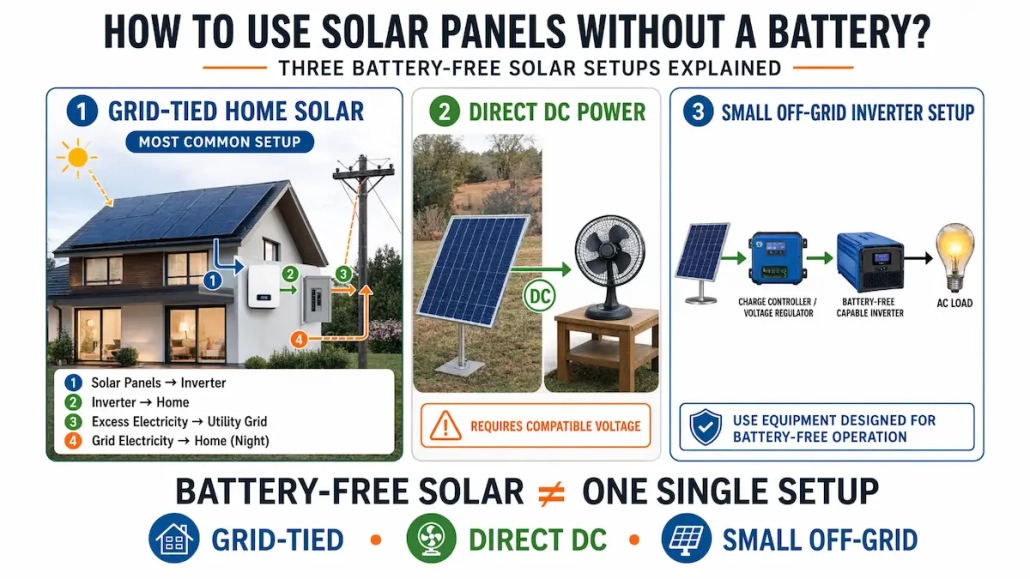
Yes, you can use solar panels without a battery. But “without a battery” means three very different things. A homeowner skipping a battery on a grid-tied system is one situation. Someone running a small DC device off a panel is another. A person wiring a budget panel to an off-grid inverter is a third. All three are common and real. This guide covers each one, fully and separately, so nothing gets lost in a mixed-together explanation.
What Are the Three Ways to Use Solar Panels Without a Battery?
- Grid-tied home solar (most common). Your system stays connected to the utility grid at all times. The grid itself acts as a substitute battery, absorbing excess power and supplying it at night.
- Direct DC power for small devices. A single panel can run a small DC device directly, with no inverter or battery required. This only works when the sun is out and when voltages are matched.
- Small off-grid inverter setups. This covers a small panel wired to an inverter, with no grid connection and no stored energy. It’s the least common setup, but it’s real, and it needs the most care.\
Each one gets its own full section below. That covers how it works, what equipment it needs, and where the real risks sit.
Setup 1: How Does Grid-Tied Solar Work Without a Battery?
This is what most people actually mean when they ask if they can use solar panels without a battery. It’s a standard grid-tied solar system: home solar panels, an inverter, and a permanent connection to the utility grid. No battery sits anywhere in the system.
Most residential solar installations work exactly this way. Your home stays connected to the utility grid even after solar panels go on. That grid connection functions as a battery most of the time.
This is the setup installers usually mean by “solar without a battery.” It’s the cheapest, most common way to go solar in 2026.
How Grid-Tied Solar Works Without a Battery?
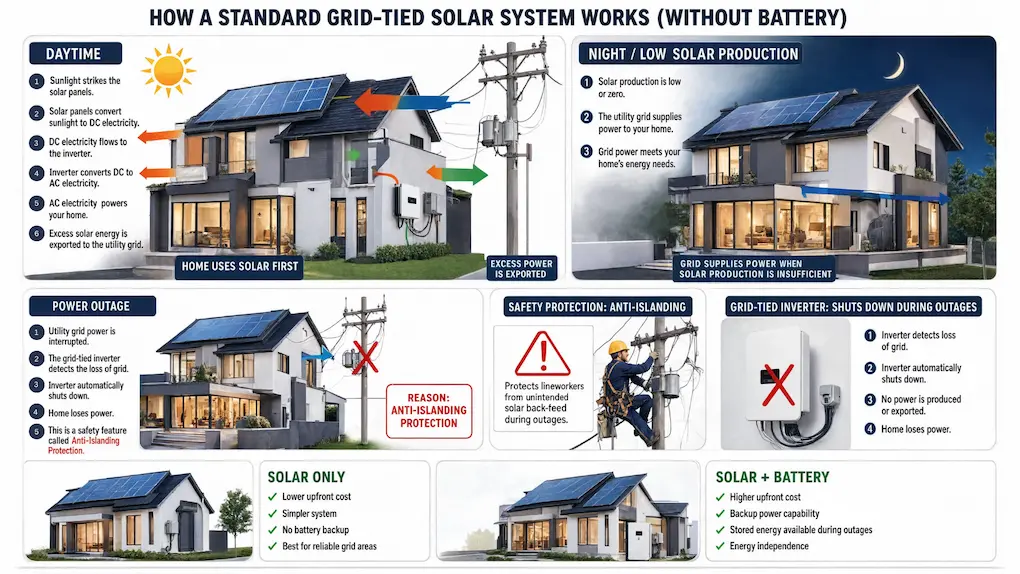
During daylight, your panels generate direct current (DC) electricity. Exactly how much energy a solar panel produces depends on panel size, orientation, and sunlight.
Your inverter converts that DC power into the alternating current (AC) your home actually uses. This daytime production is the core mechanism behind every grid-tied, battery-free system.
Your home uses solar power first, whenever the sun is shining. Any surplus power flows automatically to the utility grid, a process sometimes called grid export.
At night, or on cloudy days, your home simply draws power from the grid. That’s the same nighttime grid draw it relied on before solar. This back-and-forth is what makes a standard home installation work without stored energy.
Do Grid-Tied Solar Panels Work During a Power Outage?
Standard grid-tied systems shut down automatically during a power outage, even in full sun. This isn’t a flaw. It’s a required safety feature called anti-islanding protection, and every grid-tied inverter sold today includes it.
Utility crews need to know a line is fully dead before working on it. If your panels kept feeding power into a downed line, that could injure a lineworker. So your inverter is required to detect an outage and shut off automatically—an automatic shutdown built into the hardware itself.
Some newer inverters change this picture. Islanding-capable inverters from brands like Enphase and SMA can isolate part of your system. They can power select loads during an outage without a battery. This is not the default setup and usually requires a dedicated interconnection and specific equipment. If uninterrupted backup power is important to you, ask your installer directly whether your inverter model supports it.
What About Net Metering and Excess Power, Without a Battery?
Under net metering, surplus power is exported to the grid, and you receive a utility credit for it. Later, when your panels aren’t producing enough, you draw power back from the grid. Your utility essentially uses the grid as a stand-in for a battery, crediting and debiting your account. This runs under whatever local feed-in tariff or net-billing structure applies.
Credit rates vary a lot by location, and in many regions they’re declining. Net-billing structures increasingly pay less for exported power than they charge for power drawn back. Time-of-use rate pressure has made this even more location-specific in 2026. This directly affects whether skipping a battery makes financial sense in your area. It’s worth checking your utility’s current rate structure before deciding.
Do Solar Batteries Pay Back Their Manufacturing Pollution?
There’s also an environmental angle worth mentioning here. Lifecycle emissions estimates put solar-only systems at roughly 20 to 40 grams of CO2 per kWh generated. Adding a battery typically raises that to around 50-100 grams of CO2 per kWh due to manufacturing impacts.
Both figures are still far below the average grid mix, which is often cited at around 370 grams of CO2 per kWh. So skipping a battery isn’t just a financial choice; it can be a lower-impact one too. That gap narrows as battery manufacturing gets cleaner.
Is Grid-Tied Solar Without a Battery Worth It Financially?
This is the real question behind most searches: solar-only vs solar plus battery payback. It depends heavily on your local net metering policy and electricity rates. Here’s a straightforward comparison to help you think it through.
| Factor | Solar Only (No Battery) | Solar Plus Battery |
| Typical upfront cost | Lower, install cost of panels and inverter only | Higher, adds roughly $8,000 to $16,000 for a typical 10 kWh home battery, installed, in 2026 |
| Payback period | Usually faster, fewer components to pay off | Usually longer, unless outage protection or time-of-use savings offset the extra cost |
| Outage protection | None, with a standard grid-tied inverter | Yes, home stays powered during a blackout |
| Best fit | Areas with strong net metering and rare outages | Areas with weak net metering, high time-of-use spreads, or frequent outages |
A key policy note for 2026: The federal 30% Residential Clean Energy Credit for batteries expired for new purchases after December 31, 2025. Some state and utility programs, including incentives in California, are still available. This has shifted the math on battery payback periods for many homeowners this year. It’s worth checking what still applies in your state.
If you have decent net metering and rare outages, skipping the battery is often the sound financial choice. If your utility has weak export credit, or outages are common, a battery pays off faster than before.
Want exact numbers for your own roof and rates?
Try NEDES’ offered solar consultation before deciding either way!
Grid-tied without a battery, at a glance:
| Pros | Cons |
| No battery cost, lower upfront investment | No stored energy, unused power is exported or lost |
| Simpler system, less to install and maintain | No backup power during a standard outage |
| Net metering can offset most of your grid usage | Net metering rates vary and are declining in many areas |
| Nothing to replace mid-system, since panels outlast batteries | Full grid dependence at night and on cloudy days |
Does Grid-Tied Solar Without a Battery Work in Winter?
Winter adds a real limitation worth planning for, especially without a battery to smooth things out. Shorter daylight hours mean less production each day, even on clear days.
Snow cover can block panels entirely until it melts or is cleared off. Without stored energy, your home relies more heavily on grid power during the winter months.
This doesn’t make grid-tied solar a bad choice in colder climates. It just means your net metering credits, built up over sunnier months, do more of the work in winter.
Book Your Free Consultation Now
Setup 2: How Do You Run Small DC Devices Directly From a Panel?
This setup answers a different question entirely: can I power small devices directly from a solar panel without a battery or inverter? For a direct current load, the answer is often yes, and it’s simple, too. If you just want to power a small DC device, an LED light, a fan, or a pump, an inverter or battery isn’t required.
How Does Direct DC Power Work?
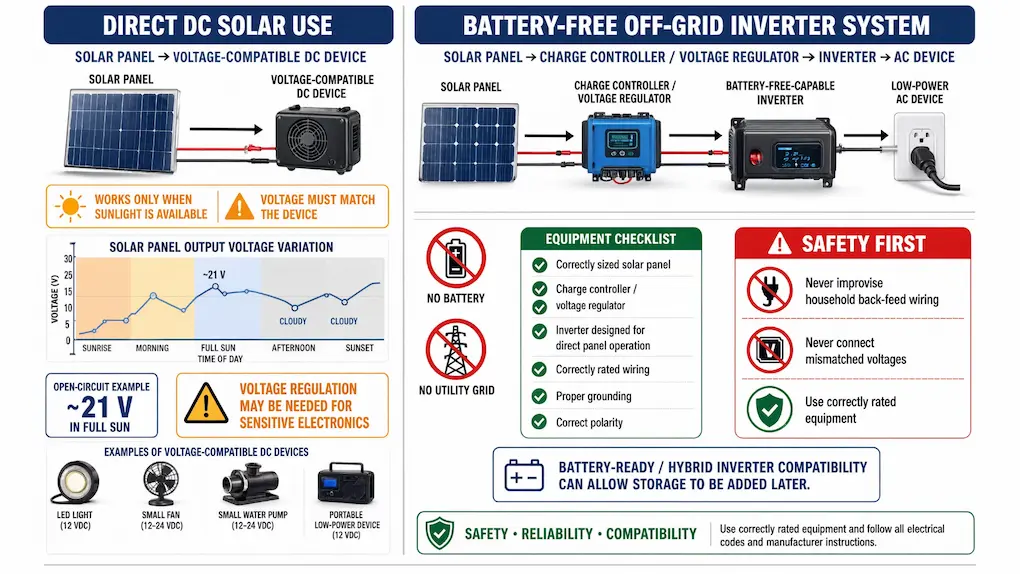
You can connect a compatible DC device directly to a solar panel, with no inverter or battery in between. It works whenever there’s enough sunlight, and stops working once the sun sets or clouds move in. There’s no AC conversion step here at all. The panel’s DC output goes directly to the device, as long as the two are rated to work together.
The Voltage Matching Problem
The catch is voltage matching. Solar panel output isn’t constant, and this fluctuation is the single biggest technical risk in this setup. An unloaded panel might read around 21 volts open-circuit voltage in full sun. That can drop into the low teens under passing cloud cover, a swing of nearly 10 volts in minutes.
This fluctuation can stress or damage sensitive electronics without some form of voltage regulation. Check your device’s rated voltage range before connecting it directly. If your device needs steady AC power or a bigger setup, you’ll need an inverter instead, covered in Setup 3 below. If you are not sure how much power your devices actually draw, contact the local solar company before sizing your panel.
Where Does This Setup Actually Show Up?
This setup appears frequently in real-world use, even though it rarely receives dedicated coverage. Small camping fans, portable phone chargers, cabin lighting, and low-power water pumps all fall into this category.
Many small solar kits sold for these exact devices already include built-in basic voltage protection. If you’re buying components separately instead of a pre-matched kit, that protection becomes your responsibility.
A simple inline voltage regulator or small charge controller adds meaningful protection for little cost. It’s a worthwhile investment for anything you don’t want to replace.
Setup 3: How Do You Connect a Small Panel to an Inverter Without a Battery?
This setup answers a third, distinct question: how do you build a battery-free, off-grid solar setup on a small budget, with no grid connection at all? There’s no grid connection or stored energy here, which makes it fundamentally different from Setups 1 and 2.
Typically, this means a small inverter powering AC devices directly from the panel output. It’s a genuinely useful, sometimes urgent setup, and it deserves a clear, safety-first answer rather than a niche afterthought.
Note: Most inverters aren’t designed to work this way by default.
Why Do Most Inverters Need a Battery or Grid as a Reference?
Standard inverters require stable voltage and frequency references to operate correctly. Normally, that reference comes from a battery or from the grid itself.
Without either one, a standard inverter often can’t reliably regulate its output. Solar panel voltage fluctuates constantly with sunlight, temperature, and cloud cover, as described in Setup 2 above.
This is why simply wiring a panel straight into a generic inverter often doesn’t work well, or at all. You typically need equipment specifically designed for battery-free direct-panel operation.
What You Actually Need for a Safe Off-Grid, Battery-Free Setup?
Here’s a practical equipment checklist for a small-scale, off-grid, battery-free setup.
- An appropriately sized panel. Match panel wattage to what your inverter and devices actually need.
- A charge controller or voltage regulator. This smooths out fluctuating panel voltage before it reaches your inverter, often using MPPT (Maximum Power Point Tracking) to squeeze out extra efficiency.
- An inverter rated for direct panel input. Look for inverters marketed as hybrid or battery-free capable, not standard grid-tie models.
- Correctly rated wiring. Undersized wiring is a common and serious fire risk in DIY setups.
Purpose-built battery-free inverters exist specifically for this use case. They’re generally much safer than improvising with mismatched, standard equipment.
A Basic Wiring Walkthrough
Once you have the right equipment, the actual connection process follows a fairly standard sequence. This is a general outline, not a substitute for your specific inverter’s manual.
- Locate the DC input terminals on your inverter, where the panel output connects.
- Run the panel’s positive and negative wires through the charge controller first, then to the inverter’s input terminals, using correctly rated, gauge-matched wiring.
- Ground the system according to your inverter’s instructions, since proper grounding protects against electrical surges.
- Double-check that every connection is tight and correctly polarized before powering anything on.
- Turn on the inverter, then test AC output with a single low-power device before connecting anything sensitive.
If any step feels unclear, that’s a sign to get a second, qualified pair of eyes on the setup before energizing it.
What are the Common Mistakes and Safety Risks?
A few real risks keep coming up in this kind of setup. These patterns show up across DIY and off-grid solar communities.
- Improvised direct wiring into household circuits, without a proper transfer switch, is genuinely dangerous. It can create back-feed hazards and put anyone working on the wiring at serious risk.
- If you’re feeding current to any battery without a controller, the risk becomes real. This can damage the battery or, in rare cases, create a fire hazard.
- Mismatched voltage between your panel and your devices can permanently damage electronics. It’s the same improper wiring and unstable output risk that shows up in Setup 2. Always check your equipment’s documented safe operating range before powering anything on.
- If you’re working with limited funds, a limited budget doesn’t mean you have to accept unsafe wiring. A correctly sized charge controller and a properly rated inverter cost far less than replacing damaged devices, or worse. And if you’re not confident about wiring safely, many community solar groups and some nonprofits offer low-cost or free guidance.
This use case comes up more often than people assume, and it deserves to be treated seriously. Some people building this kind of setup have very little margin for error. That can mean unstable housing or no easy access to an electrician. If that’s your situation, it’s worth prioritising pre-built, purpose-designed equipment over improvised wiring wherever your budget allows.
A small, properly rated all-in-one inverter kit is often safer and not dramatically more expensive than piecing together mismatched parts. Local solar cooperatives, community colleges, and some off-grid forums offer free or low-cost safety checks. It’s worth asking before you power anything on.
Do You Need a Charge Controller Without a Battery?
It is not strictly required for the simplest direct-DC setup, but it is still worth using for load protection. If you’re matching a single DC device’s voltage exactly, as in Setup 2, you can sometimes skip it. For anything beyond that simplest case, a charge controller is the safer default. It provides voltage regulation and protects connected equipment from voltage spikes.
A charge controller’s main job is normally to protect a battery from overcharging. Without a battery in the system, that specific job disappears, but the voltage-smoothing benefit doesn’t. Panel output can still spike or dip sharply as clouds pass or the sun’s angle shifts.
A basic charge controller, even an inexpensive one, absorbs a lot of that variation. That protects sensitive equipment downstream. For a single, well-matched DC device, this is optional. For anything involving electronics, multiple loads, or an inverter, it’s cheap insurance worth adding.
Can You Add a Battery Later?
Yes, in most cases, you’re not locking yourself into a permanent decision. Many modern inverters are already battery-ready or hybrid-inverter capable, built for future upgrades and modular expansion.
If you’re planning a small DIY setup now, check upgrade compatibility before you buy. Choosing a retrofit-friendly, hybrid-capable inverter today can save you a full equipment swap later.
For grid-tied homeowners from Setup 1, this decision is usually straightforward. Most installers now offer battery-ready inverters as standard, even on solar-only installs, at little or no extra cost. Ask specifically whether your proposed inverter model supports battery retrofit before signing a contract.
For small off-grid or DIY setups, the same logic applies at a smaller scale. A slightly higher upfront cost for a hybrid-capable inverter can prevent you from having to replace the entire unit if your needs grow. If your budget only allows the simplest option now, that’s a reasonable place to start. You can always add capacity as circumstances change.
How Do You Get the Most Out of Any Battery-Free Setup?
A few habits help squeeze more value out of solar power, no matter which of the three setups you’re running.
- Shift energy-heavy tasks to daylight hours. Run dishwashers, washers, dryers, and device charging while your panels are actively producing. This uses solar power directly instead of exporting it for a lower credit.
- Track your usage against production. A simple power usage monitor shows exactly when your home draws the most power, so you can nudge your habits toward peak sun hours.
- Position panels for maximum exposure. Orientation and tilt affect daily output more than most people expect, especially in winter when the sun is lower in the sky.
- Plan around your climate. If you’re in a region with long winters or frequent cloud cover, expect lower output for part of the year and size your expectations accordingly.
Not sure which of the three setups actually fits your situation?
Get personalized guidance based on your home, your budget, and your goals!
Frequently Asked Questions
Can I connect a solar panel directly to an inverter without a battery?
Sometimes. It works only with an inverter designed for battery-free operation, or one connected to the grid for a stable voltage reference. A standard grid-tie inverter usually can’t regulate fluctuating output on its own.
Is it safe to run solar panels without a battery?
Yes, it’s safe with correctly matched, properly rated equipment throughout your system. Most real risks come from improvising wiring, skipping a charge controller, or connecting mismatched voltages, not from the setup itself.
Will my solar panels work during a power outage without a battery?
No. Standard grid-tied systems shut down automatically during an outage, even in full sun, as a required anti-islanding safety feature. Some islanding-capable inverters, like certain Enphase or SMA models, can power select loads.
What’s the difference between grid-tied and off-grid solar without a battery?
Grid-tied systems stay connected to the utility grid, which acts as a substitute battery for storing and drawing power. Off-grid systems have no grid connection and need equipment designed to regulate output independently.
Can I power small devices directly from a solar panel without a battery or inverter?
Yes, for DC devices with a compatible voltage rating, like small LED lights, fans, or portable chargers. This only works while sunlight hits the panel directly, and voltage fluctuations mean sensitive electronics need protection.
Do I need a charge controller if I’m not using a battery?
Not always. For the simplest direct-DC setup with matched voltage, you can often skip it. For anything beyond that, including off-grid inverter setups, a charge controller regulates fluctuating output and protects equipment from spikes.
Can I add a battery to my system later?
Usually yes. Most modern inverters, especially battery-ready or hybrid-capable models, support adding storage later without a full replacement. Confirm retrofit compatibility with your specific inverter model before buying to avoid extra costs later.
Is solar without a battery worth it financially?
Usually yes, for a standard grid-tied home with decent net metering and infrequent outages. It depends heavily on your local utility policy, time-of-use rates, and household usage pattern, so check current numbers first.