
Off-Grid Solar Systems | A Complete Cost Breakdown & Installation Guide

But let’s be brutally honest for a second: cutting the cord completely isn’t as simple as slapping a few panels on your roof and calling it a day. Going off the grid requires serious planning, exceptional engineering, and a crystal-clear understanding of what it takes to power your life 24/7/365.
In this comprehensive guide, we are pulling back the curtain on everything you need to know about off-grid solar power systems in 2026. We will dive deep into realistic cost breakdowns, the heavy lifting required for solar battery storage Virginia residents need to survive the winter, and exactly how these incredible setups actually work.
Ready to stop renting your electricity and start owning it? Let’s get into it.
Off-Grid Solar Systems and How They Work
To understand an off grid solar system, you have to understand what it isn’t. Most residential solar setups today are “grid-tied.” That means when the sun goes down, the house pulls power from the local utility grid. If the grid goes down, the house goes dark.
An off-grid system severs that connection entirely. You become your own utility company. Here is how the magic actually happens:
- Energy Generation (The Muscle): Your solar panels system absorbs sunlight and converts it into direct current (DC) electricity.
- Power Conversion (The Brain): That raw DC power travels down to a specialized solar inverter, which converts it into alternating current (AC).
- Energy Storage (The Heart): Because you don’t have the utility grid to fall back on at night, any excess power generated during the day gets funneled directly into heavy-duty battery backup systems. This is the absolute core of off-grid living.
- Charge Controller (The Traffic Cop): This crucial device sits between your panels and your batteries, regulating the voltage and preventing your batteries from dangerous overcharging.
It is a beautifully self-sustaining loop. The panels feed the house and fill the batteries. The batteries feed the house when the sun goes down.
Grid-Tied vs Off-Grid: What’s the Real Difference?
| Feature | Grid-Tied Solar System | Off-Grid Solar System |
| Grid Connection | Yes | No |
| Battery Required? | Optional | Absolutely Mandatory |
| Monthly Utility Bill | Usually minimal (connection fees) | $0 (Non-existent) |
| Blackout Vulnerability | Loses power (unless backed up) | Unaffected by neighborhood outages |
| System Complexity | Moderate | High (requires precise load calculation) |
We know taking the leap into a fully independent home energy system feels massive. Figuring out load requirements and roof angles isn’t exactly weekend DIY territory. That’s exactly why our team offers multiple free consultation sessions alongside a comprehensive free site inspection.
Off-Grid Solar System Cost in Virginia
If you are researching solar panel cost online, you are probably seeing incredibly low figures, something like $12,000 to $15,000.
Ignore those numbers. Those estimates are for standard, grid-tied systems. Building resilient off-grid solar systems Virginia homeowners can actually rely on is a completely different financial ballpark. Why? Because you are not just buying panels but a massive micro-grid infrastructure. The bulk of your investment will go directly into energy storage systems.
To comfortably power an average Virginia home entirely off the grid, you need enough battery capacity to survive a few days of bad weather (we call this “days of autonomy”).
Here is a realistic, no-nonsense cost breakdown for a complete off-grid setup in 2026:
Estimated Off-Grid Solar Costs (Based on a typical 8kW to 10kW System)
| Component | Estimated Cost Range |
| High-Efficiency Solar Panels (8kW – 10kW) | $20,000 – $26,000 |
| High-Capacity Battery Bank (e.g., 2 to 3 Tesla Powerwalls) | $28,000 – $42,000 |
| Off-Grid Inverters & Charge Controllers | $4,500 – $7,000 |
| Mounting Hardware, Wiring & Permits | $2,000 – $4,000 |
| Professional Solar Power Installation | $4,000 – $7,000 |
| Total Gross Cost | $58,500 – $86,000 |
Yes, the initial investment for solar power off the grid systems is substantial. But you are essentially prepaying for decades of electricity. Once the system is running, your monthly power bill drops to absolute zero.
Plus, you aren’t doing this alone or taking a gamble on subpar equipment. Because we are proudly on board as a certified Tesla Powerwall installer, you are getting the undisputed gold standard in battery backup systems. But we take your peace of mind a massive step further. We actively partner with Align Solar Protection. What does that mean for you? Our clients get lifetime insurance on their systems. You make the investment once, and it is protected for life.
Looking for expert off-grid solar system installation services In the US? Call NEDES team and get a free specialized quote for your house or commercial office!
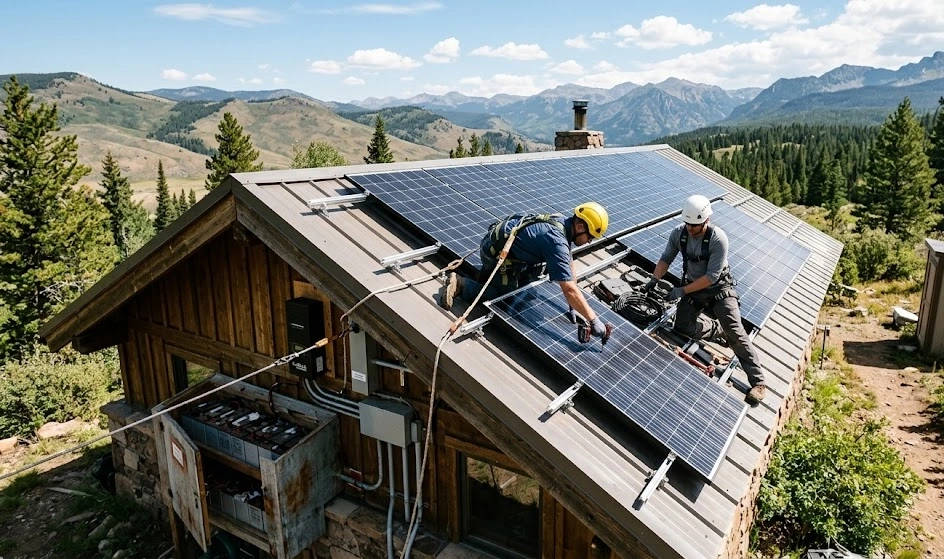
Do Off-Grid Solar Systems Work During Cloudy Days or Winter?
This is easily the most common question we hear from homeowners looking into renewable energy solutions. US weather has a mind of its own. We get humid, blazing summers and gray, biting winters. So, what happens when the sun decides to hide behind thick storm clouds for three days straight?
The short answer: Yes, your system will absolutely still work.
The detailed answer: Off grid solar systems don’t stop working just because there are clouds. Solar panels are highly sensitive to ultraviolet light, which effortlessly pierces through cloud cover. Even on a completely overcast afternoon in Richmond or the Shenandoah Valley, your panels are still generating roughly 10% to 25% of their normal capacity.
However, you don’t rely on real-time panel generation during a winter storm. You rely on your battery bank.
This is exactly why proper sizing is non-negotiable. When we design home energy systems for off-grid living, we don’t size them for a sunny day in June. We size them for a terrible, dreary week in January.
- The Winter Strategy: During shorter winter days, the sun sits lower in the sky. To counter this, off-grid arrays are often installed at steeper angles to catch the winter sun directly and shed snow rapidly.
- The Battery Buffer: Your massive bank of solar battery storage Virginia locals need is designed to hold enough reserve power to carry your home through those sunless stretches.
- The Ultimate Backup: For true off-grid resilience, practically every robust system includes a backup generator (usually propane or diesel). If a freak blizzard blocks out the sun for an entire week and depletes your batteries, the generator automatically kicks in, powers the house, and recharges the batteries simultaneously. You won’t even notice the flicker.
Don’t let a few cloudy days scare you away from energy independence. With the right engineering and premium storage, your home will stay lit, warm, and comfortable no matter what the sky is doing outside.
The Lifespan of Solar Batteries
This is where technology has made mind-blowing leaps over the last five years. In the old days of off-grid living, homeowners had to babysit massive, toxic lead-acid batteries that needed constant maintenance and died after 5 to 7 years. Those days are over!
Today’s off-grid systems run on advanced Lithium Iron Phosphate (LiFePO4) or Lithium Nickel Manganese Cobalt (NMC) chemistries, like the technology found in the Tesla Powerwall 3.
- Modern Lithium Solar Batteries: You can safely expect a lifespan of 10 to 15 years from top-tier lithium battery banks.
- Cycle Life: Instead of just measuring by years, battery life is measured in “cycles” (one full discharge and recharge). Premium lithium batteries are rated for 6,000 to 10,000+ cycles. Even if you cycle them heavily every single day, they will comfortably cross the decade mark.
When you factor in our lifetime insurance partnership through Align Solar Protection, the anxiety of replacing expensive components completely vanishes. We aren’t just selling you hardware; we are engineering a permanent solution for your property.
How To Calculate The Size Of Off-Grid Solar System For Your Home
If you want a quick, one-size-fits-all answer to this question, you are looking in the wrong place. Guessing the size of off grid solar systems is a recipe for sitting in the dark, shivering in mid-January.
When you are completely disconnected from the utility grid, your system must perfectly match your specific lifestyle. You cannot rely on neighborhood averages. A family of four running central air conditioning, two refrigerators, and a well pump requires a vastly different setup than a retired couple living in an ultra-efficient, passive-solar cabin.
Sizing your system boils down to a precise, non-negotiable process called a “Load Audit.” Here is how we break down the heavy lifting:
1. Calculating Your Daily Energy Consumption (kWh)
Everything you plug in consumes watt-hours. To build reliable home energy systems, we first have to calculate exactly how much energy you burn in a 24-hour period. We look at every single appliance, figure out its wattage, and multiply that by how many hours it runs daily.
| Common Household Appliance | Average Power Draw (Watts) | Estimated Daily Usage | Daily Energy Need |
| LED Lighting (Whole House) | 150W | 6 Hours | 0.9 kWh |
| Modern Refrigerator | 400W | 8 Hours (cycles) | 3.2 kWh |
| Well Pump | 1,500W | 1 Hour | 1.5 kWh |
| Electric Oven | 2,500W | 1 Hour | 2.5 kWh |
| Central Air Conditioning | 3,500W | 5 Hours | 17.5 kWh |
Add it all up, and you might find your home needs 30 kWh per day. That number dictates the bare minimum size of the solar panels system needed to recharge your batteries every single day.
2. The “Peak Load” (Inverter Sizing)
Here is a mistake we see constantly: people buy enough panels and batteries, but they completely ignore the peak load. Your peak load is the maximum amount of power you draw at one exact second.
Imagine it is a hot July afternoon. Your central AC kicks on. At that exact same moment, someone turns on the microwave, and the well pump surges to push water to the kitchen sink. That massive, sudden demand for electricity all runs through your solar inverter.
If your inverter isn’t rated to handle that sudden 8,000-watt spike, the entire system trips and shuts down to protect itself. Sizing the inverter correctly is the difference between a seamless life and a frustrating one.
3. Planning for Days of Autonomy (Battery Sizing)
How many days do you want your house to run perfectly normally if the sun never comes out? Most off-grid homeowners shoot for two to three days of autonomy. If your home uses 30 kWh a day, you need roughly 90 kWh of usable energy storage systems to comfortably weather a multi-day storm without immediately relying on a gas generator.
Does this math feel overwhelming? It absolutely can be. That is exactly why we refuse to let our clients guess. We pair this with a comprehensive free site inspection to measure your roof pitch, solar exposure, and shading. You get hard data, zero guesswork, and a system custom-tailored to your actual life.
Why 2026 is the Year for Energy Independence
Across the United States, the net metering policy changes are evolving rapidly. Utilities are shifting from 1:1 retail credits to “Net Billing” models (most notably California’s NEM 3.0), which can slash the value of the energy you send back to the grid by 75% or more.
What this means for your wallet:
- Lower Buyback Rates: Many states (including CA, AZ, and potentially PA) now pay only wholesale rates (roughly 5–8 cents) for your solar, while charging you full price for theirs.
- Longer Payback Periods: Without a battery, the time it takes for your system to pay for itself is stretching from 6 years to 12+.
- The Off-Grid Advantage: By going off-grid, you bypass these policy games entirely. You aren’t “selling” your power to a utility at a loss; you are storing it and using it yourself.
In 2026, the strategy has shifted from “selling to the grid” to “owning the grid.” Off-grid solar systems are no longer just for remote cabins but a savvy financial shield against a volatile energy market.
Book Your Free Consultation Now
Is an Off-Grid Solar System Worth It in The US?
This is the ultimate, bottom-line question. You are looking at a massive upfront investment, so you need to know if taking the leap into off-grid living actually makes financial and practical sense in the Commonwealth.
The honest answer? It depends entirely on your specific property location and your long-term goals. Let’s look at the two most common scenarios where pulling the plug on the utility company is wildly worth it.
Scenario A: The Rural Build
Virginia is famous for its stunning, secluded properties. If you are building a new home on a remote piece of land, going off-grid isn’t just worth it; it is often the cheapest option.
Utility companies charge a fortune to run new power lines. If your build site is half a mile off the main road, the local power company might quote you $30,000 to $50,000 just to trench lines to your property. Why hand fifty grand to a utility company just to earn the privilege of paying them a monthly electric bill forever?
In rural builds, taking that trenching money and investing it directly into robust solar power off the grid systems is a total financial no-brainer.
Scenario B: The Suburban Grid-Defector
If you already live in a suburban neighborhood with existing power lines, the math changes. You aren’t saving on trenching costs. However, you are buying total immunity.
The aging power grid of the US takes a beating from summer hurricanes, severe thunderstorms, and winter ice storms. For many homeowners, the financial worth isn’t just calculated in skipped utility bills. It is calculated in peace of mind. It’s all about knowing that when the rest of the neighborhood goes dark for three days, your food doesn’t spoil, your pipes don’t freeze, and your lights stay on. You are immune to grid failures, and completely insulated against the utility company’s annual rate hikes.
Off-Grid Solar System Maintenance
While renewable energy solutions are incredibly low maintenance compared to running a diesel generator 24/7, an off-grid home is an active power plant. It requires a baseline level of respect and upkeep to run at peak efficiency.
Here is what your actual maintenance schedule looks like:
● Solar Panels
Surprisingly, panels require almost zero work. In Virginia, frequent spring and summer rains naturally wash away most dust and pollen. If you experience a massive dry spell, a quick spray with a garden hose (from the ground) does the trick. During heavy winter snows, the steep angle of most off-grid arrays allows snow to slide right off as soon as the sun hits the dark glass.
● The Battery Bank
This used to be a nightmare of checking water levels in lead-acid batteries. Today? It is effortless. Because we are on board as a certified Tesla installer, you are utilizing the Tesla Powerwall. These units are entirely sealed, liquid-cooled, and actively manage their own internal temperatures. Your only “maintenance” is opening the app on your phone to check their charge status.
● The Inverter
Electronics hate dust and heat. You will want to ensure your inverter is installed in a cool, dry place (like a basement or garage) and simply wipe away any accumulated dust from its cooling vents a few times a year.
● The Backup Generator
If your system includes a backup generator for extreme weather, this will be your highest maintenance item. It requires regular oil changes, filter replacements, and fuel stabilizer treatments just like a car engine.
Let Us Expand Your Off Grid Solar System Without Hassle
Life changes and families grow. You might decide to build a massive heated workshop in the backyard, install a swimming pool, or finally purchase that electric vehicle you have been eyeing. When your lifestyle expands, your electricity demand skyrockets.
So, are you trapped by the size of the off grid solar power systems you bought on day one? Absolutely not!
A professionally engineered off-grid system is highly modular, meaning it is specifically designed to grow alongside you. However, there is a catch. Expansion is only easy if the original system architecture was designed with the future in mind.
Expanding Your Battery Storage
This is the easiest upgrade by far. If you realize you are draining your batteries too fast during the winter, you can simply add more storage. The Tesla Powerwall ecosystem is brilliant for this. Up to 10 Powerwalls can be stacked and linked together. If you need more juice down the road, we simply mount another unit, connect the cables, and your storage capacity instantly jumps.
Expanding Your Solar Array
Adding more panels to your roof or ground mount is slightly more complex, but totally doable. The bottleneck here is usually the charge controller and the inverter. If your original inverter is maxed out, it cannot process the power from new panels.
This is why forward-thinking design is critical. During our initial design phase, we always ask our clients: “What does your life look like in five years?”
If you know you are buying an EV in three years, we might install a larger inverter today, leaving plenty of headroom. When you are ready for more power, we just choose the best EV charger, bolt the new panels to the roof and plug them into the existing system.
Commonly Asked Questions
1. Is it illegal to live completely off the grid in a Virginia residential neighborhood?
It is not illegal statewide, but strict county zoning laws and Homeowner Association rules often require homes to maintain a physical connection to the municipal utility grid to safely secure an official certificate of occupancy.
2. Can an off-grid solar setup really charge an electric vehicle (EV) every day?
Yes, off-grid systems can easily charge electric vehicles if intentionally scaled for it. You must install a significantly larger solar panel array and expand battery storage to comfortably handle that massive daily energy draw.
3. Do off-grid solar systems increase property taxes in Virginia?
Generally, no. Most Virginia cities and counties offer specific local property tax exemptions for certified solar energy equipment. Your off-grid setup dramatically increases your overall property value without aggressively inflating your annual property taxes.
4. How loud are the backup generators used in winter off-grid systems?
Modern backup inverter generators are surprisingly quiet, running between fifty and sixty-five decibels safely. Enclosed in acoustically dampened housing and placed strategically away from bedrooms, they emit only a low, steady hum during operation.
5. Can I permanently disconnect my meter from the local Virginia utility company?
Yes, if local building codes allow it, you can legally have the utility completely remove their lines. Ensure your battery storage and backup generator systems are completely flawless before making this permanent change.
6. What happens if my off-grid solar inverter overloads from too many appliances?
If you simultaneously run heavy appliances and overload the inverter’s capacity, the system trips a built-in safety breaker to protect internal electronics. Simply flip the breaker back on to quickly restore your home’s power.
7. Do I still need county building permits for a remote, fully off-grid cabin?
Remote off-grid solar panel installations must still pass strict county electrical and structural inspections. The National Electrical Code strictly dictates proper battery venting, wire gauging, and grounding to prevent dangerous electrical house fires.
The Bottom Line
Stop throwing money at a utility company for electricity you could be owning outright. It’s time to take the power back, literally! We refuse to use guesswork when your comfort is on the line. Book one of our multiple free consultation sessions right now, and we’ll throw in a free site inspection to map your exact energy needs.
Because we are a Tesla Powerwall certified installer, you’re getting the absolute best tech on the planet. Better yet? Our exclusive partnership with Align Solar Protection guarantees you lifetime insurance on your entire setup. Let’s build your personal power plant. Call us today.