
How Much Do Solar Panels Actually Cost in Texas in 2026, and What Should You Watch Out For?
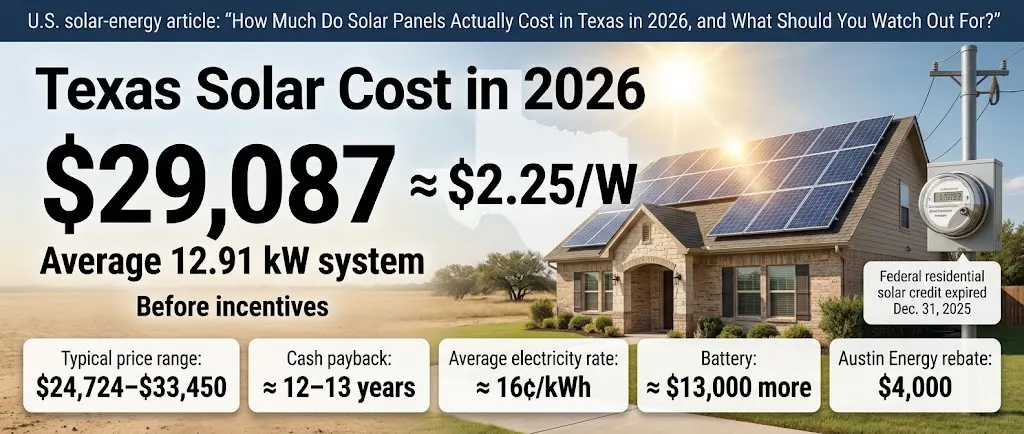
| In 2026, a standard 12.91 kW solar setup in Texas averages $29,087, or about $2.25 per watt, before applying any incentives. |
If you have ever opened a Texas power bill in August, you know why this question keeps coming up. The heat pushes air conditioners hard, and the bill follows. Solar looks like a way out, yet online prices rarely match.
This guide explains what Texas homeowners really pay in 2026 and why the numbers disagree. It also shows how buyback plans, batteries, and the expired federal credit change the math.
Texas Solar at a Glance (2026)
| Item | Typical figure |
| Average system cost | $29,087 for 12.91 kW (about $2.25 per watt) |
| Typical price range | $24,724 to $33,450 |
| Federal residential credit | Expired December 31, 2025 |
| Cash payback | About 12 to 13 years |
| Average Texas electricity rate | About 16 cents per kWh |
| Adding a battery | Roughly $13,000 more |
| Notable utility rebate | Austin Energy, $4,000 |
How Much Do Solar Panels Cost in Texas in 2026?
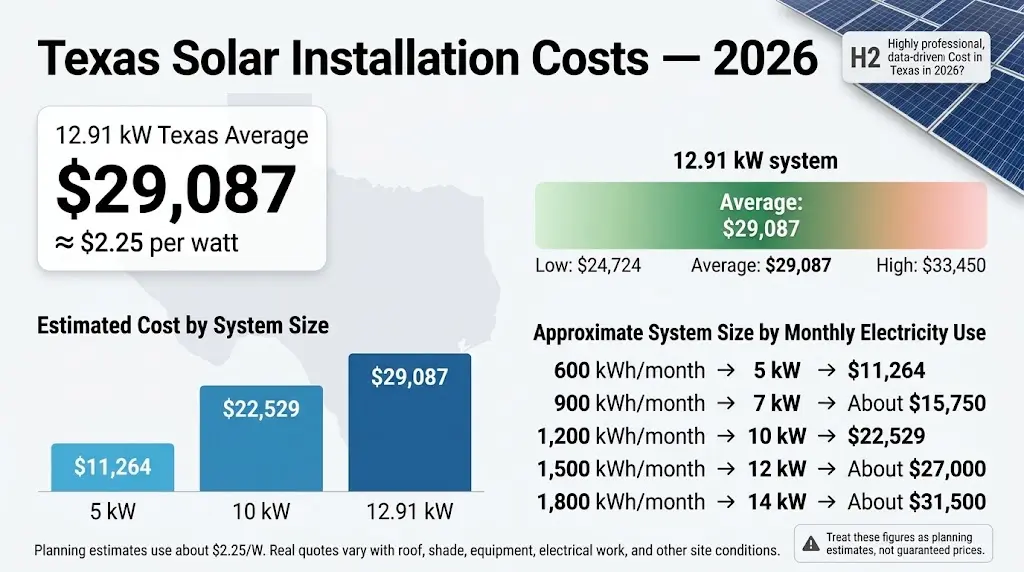
September 2026 marketplace data puts the full range for a 12.91 kW system at $24,724 to $33,450. A quote near the low end is a good price, and a quote above the high end deserves hard questions. Smaller homes cost less, and the same data estimates these totals:
| System size | Estimated cost before incentives |
| 5 kW | $11,264 |
| 10 kW | $22,529 |
| 12.91 kW (Texas average) | $29,087 |
These figures scale evenly, but real small systems usually cost more per watt because fixed costs stay the same. So treat the table as a starting line, not a promise. To judge any quote, though, you need to know where the money goes.
What Are You Actually Paying For?
Panels are one of the smaller lines on your quote. Based on NREL cost benchmarks, hardware makes up a bit under half of a typical residential project, and soft costs make up the rest.
| Cost category | Approximate share of total |
| Solar panels | 12% to 13% |
| Inverter, racking, wiring, and other hardware | About 33% |
| Labor, permits, interconnection, sales and marketing, overhead, and profit | About 55% |
Sales and marketing alone can take about 18%, which helps explain why two quotes for the same equipment can differ by thousands of dollars. Even free panels would trim your total by only about an eighth. So the first big lever is system size, which starts with how much power you use.
How Big a System Does Your Home Need?
System size follows your electricity use, not your square footage. Many Texas homes use roughly 1,100 to 1,300 kWh a month, and in most of the state, 1 kW of panels produces about 1,500 kWh a year. Divide your yearly usage by 1,500 for a rough estimate of size.
| Monthly use | Approximate system size | Approximate cost before incentives |
| 600 kWh | 5 kW | $11,264 |
| 900 kWh | 7 kW | About $15,750 |
| 1,200 kWh | 10 kW | $22,529 |
| 1,500 kWh | 12 kW | About $27,000 |
| 1,800 kWh | 14 kW | About $31,500 |
These are planning estimates at about $2.25 per watt, and shade, roof direction, and roof space will change them. The 12.91 kW Texas average is suitable for a home that uses about 1,600 kWh per month. You need not cover 100% of your use, since exported power often earns less than the retail rate. Size is only part of the story, though, because other choices move the price too.
What Changes the Price of a Solar System?
Beyond size, a handful of choices push your quote up or down.
| Factor | How it affects cost |
| Panel type | Modules alone run roughly $0.25 to $0.40 per watt for budget panels and $0.65 to $0.95 for premium ones, a gap worth several thousand dollars on a large system. |
| Roof type and pitch | Tile roofs need special hardware and more labor. Steep or multi-story roofs add safety gear and time. |
| Ground mount | Usually costs more than a roof mount, but it can rescue a shaded or cramped roof. |
| Inverter type | String inverters cost less upfront. Microinverters cost more but often carry longer warranties and handle shade better. |
| Main panel upgrade | Often adds $2,500 to $4,500 if your electrical panel is too small or too old. |
| Shading and roof direction | These change production more than price, so they result in a longer payback period. Some incentives also take roof direction into account. |
Note: Ask every installer whether your home needs a panel upgrade before you sign. That one answer can move your total by thousands.
Why Do Texas Solar Prices Look So Different from Site to Site?
With so many moving parts, websites disagree. Sites measure different things, including system size, quoted versus installed prices, and whether the expired federal credit is baked in.
System size is the first culprit, since one major marketplace uses 12.91 kW, a consumer guide uses 12.78 kW, and some installers publish 14 kW examples. Price type is the second. Marketplace quotes average about $2.58 per watt nationally, while Lawrence Berkeley National Laboratory’s installed-price data shows a cash median near $3.50. Loan quotes can look even higher, since dealer fees are often hidden within the contract price. Beyond these factors, your address also plays a part.
Does Solar Cost Change from One Texas City to Another?
Only slightly on paper, since 2026 estimates for a 5 kW system remain around $850 across seven major cities.
| City | Estimated cost (5 kW system) |
| Houston | $11,250 |
| Dallas | $11,350 |
| Austin | $11,250 |
| San Antonio | $11,000 |
| Fort Worth | About $11,200 |
| El Paso | $11,501 |
| Corpus Christi | $10,668 |
The real differences sit elsewhere. Your utility territory, whether Oncor, CenterPoint, AEP Texas, Austin Energy, or CPS Energy, shapes rebates and interconnection timelines. Permitting speed and buyback plans vary too. Still, local gaps are small next to the market and policy shifts that hit every Texas buyer this year, starting with prices themselves.
Are Solar Prices Going Up or Down in 2026?
Both, depending on the part of the system. Nationally, residential solar system prices slipped about 1.4% over the past year to $3.36 per watt in the second quarter of 2026, according to SEIA and Wood Mackenzie. That figure runs higher than the Texas average of $2.25 because the two measure different things. Module prices fell about 16% to $0.37 per watt after earlier import tariffs were invalidated, though higher logistics costs and metal tariffs offset some of that relief.
A new tariff is next. A proclamation signed August 6, 2026 adds a 15% tariff plus minimum import prices on polysilicon, wafers, cells, and modules, effective December 4, 2026. Panels are only about an eighth of your total cost, so the effect on a finished system should be modest, but it should go up. Still, the bigger change this year is the loss of the federal credit.
What Happened to the Federal Solar Tax Credit in 2026?
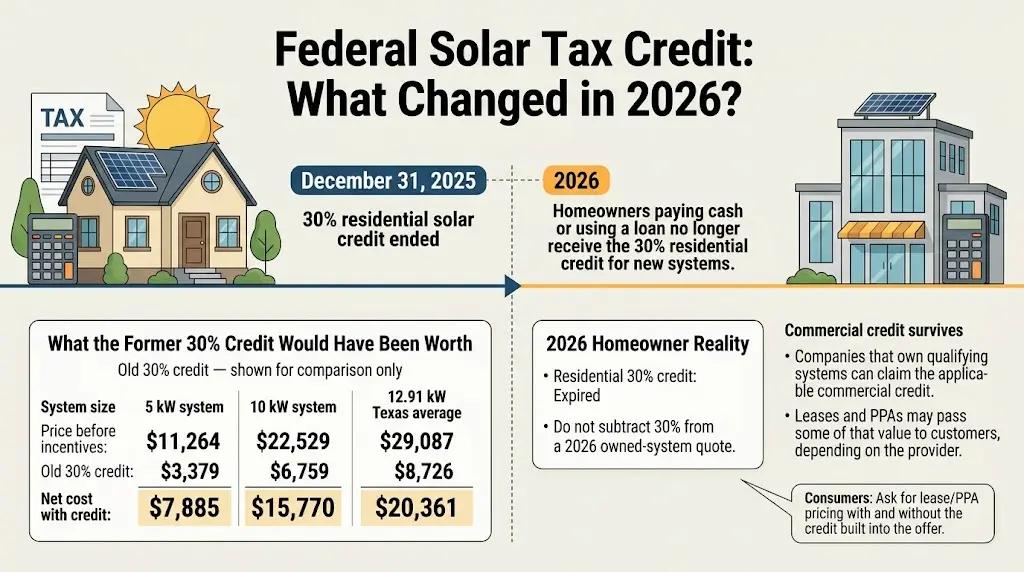
The 30% residential credit ended on December 31, 2025, so homeowners who pay with cash or a loan no longer receive it. Many older articles still tell you to subtract 30% from your quote, and that advice is now wrong for most owned systems installed in 2026. Systems placed in service in 2025 can still claim the credit on a 2025 tax return. Here is what the credit would have been worth:
| System | Price before incentives | Old 30% credit | Net cost with credit |
| 5 kW | $11,264 | $3,379 | $7,885 |
| 10 kW | $22,529 | $6,759 | $15,770 |
| 12.91 kW (Texas average) | $29,087 | $8,726 | $20,361 |
A separate commercial credit survives, though, and companies that own a system can claim it. Leases, power purchase agreements (PPAs), and prepaid leases can therefore pass some of that value to you, but only if the provider actually passes the savings along.
Pro tip: Ask any lease or PPA provider for its rate with and without the credit built in. The gap shows what you really receive, and it is why how you pay matters more than it used to.
Should You Pay Cash, Take a Loan, or Lease Solar in Texas?
Paying cash or prepaying a lease saves the most, according to current Texas data, while a standard loan or lease saves very little. First, a quick guide to the terms. With a lease or PPA, the company owns the system.
- Cash: You pay the full price upfront and own the system.
- Loan: You borrow to buy and own the system, and dealer fees may be built in.
- Standard lease: You rent the system for a fixed monthly amount.
- PPA: You pay a set rate per kWh the system produces.
- Prepaid lease: You pay one large sum upfront and skip monthly payments.
Here is how September 2026 Texas estimates compare for the average system:
| Option | Cost | 25-year savings |
| Cash | $29,087 upfront | $36,983 |
| Prepaid lease | About $26,000 upfront | $45,389 |
| PPA | About $162 per month | $17,372 |
| Loan | About $240 per month | $2,371 |
| Standard lease | About $163 per month | -$4,825 |
These numbers rest on assumptions that are not fully published, and sources disagree on whether cash or a prepaid lease wins, so ask installers to model both with your own bills. Whichever route you pick, your savings still hinge on what electricity costs and what your provider pays for extra power.
What Does Electricity Cost in Texas Right Now?
Texas homes paid about 16 cents per kWh in mid-2026 (15.94 cents in June), roughly 13% below the U.S. average of 18.34 cents, according to EIA data. Rates rose about 6% year over year as of May, and the average monthly bill ranges from roughly $180 to $235, depending on season and source.
That rate is what solar competes against. Every kWh your panels make and you use yourself replaces a 16-cent purchase, while a kWh you export may earn only 6 to 12 cents. If rates keep climbing, each kWh your system makes becomes worth more. That export gap is where buyback plans come in.
How Does Solar Buyback Work in Texas?
Texas has no statewide net metering, so your retail electric provider decides what it pays for the power you export. Some plans credit exports at the retail rate, but many pay less, and rates, fees, and rollover rules can change when your plan renews. Typical offers run about $0.06 to $0.12 per kilowatt-hour.
That gap is bigger than it sounds. Imagine you export 4,000 kWh in a year: at $0.06 per kWh, you earn $240, and at $0.12 per kWh, you earn $480. This is only an illustration, yet it shows why plan choice matters. The setup exists because the Electric Reliability Council of Texas (ERCOT) serves about 90% of the state’s load, and most homes shop for a provider.
How Long Does It Take for Solar to Pay Off in Texas?
Expect roughly 12 to 13 years for a cash purchase at average prices, although some Dallas-Fort Worth installers report 6 to 12 years. Current estimates show a 12.92-year payback and $36,983 in net savings over 25 years. The spread is driven by bill size, system size, buyback rate, and financing costs.
Your bill sets the stakes. At about $234 a month, the high end of the range above, the average Texas bill adds up to roughly $87,300 over 25 years with inflation. Solar rarely erases that bill completely, though. One Texas homeowner reports paying only a $26 grid connection fee, while others report reductions of 70% to 90%.
Want Your Exact Solar Cost Instead of Averages?
NEDES designs solar systems for Texas homes and models your savings using your real bills and roof. Request your free Texas solar quote and compare cash, loan, and lease options side by side!
What Costs Come After Solar Installation?
After a solar installation in Texas, payback calculations also have to account for your expenses. Solar is low-maintenance, but not zero-cost.
| Cost | Typical amount | Notes |
| String inverter replacement | Roughly $800 to $3,000 installed | Often needed once, around years 10 to 15 |
| Microinverter replacement | About $150 to $450 per unit | Many carry 25-year warranties |
| Panel cleaning | About $150 to $350 per visit | Once or twice a year in dusty areas |
| Monitoring | Often included | Ask if your installer charges |
Budget roughly $1,000 to $3,000 for one inverter swap, and check your warranty first, since string inverters commonly carry 10 to 12 years of coverage. Ask every installer whether their 25-year savings estimate includes these costs. Maintenance is manageable, but many Texans care more about keeping the lights on during an outage.
Do You Need a Solar Battery in Texas?
A battery is worth it if outages worry you more than payback, and it usually adds $10,000 or more. Texans remember Winter Storm Uri in 2021, and Houston residents regularly deal with storm-related outages. A University of Houston energy economist notes that backup power carries real value for medical equipment. Still, one or two batteries rarely power an entire all-electric home for days.
Prices vary widely by source. Guides list $10,000 to $13,000 for a 13.5 kWh unit, or $7,000 to $18,000 more broadly, and DFW quotes range from $15,000 to $25,000 per battery. Brand, capacity, and installation explain most of the gap. September 2026 marketplace data puts a typical 13 kWh battery near $13,000, or about $1,000 per kWh, with a range of $11,050 to $14,950. Here is what that does to your total:
| Package | Estimated cost before incentives |
| Solar only (12.91 kW) | $29,087 |
| One 13 kWh battery | About $13,000 |
| Solar plus battery | About $42,100 (range about $40,100 to $44,000) |
Some utility programs, like Oncor’s, pay incentives only when a battery is included, so the real gap can be smaller in those areas. That makes it worth checking what programs could lower your total.
What Texas Incentives Can Lower Your Solar Cost?
Texas has no state solar tax credit or income tax, but property tax relief and some utility programs can still trim your cost. Texas Tax Code Section 11.27 exempts the added value of a home from solar for property tax purposes. Utility programs differ a lot, so here is where three major utilities stood in September 2026:
| Utility | Residential solar incentive |
| Austin Energy | $4,000 rebate (up from $2,500 on July 1, 2026) for systems over 3 kW from a participating contractor, plus 9.91 cents per kWh for the energy your system produces. Apply before installing. |
| Oncor (Take A Load Off Texas) | Paid to participating installers when solar is paired with a battery. The amount depends on system size, roof direction, and other factors. Typically runs February through November. |
| CPS Energy (San Antonio) | No residential solar rebates are currently offered. |
Some installers advertise Oncor incentives as high as $9,000 for larger systems, but Oncor does not publish a flat amount. Funding and rules change often, so confirm with your utility and the DSIRE database before you sign.
What Texas-Specific Risks Should You Plan For?
Hail, roof age, HOA approvals, and insurance changes cause most surprises in Texas, and each one is easy to plan for.
- Hail can damage panels, but homeowners insurance often covers the repair, so check your deductible first.
- Roof age matters just as much, since an aging roof should be replaced before installation, or you will pay to remove and reinstall the array.
- HOAs are less scary than they sound, because Texas law prevents them from blocking solar outright, though approvals can add weeks.
- Insurance can shift too, since some carriers raise premiums after installation.
With these risks mapped, you can finally judge whether the investment makes sense.
Is Solar Worth It in Texas?
Yes, for most homeowners with sunny roofs, high bills, and plans to stay for years, but not for everyone. Texas gets about 5.5 to 6.5 peak sun hours per day, depending on location. That sunshine offsets weaker incentives and lower rates than the Northeast. Solar tends to be a good fit when you own your home, your roof faces open sky, and your usage is high.
It fits poorly if your roof is heavily shaded, you plan to move soon, or your usage is very low. In those cases, an honest installer will tell you to wait. If solar fits, your next task is to choose the right quote.
How Do You Check a Solar Quote in Texas?
Compare three or four quotes on price per watt, expected production, equipment models, warranties, and financing fees, and do not choose on price alone. Red flags include no production estimate, pressure to sign fast, and undisclosed dealer fees. The Texas Department of Licensing and Regulation also publishes a consumer protection guide.
This is where NEDES fits for Texas homeowners. The company is a highly rated, independently verified solar installer that designs each system around your actual roof, your real electric bills, and your Texas utility. NEDES uses premium equipment and can model cash, loan, and lease options side by side before you commit. Our engineers also design every layout to stay battery-compatible, so you can add storage later without redoing the system.
Ready to See What Solar Would Cost for Your Texas Home?
Start with a free quote from NEDES, built around your roof, your bills, and your Texas utility!
What Else Do Texas Homeowners Ask About Going Solar?
Can I get free solar panels in Texas?
Not truly free. “Free” offers often hide costs, but you can lease or use a PPA with little or no money down.
Can I install solar panels myself in Texas?
It is possible but risky. The work is difficult and dangerous on a large system, and professional installation keeps warranties and permits simpler.
How many panels does a typical Texas home need?
Most homes need roughly 30 to 35 panels, and a 14 kW system uses about 35. Your number depends on annual kWh, roof space, and panel wattage.
How long do solar panels last in Texas?
Quality panels typically last 25 to 30 years and protect you from rising utility rates for decades. Inverters may need replacing sooner, so ask about that warranty too.
Should I wait for solar prices to fall?
Waiting is a gamble that has not clearly paid off. National residential prices were nearly flat over the past year, and a new 15% tariff on imported modules and cells takes effect on December 4, 2026. Panels are only about an eighth of your cost, so module swings barely move your quote, while every month of delay means another full utility bill.
Will my solar panels work during a blackout without a battery?
Usually no. Most grid-tied systems shut off during an outage to protect utility workers. A battery with proper backup wiring keeps your home running.
How much can I save on my electric bill with solar in Texas?
It depends on your bill, system size, and buyback plan. Many homeowners report 70% to 90% reductions, and some pay little more than a grid connection fee.
Does solar increase my home’s value in Texas?
Owned systems tend to add value when you sell, while leased systems pass their contract to the buyer. Texas Tax Code Section 11.27 also exempts the added value from property taxes.
Do I need a new roof before installing solar panels?
If your roof is near the end of its life, yes, replace it first, or you will pay to remove and reinstall the array later. Ask your installer to inspect the roof before you sign.
Can my HOA stop me from installing solar panels in Texas?
Not outright, because Texas law prevents HOAs from completely blocking solar. Approvals can still add weeks, so read your HOA rules and apply early.