
Virginia Solar Incentives and Net Metering in 2026: The Complete Guide
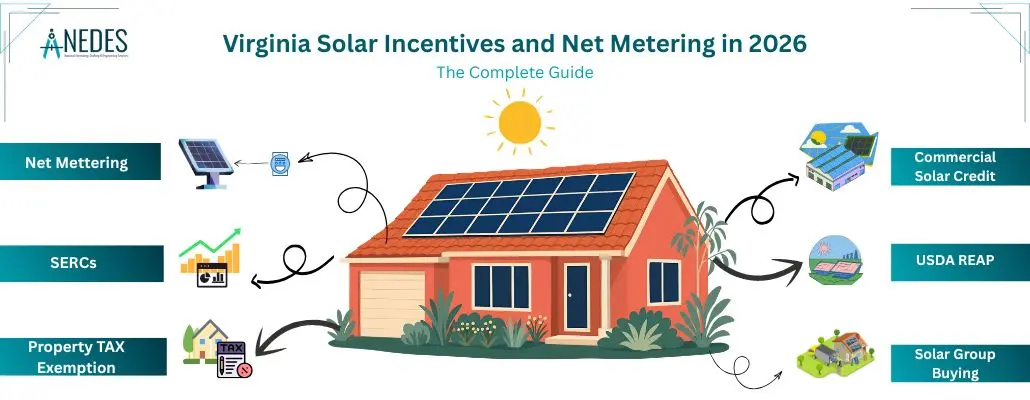
Additionally, Virginia’s Clean Economy Act and a series of 2026 State Corporation Commission rulings protected the Commonwealth’s most valuable solar incentive, full retail-rate net metering, for both Dominion Energy and Appalachian Power customers.
This guide breaks down every incentive currently active in Virginia, what changed in 2026, and how each program affects the return on a residential, commercial, or agricultural solar installation.
A Quick Look At The Incentives Stack
Here is every program covered in this guide, organized by who administers it and where it stands heading into the rest of 2026.
| Incentive | Level | Approximate Value | 2026 Status |
|---|---|---|---|
| Net metering | State / utility | Full retail rate (~$0.14/kWh, Dominion) | Preserved; NEM 2.0 finalized April 30, 2026 |
| SRECs | State market | $22.50 to $33 per credit | Active; demand rising under new 4.5% RPS |
| Property tax exemption | Local, mandatory for ≤25 kW | 100% of assessed system value | Active statewide |
| Federal residential credit (25D) | Federal | 30% of system cost | Expired December 31, 2025 |
| Federal commercial/lease credit (48E) | Federal | 30% of system cost | Active through December 31, 2027 |
| USDA REAP grant | Federal | Up to 50% of project cost | Active for rural small businesses and farms |
| C-PACE financing | State / local | Up to 100% of project cost | Active in 21+ localities |
| Switch Together | State | Group-negotiated pricing | Open through October 15, 2026 |
| Dominion EV Charger Rewards | Utility | $125 enrollment + $40/year | Active |
| Shared / community solar | Utility | Bill-credit subscription | Expanding; low-income minimum-bill waiver |
Net Metering in Virginia
Net metering is a billing arrangement that credits solar owners for excess electricity sent back to the grid at the same retail rate they pay for power drawn from it.
Solar panels rarely produce exactly what a home consumes at every hour of the day. A system reaches peak output at midday, while a household’s heaviest demand typically falls in the morning and evening. Net metering closes that gap. Under Virginia law, Dominion Energy and Appalachian Power Company must offer net metering to eligible residential and commercial customers who install a qualifying renewable energy system, and excess generation earns a credit that offsets future consumption.
Caps, Credit Rates, and the 12-Month Banking Cycle
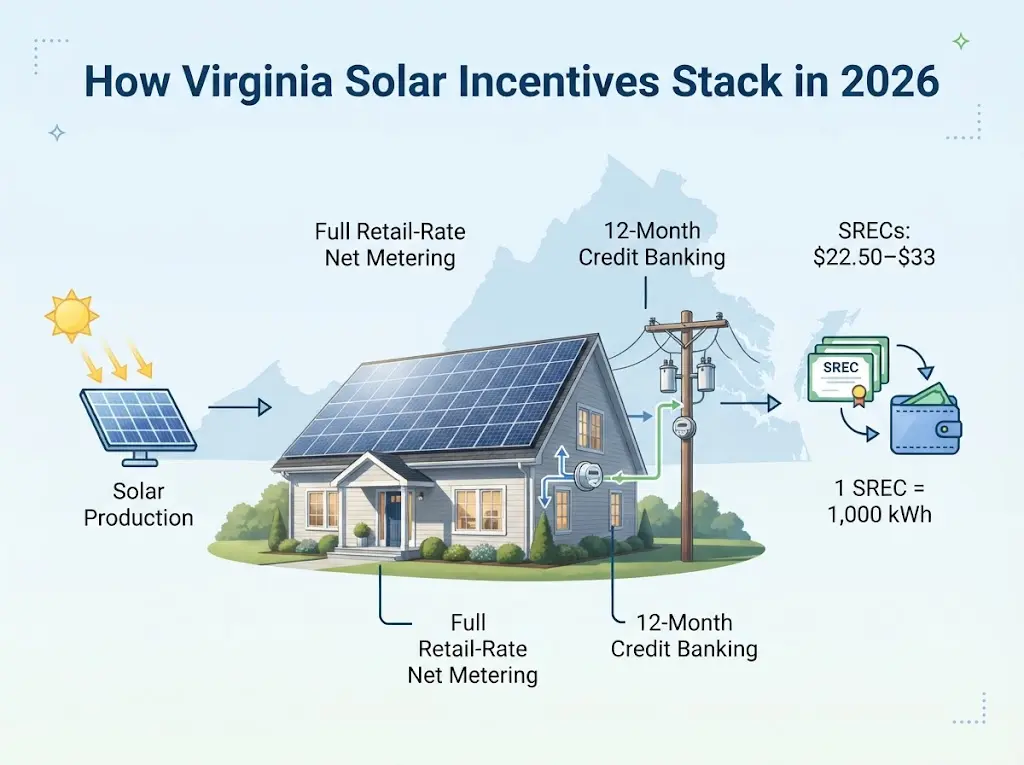
Virginia banks net metering credits over a 12-month cycle, so a surplus generated in June can cover a shortfall in December. A handful of program rules shape how much value a homeowner or business can actually capture:
- Residential systems are capped at 20 kW, and non-residential systems are capped at 100 kW, under the state’s net metering rules (EnergySage).
- Dominion Energy’s current retail credit rate runs close to $0.14 per kilowatt-hour.
- Appalachian Power applies a comparable full retail-rate credit within its own service territory.
- The aggregate net metering program is capped at 6% of each utility’s prior-year peak load.
- 1% of that capacity is reserved specifically for income-qualified customers under the Virginia Clean Economy Act.
The 2026 Ruling That Kept Full Retail-Rate Net Metering Alive
The Virginia State Corporation Commission ruled on April 30, 2026 that Dominion Energy customers keep full retail-rate net metering credits, rejecting a utility proposal that would have cut compensation by roughly 32%.
What Dominion Energy Proposed
Dominion Energy had petitioned the Commission to replace the current program with a new tariff, referred to as NEM 2.0, that would have dropped the export credit from about $0.14 per kilowatt-hour to roughly $0.0955 per kilowatt-hour. Solar United Neighbors and more than 1,300 public commenters opposed the proposal during the docket, and over fifty residents testified in person against it.
What the Commission Actually Decided
Appalachian Power attempted a similar reduction the year before, and the Commission rejected that plan too, keeping the utility’s 6% aggregate cap intact. The final Dominion order:
- Keeps the full retail-rate export credit in place rather than adopting the reduced NEM 2.0 rate.
- Leaves the 12-month netting period untouched.
- Adds an extra penny per kilowatt-hour to the annual net-excess-generation payout, reflecting the value solar exports provide.
- Grandfathers homeowners who interconnected under the prior rules, so they keep those terms going forward.
This ruling matters because a full retail-rate credit lets a well-sized system offset most of a household’s annual electric bill, not only the portion consumed at the exact moment of generation.
Book Your Free 15-min Consultation With Virginia Certified Solar Experts
Ready to see how net metering pencils out for your roof? Book a free 15-minute consultation with a NEDES energy advisor to review your utility rate, roof orientation, and ideal system size before you sign anything.
Dominion Energy vs. Appalachian Power: Why Your Utility Territory Matters
Dominion Energy serves most of Virginia, including Richmond, Hampton Roads, and Northern Virginia, while Appalachian Power serves far southwestern Virginia, including Roanoke, and each utility runs a separately regulated net metering tariff.
Dominion Energy Territory
Dominion Energy is Virginia’s largest utility and has moved further into utility-scale solar ownership than Appalachian Power. NEDES designs systems around Dominion’s rate structure and interconnection process in cities such as:
- Richmond
- Virginia Beach
- Newport News
- Suffolk
- Alexandria
- Hampton
- Arlington
Appalachian Power Territory
Appalachian Power’s own 2025 attempt to reduce its net metering cap and export credit was rejected by the State Corporation Commission as well, preserving full retail-rate crediting for its customers. NEDES builds systems for Roanoke and the surrounding Appalachian Power footprint using that utility’s own interconnection rules.
Electric Cooperatives Play by Their Own Rules
Homeowners served by an electric cooperative, including BARC Electric, Rappahannock Electric, Northern Neck Electric, and A&N Electric, follow separate net metering and community solar rules set by each cooperative’s own board rather than by the Commission directly.
Two homes with nearly identical roofs can see different net metering economics simply because they sit on opposite sides of a utility service boundary, which is why a Virginia-specific site assessment matters more than a generic online estimate.
Solar Renewable Energy Credits
A Solar Renewable Energy Certificate, or SREC, is a tradable credit earned for every 1,000 kilowatt-hours a solar system produces, and Virginia SRECs currently sell for about $22.50 to $33 each.
The Virginia Clean Economy Act requires Dominion Energy and Appalachian Power to source a growing share of their electricity from solar generation. Utilities that fall short of that requirement pay a Solar Alternative Compliance Payment penalty, currently near $75 per SREC, rather than purchasing credits on the open market. That penalty sets a soft ceiling under SREC prices and gives brokers room to negotiate on behalf of homeowners.
What a Typical System Earns
- A typical 10 kW residential system in Virginia generates roughly 12 to 14 SRECs per year.
- That production translates to between $270 and $460 in additional annual income once sold through a broker such as SRECTrade, RECmint, or Flett Exchange.
- Owners register their system through their utility, then sell certificates independently of any fixed utility rate.
- SREC income is separate from net metering savings, meaning the two incentives stack rather than compete for the same production.
The Distributed Generation Expansion Act Changes the Math
The Distributed Generation Expansion Act, effective July 1, 2026, raises the utility solar procurement requirement from 1% to 4.5%.
Brokers active in the state estimate this shift could lift SREC values by 60% to 90% over the following eighteen months as utility demand for credits increases, which makes locking in a system now more attractive than waiting for prices to climb on their own.
Virginia’s Mandatory Solar Property Tax Exemption
Virginia exempts certified solar energy equipment up to 25 kilowatts on residential and agricultural property from state and local property taxation, a mandatory benefit under Virginia Code § 58.1-3661.
Adding a rooftop solar system typically increases a property’s assessed value the same way a finished basement or a new deck would. Senate Bill 686, effective January 1, 2023, amended § 58.1-3661 to make this exemption mandatory rather than optional for residential and agricultural systems of 25 kW or smaller, so the added value of the equipment does not raise the owner’s annual property tax bill.
How Homeowners Actually Claim It
Local assessors in jurisdictions such as Fairfax County, Loudoun County, and Prince William County process the exemption through a certification application once the system passes its final electrical inspection under the Virginia Uniform Statewide Building Code.
Commercial systems above 25 kW remain eligible for a full or partial exemption at each locality’s discretion under the same statute. Combined with net metering and SRECs, this exemption removes one of the few remaining cost frictions Virginia solar owners faced after the federal residential credit expired.
The Federal Credit Is Gone. Here’s What Still Works
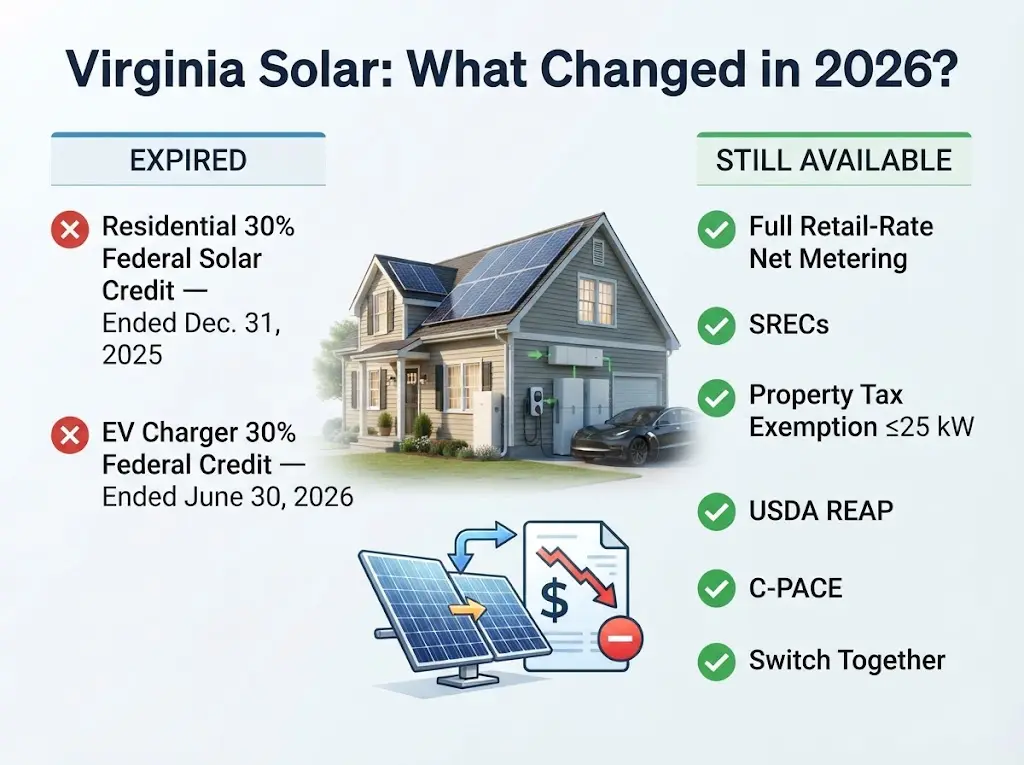
The 30% federal residential solar tax credit under Section 25D expired on December 31, 2025, so Virginia homeowners who buy a system with cash or a loan in 2026 receive no federal credit.
Section 25D: Expired for Cash and Loan Purchases
The One Big Beautiful Bill Act, signed July 4, 2025, repealed Section 25D nearly a decade ahead of its original 2034 phase-out schedule. Systems placed in service on or before December 31, 2025 still qualify for the credit on a 2025 federal tax return using IRS Form 5695, but any system installed in 2026 misses that window entirely.
Section 48E: Still Active for Commercial and Leased Systems
The commercial and third-party-ownership credit under Section 48E remains active, offering a 30% credit through December 31, 2027, to businesses and to solar lease or power purchase agreement (PPA) providers.
Under a lease or PPA, the system owner, not the homeowner, claims the Section 48E credit and typically passes part of that value through as a lower monthly payment or a lower per-kilowatt-hour rate. This makes $0-down lease and PPA financing one of the only remaining paths for a Virginia homeowner to indirectly benefit from the 30% federal Tax credit in 2026.
What a Virginia Solar System Actually Costs in 2026
A 10 kW residential solar system in Virginia typically costs between $22,000 and $28,000 before incentives, and net metering, SREC income, and the property tax exemption combined still return most of that cost over the system’s 25-year lifespan even without the federal residential credit.
Paying Cash
- A 10 kW system installed for cash costs roughly $25,000 up front.
- No federal credit applies to a 2026 purchase.
- Net metering offsets most of the connected electric bill at the full retail rate.
- SREC sales add $270 to $460 per year.
- The mandatory property tax exemption keeps the added system value off the owner’s annual tax bill.
$0-Down Lease or PPA
- The same 10 kW system carries no upfront cost to the homeowner.
- The leasing company claims the 30% Section 48E credit and prices part of that value into the monthly payment or per-kilowatt-hour rate.
- Net metering credits still apply to the household’s usage, though they typically flow through the lease structure rather than directly to the homeowner.
Choosing between these two paths depends on available cash, tax appetite, and how long the homeowner plans to stay in the property.
Financing and Grants for Virginia Businesses and Farms
Virginia businesses and agricultural producers can combine the 30% Section 48E federal credit, five-year MACRS depreciation, and a USDA REAP grant covering up to 50% of project costs to offset the majority of a commercial solar installation.
| Program | Covers Up To | Repayment Structure | Best Fit |
|---|---|---|---|
| Section 48E federal credit | 30% of cost | Tax credit | Commercial and third-party-owned systems |
| USDA REAP grant | 50% of cost | Grant, no repayment | Rural small businesses and farms |
| C-PACE financing | 100% of cost | Property tax assessment, 20 to 30 years | Commercial and multifamily (5+ units) |
| MACRS depreciation | 5-year accelerated schedule | Tax deduction | Commercial system owners |
USDA REAP Grants for Rural Properties
The USDA Rural Energy for America Program provides competitive grants of up to 50% of eligible project costs, plus loan guarantees of up to 75%, for small businesses and agricultural producers located in rural areas or communities under 50,000 in population. Virginia farms that combined REAP with the federal commercial credit have reported an average return on investment near 20%, with payback periods of five to six years, based on installer project data.
C-PACE Financing for Larger Commercial Projects
Commercial property owners who prefer to finance rather than deploy capital upfront can use Commercial Property Assessed Clean Energy financing, administered statewide by the Virginia PACE Authority on behalf of Virginia Energy. C-PACE covers up to 100% of a solar, battery, or EV charging infrastructure project with fixed-rate terms extending 20 to 30 years, repaid through a voluntary property tax assessment rather than a conventional business loan.
Switch Together: Virginia’s New Group-Buying Program
Switch Together is a statewide group-purchasing program launched by Governor Spanberger in July 2026 that negotiates lower solar and battery pricing for Virginia homeowners, with participating households projected to save around $2,200 a year on electricity.
The program is administered by the nonprofit Solar United Neighbors and was the first statewide offering of its kind in the country.
- Homeowners submit a no-obligation, address-based assessment.
- The program pools demand across a region to negotiate volume pricing with participating installers.
- The 2026 campaign opened in more than 100 Virginia localities and runs through October 15, 2026, with plans to expand further.
- Participants in some regions also qualify for discounts on battery storage and heat pump installations bundled into the same purchasing round.
Because Switch Together is a group-buy discount rather than a rebate or a tax credit, it works alongside every other Virginia solar incentive covered in this guide instead of replacing any of them.
Solar Access for Low-Income Virginia Households
Virginia reserves 1% of each utility’s net metering capacity for income-qualified customers and exempts low-income participants from the minimum monthly bill charge under the state’s shared solar program, though a $156 million federal Solar for All award for the Commonwealth was rescinded in 2025.
The Virginia Clean Economy Act carved out a portion of shared solar and net metering capacity specifically for lower-income households, guaranteeing access even as demand from other customers grows.
- Dominion Energy’s shared solar program was expanded to 350 megawatts under 2024 legislation and expanded again under 2026 legislation covering both Dominion and Appalachian Power territory.
- Subscribers receive a bill credit for a portion of a solar facility’s output without installing anything on their own roof.
- Non-low-income shared solar subscribers pay a $55 monthly minimum bill set by the State Corporation Commission, but income-qualified participants are exempt from that charge entirely.
- Electric cooperatives including BARC Electric, Rappahannock Electric, Northern Neck Electric, and A&N Electric also operate their own community solar programs across rural Virginia.
Get A Free Quote From Virginia’s Top Installer
Get your free, itemized solar quote from NEDES to see exactly how net metering credits, SREC income, and Virginia’s property tax exemption reduce your real cost of going solar, with EV charger, battery, and roof-safe mounting work included under one warranty.
EV Charger Incentives After Section 30C’s Expiration
The federal 30% tax credit for home EV chargers under Section 30C expired on June 30, 2026, but Dominion Energy still pays a $125 enrollment incentive plus $40 a year to customers who install a qualifying Level 2 smart charger and enroll it in managed charging.
What Disappeared
Section 30C previously allowed homeowners in eligible census tracts to claim 30% of charger hardware and installation costs, up to $1,000, but the One Big Beautiful Bill Act moved its expiration up from 2032 to mid-2026, and no extension is currently pending in Congress.
What Dominion Energy Still Offers
Dominion Energy’s EV Charger Rewards program remains active for Virginia residential customers who own a single-family home and enroll a compatible Level 2 charger in the utility’s demand-response network. A properly installed home charger still delivers a direct, code-driven benefit regardless of tax policy:
- Per NEC Article 625, a dedicated Level 2 circuit must be sized to 125% of its continuous load.
- A hardwired 60-amp circuit supports a sustained 11.5 kW charging stream, adding roughly 25 to 35 miles of range per hour.
- Business owners installing fleet or workplace charging can still pursue Dominion’s commercial make-ready rebate, which covers up to 50% of the electrical infrastructure costs behind a fleet charging installation.
Battery Storage Without a Federal Credit: Still Worth It?
Standalone battery storage lost its federal tax credit alongside solar panels on December 31, 2025, but a battery still lowers a Virginia electric bill through time-of-use rate optimization and will soon generate income through Dominion Energy’s Virtual Power Plant pilot launching later in 2026.
- A Tesla Powerwall 3 stores 13.5 kWh of usable energy at 97.5% round-trip efficiency and delivers 11.5 kW of continuous output, enough to run central air conditioning and other high-draw appliances during an outage without shedding load.
- Configuring a battery for time-of-use optimization shifts stored solar power to the hours when Dominion’s rates peak, which increases the effective value of every kilowatt-hour a system produces even without a federal credit attached to the hardware.
- Dominion Energy’s Virtual Power Plant pilot, on track to begin enrolling Virginia homes in late 2026, is expected to pay battery owners for allowing the utility to draw on stored capacity during periods of peak grid demand.
Protecting Your Incentives During Roof Repairs and System Upgrades
A solar system has to stay correctly interconnected and undamaged to keep earning net metering credits and SRECs, which is why unmounting panels before a roof repair and remounting them afterward, rather than leaving them in place, preserves both the equipment warranty and the utility interconnection agreement.
Unmount, Repair, Remount
Homeowners occasionally need a roof replacement years after their solar system goes online. NEDES unmounts the array before roof work begins, then remounts it once repairs are complete, resealing every penetration point to manufacturer specification and preserving the racking warranty. This keeps a system’s net metering interconnection agreement and SREC registration intact rather than forcing a new application from scratch.
Adding Panels or a New Inverter
System add-on panels or a replacement inverter can also raise a home’s total production and, by extension, its SREC yield, but any addition must stay within Virginia’s net metering capacity limit for the interconnection to remain valid. NEDES checks a home’s existing equipment warranty terms and interconnection limit before integrating new panels or inverters, so a homeowner adding capacity does not accidentally void coverage or exceed the utility’s approved system size.
Small Add-Ons, Big Protection
A PVC-coated critter guard is a small addition with an outsized effect on long-term system value. Rodents that chew exposed DC wiring under a rack-mounted array can cause $200 to $500 in repair costs per affected wiring run, and preventing that damage protects the production numbers that both net metering credits and SREC income depend on.
Ready to Put These Virginia Solar Incentives to Work?
Virginia’s solar incentives changed meaningfully in 2026, but the state’s core value proposition held. Full retail-rate net metering survived two separate utility challenges, SRECs are positioned to climb in value under the Distributed Generation Expansion Act, and a mandatory property tax exemption still protects every qualifying system under 25 kW.
NEDES designs every residential, commercial, and agricultural system around this exact incentive stack, sizing arrays to Dominion Energy and Appalachian Power’s net metering rules, registering systems for SREC income, and coordinating each project with EV charger, battery, and roof-safe mounting work under one lifetime, insurance-backed warranty.
Book a free 15-minute consultation to map these Virginia solar incentives against your roof, utility rate, and household electricity usage, or request a free, itemized quote to see the full numbers in writing before you commit to a system size.
Leave a Reply
Want to join the discussion?Feel free to contribute!