
Solar Panel Cost in Virginia (2026)
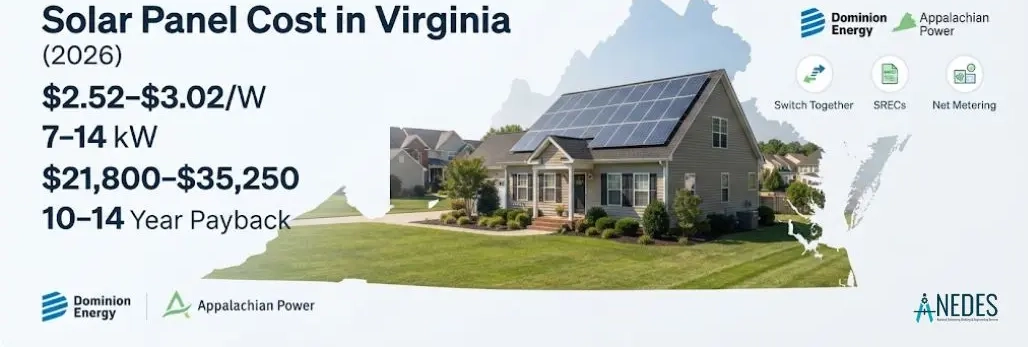
| Virginia solar panels cost roughly $2.52–$3.02/watt ($21,800–$35,250 for a typical 7–14 kW system before incentives); the 30% federal tax credit no longer applies to cash or loan purchases; and the new Switch Together program can cut costs by ~23% for homeowners who sign up before October 15. |
Going solar in Virginia looks different than it did a year ago. The federal tax credit is gone, Governor Spanberger launched a new statewide savings program, and Dominion Energy versus Appalachian Power territory now matters more than ever. Here’s the current, verified picture.
How Much Do Solar Panels Cost in Virginia in 2026?
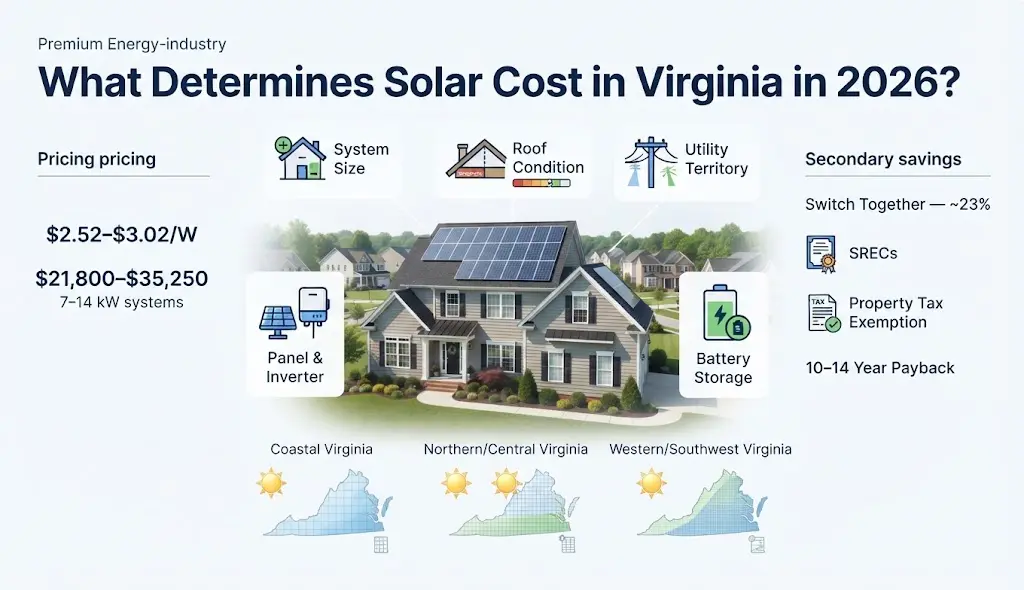
Virginia homeowners pay roughly $2.52–$3.02 per watt, putting a typical 7–14 kW system between $21,800 and $35,250 before any incentives.
- Average cost per watt varies by installer, panel brand (REC, Qcells, Panasonic, and Canadian Solar are common in Virginia installs), and inverter choice (Enphase and SolarEdge are the two most-used brands)
- Larger systems have a lower per-watt cost but a higher total price
- Dominion Energy territory (Northern Virginia, Richmond, Coastal Virginia) vs. Appalachian Power (AEP) territory in Western/Southwest Virginia can see different installer pricing
Is the Federal Solar Tax Credit Still Available in Virginia in 2026?
No. The 30% Residential Clean Energy Credit (Section 25D) ended for any system placed in service after December 31, 2025, under Public Law 119-21 (the One Big Beautiful Bill Act, or OBBBA).
Cash and loan buyers in 2026 cannot claim this credit. This is a detail some older guides still get wrong. Eligibility hinged on your system’s Permission to Operate (PTO) date, not your contract date. Exception: lease/PPA customers may see indirect savings, since the commercial Section 48E credit stays available to system owners through 2027.
What Is Virginia’s New “Switch Together” Solar Program?
Switch Together is a state-backed group-purchasing initiative announced by Governor Abigail Spanberger on July 13, 2026, offering an average 23% discount, about $6,300 off a typical system.
- Runs through October 15, 2026, across 100+ localities
- A reverse auction among vetted local installers, run with the nonprofit Solar United Neighbors
- Also discounts battery storage and, in many areas, heat pumps
Suggestion: If your ZIP code is in the rollout, this is likely the single biggest savings lever available right now, bigger than any remaining state tax break.
Are Solar Panels Worth It in Virginia in 2026?
Yes, for most households paying $150 or more per month in electricity, though realistic payback now runs 10–14 years rather than the 6–8 years often quoted before the federal credit expired.
- High-usage homes (EVs, heat pumps, larger square footage) see the fastest payback
- Homes under 700 kWh/month or with heavy shading may not break even within the panel warranty
- Long-term homeowners (10+ years) benefit most
How Does Net Metering Work in Virginia?
Virginia utilities credit exported solar power at an avoided-cost rate, roughly 7–9¢/kWh, which is well below the 16-17.6¢/kWh residential retail rate in the U.S. Energy Information Administration (EIA) reports for Virginia as of August 2026.
Energy you use directly is worth more than energy you export. Unused credits reset on a 12-month cycle and settle at the lower rate rather than rolling forward indefinitely. The State Corporation Commission (SCC) regulates these tariffs under Va. Code § 56-594.
Dominion Energy vs. Appalachian Power: Does Your Utility Change Your Savings?
Yes. Dominion Energy customers (~75% of the state) generally get faster interconnection and better net metering terms than Appalachian Power (AEP) customers in Western/Southwest Virginia.
| Factor | Dominion Energy | Appalachian Power (AEP) |
| Service area | ~75% of Virginia, including Northern Virginia, Richmond, and Coastal Virginia | Western and Southwest Virginia (Roanoke, Blacksburg, Bristol) |
| Interconnection approval time | 3–6 months in high-demand areas like Northern Virginia and Richmond | Generally slower processing than Dominion |
| Net metering credit rate | Higher, but still avoided-cost (not retail) | Historically lower, extending payback by 1–2 years |
| Fixed monthly customer charge | Roughly $7–9, applies regardless of solar production | Roughly $7–9, applies regardless of solar production |
| Recent policy change | Senate Bill 508 (signed by Governor Spanberger, April 2026) directs a check of existing interconnection points for unused capacity, aiming to speed up approvals without new queue applications | Same SB 508 requirement applies |
What State and Local Solar Incentives Exist in Virginia?
Virginia has no state-level solar tax credit, but homeowners can still access a property tax exemption, a sales tax exemption, SRECs, and the new Switch Together discount.
Property Tax Exemption (Va. Code § 58.1-3661)
Solar panels typically raise a home’s market value, but Virginia exempts that added value from local property tax assessments. This applies to systems up to 25 kW, so homeowners get the resale benefit of solar without a higher annual tax bill.
Sales Tax Exemption (Va. Code § 58.1-609.3)
Virginia waives its 5.3% state sales tax on solar equipment purchases, including panels, inverters, and racking. This exemption is applied automatically by most installers at the point of sale, lowering the upfront project cost without any separate application from the homeowner.
SRECs
Under the Virginia Clean Economy Act, solar owners can generate Solar Renewable Energy Certificates for the electricity their system produces and sell them on the open market. Utilities buy these to meet clean energy mandates, giving homeowners an extra income stream beyond their bill savings.
PACE/C-PACE Financing
Property Assessed Clean Energy financing lets homeowners in participating Virginia localities fund solar installations through a special property tax assessment, repaid over time. It often requires little to no upfront cost and can offer longer repayment terms than a standard solar loan.
How Do Costs and Savings Vary Across Virginia’s Regions?
Coastal Virginia gets the most sunlight, Northern Virginia has more shading/HOA friction, and Western/Southwest Virginia sees the longest payback due to AEP’s rates.
Coastal Virginia (Virginia Beach, Norfolk, Chesapeake)
This region sees the state’s best solar exposure, averaging 4.4–4.7 peak sun hours daily with flat terrain and minimal tree shading, which helps systems here produce closer to their rated output year-round.
Northern Virginia (Fairfax, Loudoun, Arlington)
Higher electricity usage and higher rates make ROI strong here, though dense HOA communities often add extra approval steps and design restrictions before installers can move forward with a project.
Central Virginia (Richmond, Charlottesville)
Sun exposure and electricity rates sit in the middle of the state’s range, giving homeowners fairly predictable payback timelines without the shading issues common further north or the rate disadvantages seen in AEP territory.
Western/Southwest Virginia (Roanoke, Blacksburg, Bristol)
Mountainous terrain reduces peak sun hours, and Appalachian Power’s lower net metering credit rates further stretch payback periods, making this the slowest-return region for solar in the state.
What Factors Affect Your Solar Panel Cost in Virginia?
System size, panel/inverter choice, roof condition, HOA approval, and interconnection timelines are the biggest drivers of cost and timeline variability.
System Size
Larger systems cost more upfront but lower the per-watt price, directly shaping your total investment, monthly bill savings, and how quickly the system pays for itself based on usage.
Panel/inverter Choice
Premium brands like REC, Qcells, or Enphase raise upfront cost but often improve efficiency, warranty length, and long-term reliability, which can affect total lifetime savings over the system’s warranty period.
Roof Condition
Aging, weak, or heavily shaded roofs may need repair or trimming first, adding cost before installation begins. Replacing a roof within 5 to 7 years first avoids costly rework later.
HOA Approval
Associations can require design review and add timeline delays, though Virginia law prevents outright bans. Under Va. Code Section 55.1-1820, HOAs may still regulate panel placement and visibility.
Interconnection Timelines
Utility approval delays push back activation dates, postponing savings and occasionally affecting time-sensitive incentive deadlines, especially in high-demand areas with lengthy interconnection queues that stretch for several months.
Battery Storage
Adding a battery like a Tesla Powerwall, Enphase IQ Battery, or Franklin WH typically adds $7,000 to $18,000 to total project cost, but provides valuable backup power during outages.
How Can You Pay for Solar Panels in Virginia?
Most Virginia homeowners choose between four payment paths, balancing upfront cost against long-term savings.
- Cash requires the largest initial investment but delivers the highest lifetime returns, with no interest or transfer of ownership involved.
- A solar loan needs little to no money down, though interest payments reduce total savings.
- PACE financing repays the cost through a property tax assessment.
- A lease or PPA needs zero dollars down but produces the lowest overall savings, since the homeowner never owns the system.
Ready to go solar in Virginia? Get a free, personalized quote based on your utility, roof, and energy usage from NEDES today.
How Long Does It Take Solar Panels to Pay for Themselves in Virginia?
Most Virginia homes now see a 10–14 year payback period, reflecting the loss of the federal tax credit for 2026 installations. High-bill Dominion households ($200+/month) land at the shorter end, while lower-usage or AEP-territory homes should expect 15+ years.
Note: Every homeowner’s numbers depend on roof orientation, shading, and actual electricity usage. Get a personalized quote before committing to any system size.
Frequently Asked Questions
Does Virginia require solar installers to be licensed?
Yes, Virginia’s Board for Contractors requires solar installers to hold an Alternative Energy System (AES) license in addition to a general contractor license, confirming they meet state electrical, structural, and safety standards for homes in Dominion or AEP territory.
Can renters benefit from solar in Virginia?
Not through direct ownership, since renters can’t install panels on a home they don’t own. However, some Virginia utilities and community solar developers offer shared solar subscriptions, letting renters in Richmond, Norfolk, or Northern Virginia access bill credits.
Does solar increase my home’s assessed value?
Yes, installing solar typically raises a Virginia home’s market value, but under Va. Code § 58.1-3661, the state exempts that added value from local property tax assessments, so homeowners in any county gain resale value tax-free.
What roof size does solar typically need?
Most Virginia homes need roughly 350 to 650 square feet of usable, unshaded roof space to fit a typical 7 to 9 kW system, though homes in shadier Northern Virginia neighborhoods may need more space.
Do panels hold up during hurricane season?
Yes, solar panels installed in Virginia, including in coastal areas like Virginia Beach and Norfolk, are rated to withstand high wind loads common during hurricane season, though output temporarily drops on overcast, stormy days.
What does annual maintenance cost?
Routine solar maintenance for a Virginia home, including panel cleaning and a basic inverter and wiring inspection, typically costs between $150 and $400 per year, with slightly higher costs for larger rooftop systems in Dominion territory.
What size system does an average home need?
Most average Virginia households need a 7- to 9-kilowatt solar system to offset typical monthly electricity usage, though larger homes, EV owners, or high-usage households in Loudoun or Fairfax County may need more capacity.
Is there financing for low-income households?
Yes, Virginia offers the Low-to-Moderate Income Solar Loan and Rebate Fund, administered through state energy programs, providing financing assistance and rebates to qualifying households across the Commonwealth who couldn’t otherwise afford upfront installation costs.
Is there a size cap for net metering?
Yes, Virginia’s State Corporation Commission caps residential net metering eligibility at 25 kilowatts of system capacity under both Dominion Energy and Appalachian Power tariffs, meaning larger systems may not receive full export credit.
How do I check if my locality is in Switch Together?
To check whether your Virginia locality is part of Governor Spanberger’s Switch Together rollout, visit the Solar United Neighbors website or contact your county or city’s local energy office for the current participating-area list.
Ready to Get an Accurate, Local Quote?
Before you sign anything, compare your installer’s numbers against independent guidance. NEDES provides solar installation services across the US, including Virginia, and helps homeowners cut through inflated projections and outdated tax-credit claims with clear, current breakdowns tailored to your utility, roof, and usage. If you’re evaluating a quote or just want a fair 2026 price benchmark, get in touch with NEDES first!