
Buying vs Leasing Solar Panels: Which One Actually Saves You More?
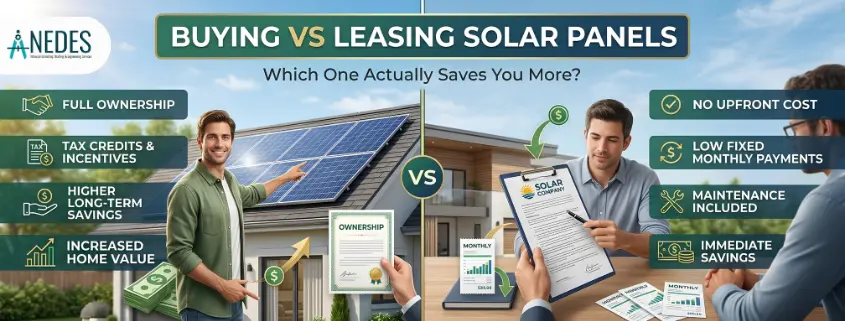
Buying or leasing solar panels? The answer to this question was easy: buy them, claim the 30% federal tax credit, and watch your payback period shrink. That math has changed in 2026. The recent updates state that homeowners who purchase solar panels after 31 December 2025 no longer receive the federal credit, but companies offering leases or PPAs can still claim it. So, deciding which paths to put more money back in your pocket is hard now.
The truth is, buying or leasing is no longer a one-size-fits-all decision. It depends on your upfront cost, how long you plan to stay at your home, and how tax rules affect your specific numbers. In this blog, we will discuss what has changed, what costs more in 2026, and which option is suitable for you.
Buy vs Lease vs PPA: An Insight for Basic Understanding
Before moving forward, it is important to gain a basic understanding of all the options for going solar. There are three main ways to go solar.
- Cash Purchase: You pay for the system and own it from day one.
- Solar Lease: A solar company installs and owns the system on your roof. You pay a fixed monthly fee to use it. This option is similar to renting an apartment.
- Solar PPA (Power Purchase Agreement): This is also third-party owned, but instead of paying a fixed amount per month. You pay per kilowatt-hour of electricity that a system actually generates.
The biggest difference among the three? Who owns the panels because ownership determines who gets the tax credit, who handles repairs, and whether your home’s resale value gets a bump.
| Differentiators | Cash Purchase | Lease | PPA |
| Who owns it | You | Solar company | Solar company |
| Upfront cost | High | None | None |
| Who claims the tax credit | N/A (25D expired 2026) | Solar company (48E) | Solar company (48E) |
| Maintenance | Your responsibility | Included | Included |
| Home value impact | Increases | No increase | No Increase |
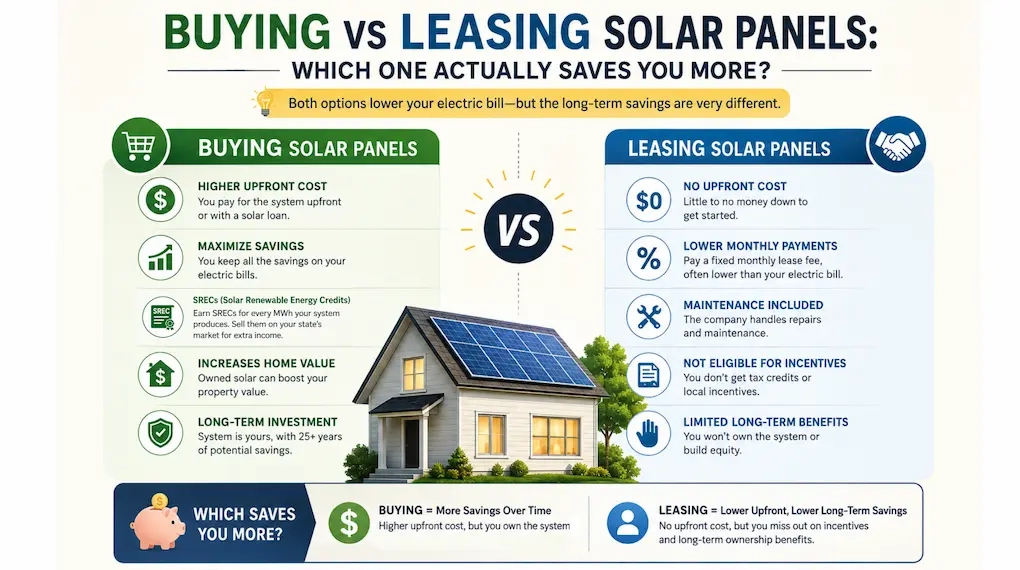
The 2026 Game-Changer: The Tax Credit Shift
For over a decade, homeowners who purchased solar panels could claim the 30% federal Residential Clean Energy Credit. That is gone now. A law enacted on July 4, 2025, known as the Big Beautiful Bill, terminated the credit for all expenditures made after December 31, 2025 (Congress.gov, Public Law, Section 25D). So anyone who buys a system in 2026 or later gets zero federal credit.
The shocking fact is that credit didn’t disappear for everyone. The business-claimed 48E tax credit for residential solar leases, PPAs, and prepared solar products remains in effect through the end of 2027. Leasing companies can still claim a 30% credit.
What does this mean practically?
Removing federal credits means the payback period just got longer, since you are now covering 100% of the cost with no federal offset. On the other hand, leasing has become a relatively more attractive option for the first time in years, not because leasing has improved, but because buying solar panels has lost its biggest advantage.
This shift changes the mindset of homeowners who prefer buying over leasing. They are now confused about which option is better for their roof, budget, or timeline. This is not something that a generic online calculator built before 2026 will account for.
Curious how the new tax rules actually shake out for your home? Get a free consultation with our solar installer experts, who will walk you through real numbers based on current 2026 incentives.
Buy vs Lease: 2026 Cost Comparison
Numbers can help you in choosing between buying and leasing because they can do things that opinions often don’t do. That is why let’s have a look at what solar actually costs in 2026.
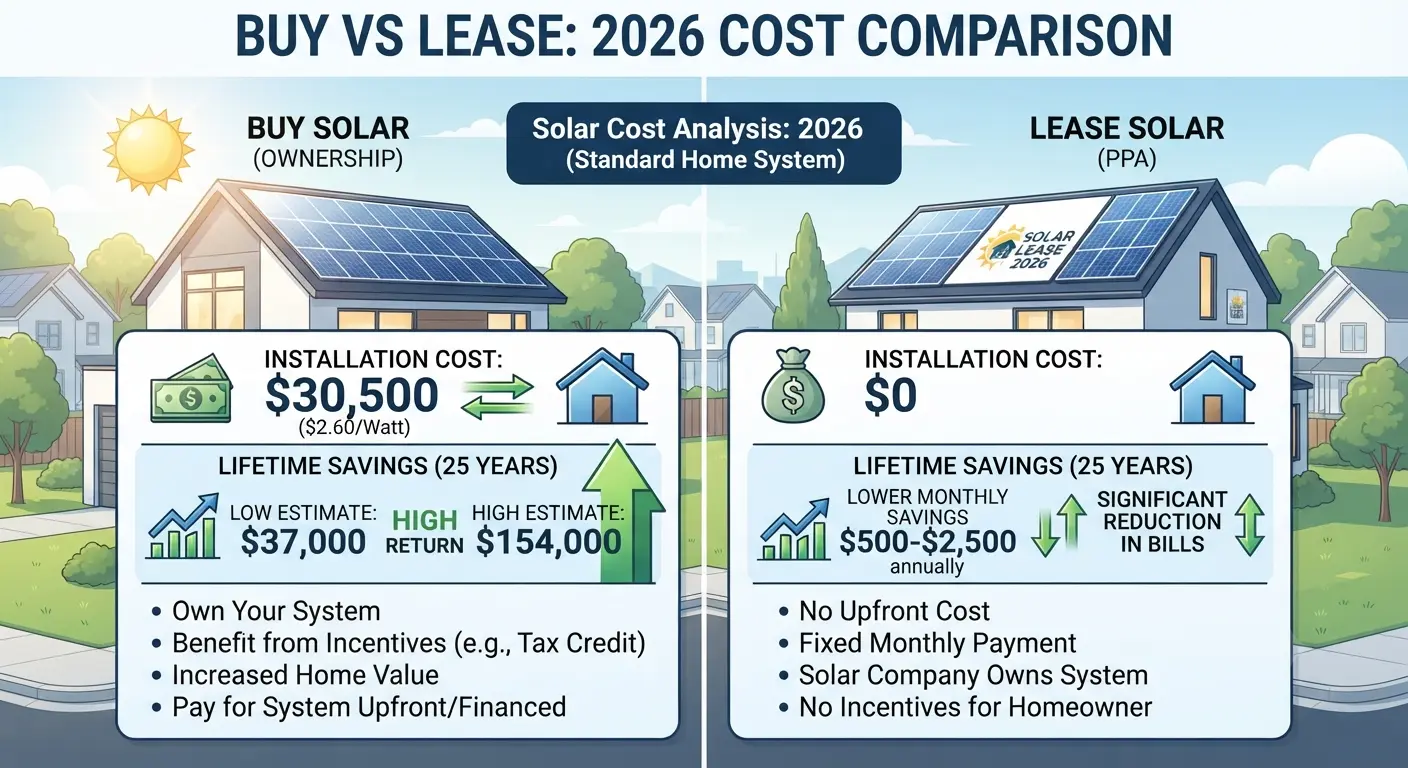
Currently, a standard solar system typically costs $2.60 per watt before incentives and requires an installation cost of around $30,500 for a standard home system. Over 25 years, that investment can save owners anywhere from $37,000 to $154,000, depending on location, electricity rates, and financing.
But the question arose: how would they pay that $30,500 installation cost after no longer having credit available to soften the upfront hit?
Here is a worked example based on a typical 8kW system:
| Factors | Cash Purchase | Lease / PPA |
| Upfront cost | ~$24,000 | $0 down |
| Monthly payment | $0 | ~$90–150/mo |
| Federal tax credit (2026) | None | Indirect, via 48E (leasing company claims it) |
| Breakeven point | ~7–10 years | Rarely breaks even — no equity built |
| 25-year total cost | ~$24,000 | ~$27,000–45,000+ (with escalator) |
| Who keeps the savings after payoff | You, forever | Solar company |
From the table, a few things jump out. Cash purchase still wins on lifetime cost, but the 30% credit cut has narrowed the gap. Leases or PPAs can look cheapest with month-to-month payments, especially with 48E savings. But you are renting the benefit rather than owning equity. Additionally, most leases include a 1-3% annual escalation that quietly raises your payment every year.
The honest takeaway is that buying remains a long-term investment for homeowners who can afford the upfront cost or qualify for a loan. But the margin over leasing is tighter in 2026 because it is worth running your specific numbers instead of relying on the old rule of thumb.
Want to see what these numbers look like for your actual roof and electric bill? Avail our residential solar panel installation services that give you real 2026 figures, not a generic estimate.
Pros and Cons of Buying a Solar Panel System
Here are some advantages and disadvantages of buying a solar panel system that help you make a better decision.
Pros
- Give Full Ownership: Buying means the solar system is yours. You decide on upgrades, additions, or repairs without any third-party involvement.
- No Monthly Bill, One-time Payment: Once you’ve covered the upfront cost, your electricity is essentially free for the remaining 15–20+ years of the system’s life.
- A Real Bump in Home Value: Lawrence Berkeley National Laboratory found that owned solar panels increase sale prices by an average of $4 per watt of installed capacity, about $24,000 for an 8 kW system. That’s equity you keep, and equity a leased system simply doesn’t offer.
- Long-term Savings: Every year after the payback period, the savings are 100% yours. No lease payment is eating into it.
Cons
- Higher Upfront Cost: Even with financing, you’re taking on either a lump sum or a loan payment that is a bigger commitment than $0-down leasing.
- Maintenance is on You: Repairs, monitoring, and inverter replacements are your responsibility once any workmanship warranty expires.
- No Federal Tax Credit in 2026: With Section 25D expired, buyers no longer get the 30% offset that used to make ownership an easy call.
- A Modest Increase in Insurance Premiums: Adding a high-value asset to your roof typically means a small increase in your homeowner’s policy.
Thus, if long-term savings and home equity matter more to you than a low monthly payment, buying still makes the strongest financial case, even without the tax credit.
Pros and Cons of Leasing a Solar Panel System
Leasing has picked up momentum in 2026 due to 48E, but there are still some trade-offs as real as the upsides. Have a look at the pros and cons of leasing a solar panel system.
Pros
- $0 Down: No upfront cost means you can start saving on your electricity bill immediately, without touching savings or taking out a loan.
- Zero Maintenance Responsibility: The solar company owns the system, so repairs, monitoring, and part replacements are on them, not yours.
- Still Indirectly Tax-credit-subsidized: Even though you can’t claim it yourself, the leasing company can use the 48E credit and often passes some of that value along through lower monthly payments.
- Completely Hands-off. No research into equipment, no managing warranties, no decisions to make once it’s installed.
Cons
- No Home Value Increase: Because you don’t own the system, it doesn’t add equity or resale value the way a purchased system does.
- Selling Your Home Gets More Complicated: You’ll need to either transfer the lease to the buyer or pay it off before closing—an extra hurdle that purchased systems don’t have.
- Escalator Clauses Quietly Raise Your Cost: Most leases include a 1–3% annual payment increase, so your fixed rate isn’t actually fixed over 20+ years.
- Lower Lifetime Savings: You’re paying for the use of the system indefinitely rather than building toward owning it outright.
- No SREC Eligibility: Since you don’t own the system, you can’t sell any Solar Renewable Energy Certificates it generates. That income goes to the leasing company.
For owners who value simplicity and immediate savings over long-term equity, leasing still fills a real need. Just go in knowing exactly what you’re trading away.
Book Your Free Consultation Now
Which One Actually Saves You More? A 3-Question Gut-Check
Every homeowner’s situation is different, but the decision usually comes down to just a few factors. Answer these three questions honestly, and you’ll know which path fits you — no complicated spreadsheets or solar jargon required.
1. Do you have $20,000–$30,000 available, or can you qualify for a solar loan?
If you have the money for investment, buying wins on lifetime savings and home equity, even without the 2026 tax credit. If no, that alone rules out a cash purchase and points you toward a loan or lease.
2. Are you staying in your home for 10+ years?
This is the number that makes or breaks buying. Most systems break even in 7–10 years, so if you’re moving sooner, you may not recoup the upfront cost, and leasing starts to look smarter.
3. Do you want maximum savings or maximum simplicity?
If you want the biggest possible return and don’t mind handling maintenance, buy a solar panel system. If you’d rather have zero responsibility and don’t mind lower lifetime savings, a lease or PPA is the better fit.
Quick Decision Making:
Buy a solar panel system if:
- Cash on hand
- Planning long-term stay
- Want savings
Go to a lease or PPA solar panel system if:
- Tight budget
- Short timeline
- Want hands-off
Still not sure which bucket you fall into? A free personalized quote can run these numbers against your actual roof, budget, and utility rates.
Conclusion
The old advice “always buy if you can” is not wrong, but it’s no longer the whole story. With the 30% federal tax credit gone for buyers and still available to leasing companies through 2027, 2026 is the first year in over a decade in which the gap between buying and leasing has genuinely narrowed. The right choice still comes down to your cash on hand, how long you’re staying put, and whether you value long-term savings or upfront simplicity more.
Whichever way you lean, the worst move is guessing. Run your actual numbers before you sign anything. Ready to see what buying or leasing your home actually looks like in 2026? Hire Nedes.us to get a no-obligation solar quote. We’ll walk you through real pricing, real savings, and which option makes the most sense for your roof and budget.
Frequently Asked Questions
Is leasing solar still worth it in 2026?
Yes, for the right homeowner. With the federal tax credit gone for buyers, leasing companies can still claim it through 2027 and often pass some of that value along through lower monthly payments. It makes leasing relatively more competitive than it’s been in years.
Does leasing solar panels hurt my home’s resale value?
It doesn’t hurt it directly, but it doesn’t help either. Since you don’t own the system, it adds no equity to your home the way a purchased system does. You’ll also need to transfer the lease to your buyer or pay it off before closing, which can complicate a sale.
Can I still get a tax credit for solar panels in 2026?
Not if you buy. The 30% federal Residential Clean Energy Credit expired for homeowner-owned systems installed after December 31, 2025. If you lease or sign a PPA, the leasing company can still claim a separate credit through 2027 and may pass along savings.
How long does it take for solar panels to pay for themselves?
Most purchased systems break even in 7 to 10 years, depending on your electricity rates, system size, and location. If you’re planning to move sooner than that, leasing may make more financial sense than buying.
Is it cheaper to buy or lease solar panels?
Buying is almost always cheaper over the system’s lifetime, even without the 2026 tax credit, because you stop making payments once it’s paid off. Leasing costs less upfront but continues indefinitely, often with a built-in 1–3% annual increase.