
Solar vs. Wind Energy: Which Is Better in 2026?
Solar vs. Wind Energy: Which Is Better in 2026?
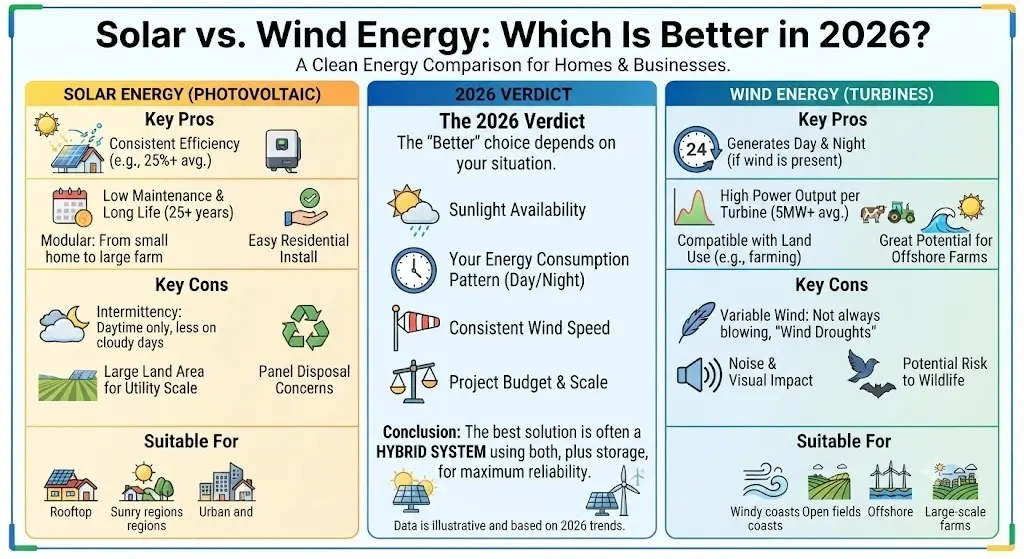
Solar energy suits homeowners better. Wind energy suits utility-scale projects better.
Solar panels convert sunlight into electricity with 15–22% efficiency. Wind turbines convert moving air into electricity with 20–50% efficiency. Solar wins on accessibility and low maintenance. Wind wins on raw output and land-use efficiency.
This guide compares solar vs. wind energy across cost, efficiency, reliability, and environmental impact, using 2026 current data.
What Is Solar Energy?
Solar energy is electricity generated from sunlight through photovoltaic (PV) cells.
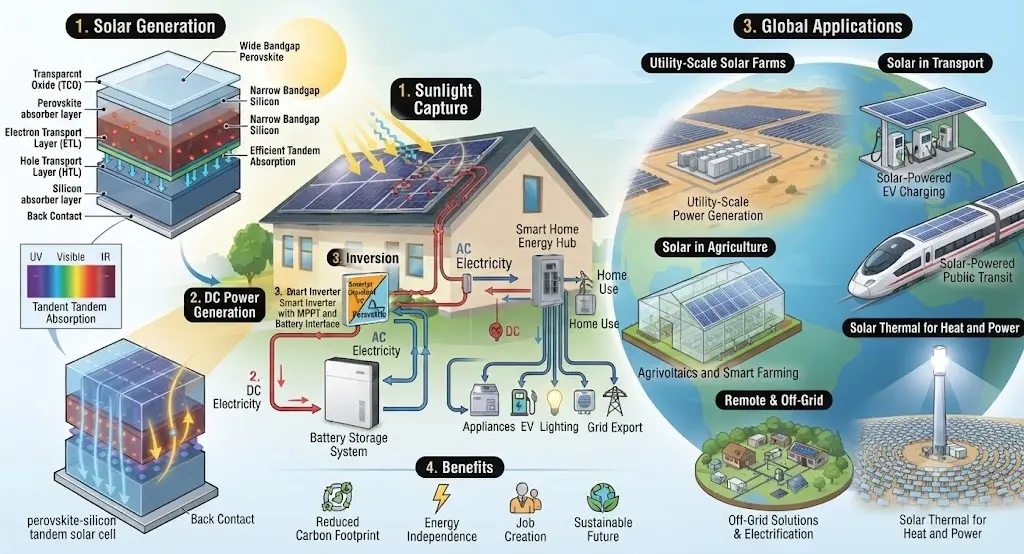
How Does It Work? PV cells absorb photons and release electrons, creating an electric current. Inverters convert that current into usable household power. Solar energy powers homes, businesses, and utility-scale solar farms. The technology produces zero operational emissions.
What Are the Types of Solar Energy?
Solar technology splits into four main categories.
| Type | Function | Common Use |
| Photovoltaic (PV) | Converts sunlight directly into electricity | Rooftop, ground-mount, utility farms |
| Concentrated Solar Power (CSP) | Uses mirrors to focus sunlight and generate heat | Utility-scale power plants |
| Passive Solar Heating | Uses building design to capture heat | Residential heating |
| Active Solar Heating | Uses pumps to circulate solar-heated water | Water heating systems |
Newer PV variants are entering the market.
- Bifacial panels capture sunlight on both sides.
- Perovskite cells offer higher theoretical efficiency at lower manufacturing cost.
Note: Neither technology dominates the residential market yet, but both are scaling fast in 2026 pilot projects.
What Is Wind Energy?
Wind energy is electricity generated from moving air through turbine blades.
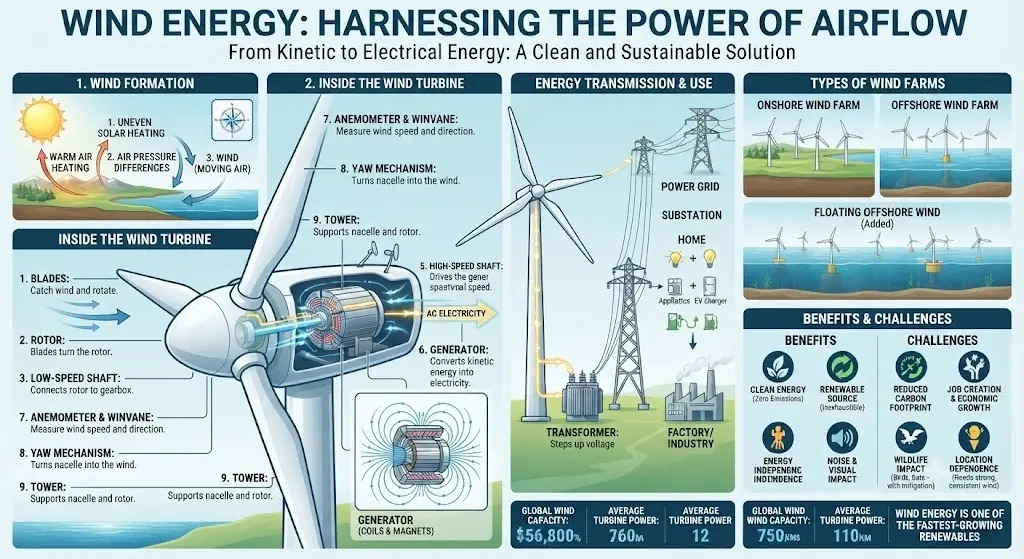
How Does It Work? Turbine blades capture kinetic energy from wind. A generator inside the nacelle converts blade rotation into electricity. A gearbox increases rotation speed from roughly 50 rpm to 1,500 rpm for efficient generation. Wind itself forms from uneven solar heating of Earth’s surface, making wind an indirect form of solar energy.
What Are the Types of Wind Energy?
Wind energy is divided into four deployment categories.
- Onshore wind: Land-based turbines, the most common and lowest-cost format.
- Offshore wind: Ocean-based turbines that access stronger, steadier winds.
- Distributed wind: Small turbines serving a single home, farm, or business.
- Vertical-axis wind turbines (VAWT): Compact, low-noise turbines designed for urban and rooftop use.
Offshore wind turbines now reach 11 MW capacity, per Siemens Gamesa’s SG 11.0-200 DD model. Larger rotor diameters and AI-driven blade-pitch optimization pushed peak turbine efficiency to 44–48% in 2026, according to GLOBE NEWSWIRE.
How Do Solar Panels and Wind Turbines Work?
Solar panels and wind turbines convert different natural forces into the same output: electricity.
Solar Panel Mechanism
Sunlight strikes silicon cells inside a solar panel. The cells release electrons, generating direct current (DC). An inverter converts DC into alternating current (AC) for home use.
Wind Turbine Mechanism
Wind rotates the turbine blades. The rotor shaft spins a generator inside the nacelle. The generator converts mechanical energy into AC electricity, which then feeds the grid.
Which Is More Efficient: Solar or Wind Energy?
Wind turbines convert more energy than solar panels, but solar performs more consistently by location. According to The Renewable Energy Institute (REI), wind turbine efficiency reaches 20–50% of available wind energy. And solar panel efficiency ranges from 15% to 22% of available sunlight, per PowerOutage.
What Is Capacity Factor and Why Does It Matter?
Capacity factor measures actual output against maximum possible output. The average U.S. wind farm ran at a 34% capacity factor in 2024, while solar farms averaged 23%, according to Department of Energy data. Nuclear plants averaged 92.3% by comparison, showing renewables still trail baseload sources on consistency.
| Metric | Solar PV | Onshore Wind |
| Conversion efficiency | 15–22% | 20–50% |
| Average capacity factor (2024) | 23% | 34% |
| Offshore wind capacity factor | N/A | 36–45% |
| Best-case output | Sunny, unshaded sites | Sites averaging 12+ mph wind |
Pro Tip: Check your local capacity factor before committing. A high-efficiency turbine in a low-wind area underperforms a mid-tier solar panel in a sunny region.
Solar vs. Wind Turbine: Which Produces More Energy Per Installed kW?
Wind produces roughly 85% more energy per kW of installed capacity. According to Blackridge Research & Consulting, onshore wind turbines generate approximately 3,241 kWh per installed kW annually. Solar panels generate approximately 1,752 kWh per installed kW annually, per High Desert Energy.
What is the Cost Difference Between Solar and Wind Energy?
Solar costs less to install for homeowners. Wind costs less per kWh at utility scale.
| System Type | Estimated Cost |
| Residential solar (10 kW) | $18,000–$25,000 before incentives |
| Residential wind turbine (5 kW) | $32,000–$50,000 before incentives |
| Commercial wind turbine | $2–4 million per unit |
| Utility-scale solar (per watt) | $0.90–$1.30 |
What Is the Levelized Cost of Electricity (LCOE) for Solar and Wind?
Onshore wind produces electricity for $0.02–$0.05 per kWh. Solar PV produces electricity for $0.03–$0.06 per kWh, according to NREL’s Annual Technology Baseline, IEA Renewables, and Lazard’s LCOE. Wind holds a slight cost edge at utility scale. Solar deploys faster, typically in 3-6 months versus 12–24 months for wind projects.
What Are the Maintenance Costs for Solar and Wind Turbines?
Wind turbines are more costly to maintain than solar panels. How? Solar panels contain no moving parts, and, therefore, their maintenance stays minimal across a 25-30 year lifespan. On the other side, wind turbines contain gearboxes, bearings, and rotating blades. All of these require 2-3 maintenance visits per year, increasing long-term operating costs.
Are Solar and Wind Tax Credits Available in 2026?
No federal credit exists for homeowner-purchased solar or wind systems in 2026. The 30% Residential Clean Energy Credit (Section 25D) expired December 31, 2025, under the One Big Beautiful Bill Act. Homeowners who buy solar with cash or a loan get $0 federal credit.
Leased or PPA systems still qualify indirectly: the third-party owner claims the commercial credit (Section 48E, up to 30%) and may pass savings through at a lower rate. Commercial and utility-scale wind and solar projects retain access to Section 45Y/48E credits, though IRS Notice 2025-42 tightened construction-start rules. State incentives and net metering remain widely available.
What Financing Options Are Available for Solar vs. Wind in 2026?
Solar offers more financing flexibility than wind for residential buyers.
Solar Financing Options
In the solar world, you have the following financing options:
- Solar loans: Fixed monthly payments; homeowner retains full ownership and tax credit eligibility.
- Solar leases: Third party owns the system; homeowner pays a fixed monthly fee.
- Power Purchase Agreements (PPAs): Homeowners pay only for electricity generated, not the hardware.
- Community Solar: Subscribers buy a share of a shared solar farm without rooftop installation.
Know more about these options here: Solar Lease vs Cash Purchase vs PPA in 2026
Wind Turbine Financing Options
Most residential wind turbine buyers use direct loans or cash purchases. Lease and PPA programs rarely cover home turbines due to low demand and inconsistent output. Utility-scale wind projects finance differently, relying on long-term Power Purchase Agreements (PPAs) with utilities, which guarantee revenue and make large turbine investments financially viable for developers.
Which One Is More Reliable Between Solar and Wind Energy?
Wind can generate power at any hour. Solar generates power only during daylight, unless battery storage is attached. Wind turbines produce electricity day and night, provided wind speed stays above the turbine’s cut-in threshold, typically 6–9 mph. Solar panels stop generating electricity after sunset. Without battery storage, a solar-powered home draws electricity directly from the grid once the sun sets. With battery storage attached, stored daytime solar power supplies the home through the night. This makes standalone solar systems daylight-only by default, while battery-backed solar systems extend usable power into nighttime hours.
Book Your Free Consultation Now
Why Does Intermittency Matter for Both Technologies?
Both solar and wind output fluctuate, requiring backup power to guarantee 24-hour supply. Solar output drops to zero at night and falls 10–25% under heavy cloud cover. Wind output rises and falls with wind speed and can drop to zero during calm periods, regardless of time of day. Neither technology alone guarantees constant power, making backup solutions, such as batteries or grid connection, necessary for uninterrupted supply.
How Does Battery Storage Solve the Intermittency Problem?
Battery storage stores excess solar or wind electricity for use when generation drops. Lithium iron phosphate (LFP) batteries dominate the 2026 residential storage market due to lower fire risk and longer cycle life than older lithium-ion chemistries. According to PowerOutage, a typical home battery, such as a Tesla Powerwall-class unit, stores 10-13.5 kWh, covering several hours of essential household use during an outage or overnight.
Pro Tip: Size your battery to cover evening and nighttime usage, not your full daily consumption. Your installer should base sizing on when you actually need backup power, not total household load. Oversizing adds cost without meaningful extra benefit for most homes.
Virtual Power Plants (VPPs), which are a network of decentralized energy resources, now aggregate thousands of home batteries into a single grid-responsive network. VPPs let utilities draw stored solar or wind power during peak demand, reducing the need for new fossil-fuel peaker plants.
Which One Is Greener Between Solar and Wind Energy?
Both technologies, solar and wind turbines, produce near-zero emissions during operation. However, their lifecycle and manufacturing emissions differ.
| Stage | Solar PV | Onshore Wind |
| Operational emissions | ~0 g CO2/kWh | ~0 g CO2/kWh |
| Manufacturing (embodied) emissions | 20–70 g CO2e/kWh | 10–15 g CO2e/kWh |
| Carbon payback period | 1–3 years | Under 1 year |
| Typical lifespan | 25–30 years | 20–25 years |
Wind carries a lower embodied-carbon footprint than solar, largely due to steel and concrete requiring less processing energy than silicon refinement. A global study of 26,821 wind farms found a median footprint of 10 g CO2e/kWh, with a range of 4–56 g CO2e/kWh, depending on turbine size and location.
What Happens to Solar Panels and Wind Turbines at End of Life?
Solar panels contain silicon, glass, and small amounts of silver and lead. Recycling infrastructure remains limited in most U.S. states. Wind turbine blades pose a harder recycling challenge due to composite fiberglass construction. Some manufacturers now test chemical recycling methods that recover resin and fiber for reuse, cutting landfill waste.
Suggestion: Ask your installer about end-of-life recycling partnerships before signing a contract. This detail rarely appears in standard sales pitches but affects long-term environmental impact.
How Do Solar and Wind Affect Wildlife?
Wind turbines pose a documented risk to birds and bats through blade strikes. Solar farms require large land tracts, displacing native habitat and disrupting local ecosystems during construction. Rooftop solar avoids this land-use conflict entirely, since it uses existing structures. Both technologies carry lower wildlife impact than fossil fuel extraction and emissions overall.
What Are the Space and Location Requirements for Solar vs. Wind?
Solar works almost anywhere with sun exposure, but wind requires consistently high wind speed for good efficiency.
Where Does Solar Perform Best?
Solar panels perform best in regions with high annual irradiance, such as Arizona, California, and Florida. It doesn’t mean that solar does not perform in cloudy regions; they still perform profitably in cloudier regions, including Upstate New York and Ohio, due to declining equipment costs.
Where Does Wind Perform Best?
Wind turbines perform best in areas averaging 12+ mph sustained wind speed. The Great Plains region ranks among the strongest U.S. wind corridors, spanning Texas through the Dakotas. Offshore locations in the North Atlantic and North Sea deliver even higher, steadier wind speeds, making them ideal for large-scale turbine deployment.
What Zoning and Noise Rules Apply to Solar and Wind Turbines?
Solar panels produce no operational noise and rarely trigger zoning disputes. Wind turbines generate audible mechanical noise and require safety setback distances from property lines. Many HOAs restrict or ban residential wind turbines outright, while solar access laws protect homeowner rights to install panels in most U.S. states.
Note: Check your HOA covenant and local zoning code before purchasing a residential turbine. Setback requirements can eliminate wind as an option even on large rural lots.
Solar vs. Wind: How Do They Differ in Regional and Global Trends?
Global solar capacity growth now outpaces wind capacity growth. The utility-scale solar pipeline grew 17% globally in 2025, reaching 2.2 terawatts (TW), per Global Energy Monitor. The global wind pipeline grew 7% in the same period, reaching 2.7 TW. U.S. FERC data shows solar accounted for over 72% of new U.S. generating capacity added in 2025, with wind adding another 16%.
Offshore wind continues expanding fastest in Europe. The UK, Denmark, and Norway lead global offshore wind capacity per capita. China’s combined wind and solar capacity surpassed 1.6 TW in 2025, triple that of the U.S. and India combined.
How Do Solar and Wind Systems Affect Property Value and Insurance?
Solar panels generally raise home resale value, and residential wind turbines show mixed results.
Homes with owned solar systems typically sell at a premium compared to homes without solar, based on multiple U.S. real estate studies. Residential wind turbines lack equivalent resale data due to low adoption rates, and visible turbines can deter some buyers due to noise concerns.
Most standard homeowner’s insurance policies cover solar panels under existing dwelling coverage, though high-value systems may need a policy rider. Residential wind turbines often require a separate liability rider due to moving-part risk and taller structure height.
Are Hybrid Solar and Wind Systems Worth It?
Hybrid systems combine solar and wind to reduce intermittency risk. Solar generates during the day. Wind often generates more at night and during storms. Pairing both technologies smooths out total power supply across a 24-hour cycle.
How to Size a Hybrid System?
A household using 900 kWh per month might pair a 6 kW solar array with a 2–3 kW small wind turbine, depending on local wind speed. This split reduces battery storage needs by covering more hours of direct generation.
Pro tip for rural projects: Hybrid systems make the most sense on large rural properties with both open land and confirmed average wind speeds above 10 mph. Urban and suburban homeowners rarely have sufficient space or wind exposure to justify the added turbine cost.
How to Decide Between Solar and Wind Energy?
Follow four steps to match the right system to your property.
- Check your solar irradiance and wind speed data. Use NREL’s National Solar Radiation Database and local wind speed averages before purchasing either system.
- Calculate your monthly energy needs in kWh. Pull this figure from 12 months of utility bills for accuracy.
- Compare upfront costs against long-term savings. Divide total system cost by expected annual savings to estimate your break-even year.
- Confirm zoning, HOA rules, and incentive eligibility. Contact your local permitting office before signing any contract.
Quick-Reference Decision Matrix
| Your Situation | Recommended System |
| Urban or suburban homeowner | Solar |
| Rural property, confirmed high wind speed | Wind or hybrid |
| Business seeking cost efficiency at scale | Wind (utility) |
| Business seeking fast, flexible deployment | Solar farm |
| Off-grid cabin with variable weather | Hybrid solar + wind + battery |
Note: Working with a licensed solar installer, like NEDES, simplifies this process and decision-making. Experts assess your site’s irradiance, calculate accurate system sizing, and confirm local incentives, saving homeowners time and reducing costly sizing or compliance mistakes.
Frequently Asked Questions About Solar Vs. Wind Energy
What is the difference between onshore and offshore wind?
Onshore wind turbines sit on land and cost less to install and maintain. Offshore wind turbines sit in ocean waters, access stronger and steadier wind, and reach capacity factors of 36–45%, higher than most onshore sites.
How much does a home wind turbine cost?
A residential wind turbine costs $20,000–$50,000 installed, per HomeGuide 2026 data, averaging $35,000. Small 1.5 kW systems start near $15,000, while larger free-standing units reach $75,000+, excluding battery storage and permits.
What wind speed does a turbine need to start generating power?
Most wind turbines require a “cut-in” speed of 5–9 mph to start spinning. Peak output typically occurs between 25–35 mph. Turbines automatically shut down above 55 mph to prevent structural damage during storms.
Do solar panels work without direct sunlight or in winter?
Yes, solar panels generate reduced power under diffused or cloudy light, typically 10–25% of rated output. Winter output drops further due to shorter daylight hours and lower sun angle, not cold temperature itself.
How loud is a residential wind turbine?
Small residential turbines produce 40–60 decibels at the base, comparable to a running refrigerator or light traffic. Noise increases with turbine size and wind speed, prompting most jurisdictions to require minimum setback distances.
Can I legally install a wind turbine on my property?
Legality depends on local zoning, HOA rules, and height restrictions. Many suburban areas restrict or ban residential turbines outright. Rural properties typically have fewer restrictions, though permits and setback compliance remain mandatory.
How many solar panels equal the output of one small wind turbine?
A 5 kW residential wind turbine roughly matches 15–18 standard 350-watt solar panels in ideal wind conditions. Actual output varies significantly by site-specific wind speed and solar irradiance, making direct comparisons location-dependent.
Do wind turbines work during storms or hurricanes?
Wind turbines automatically shut down and lock their blades once wind speed exceeds roughly 55 mph. This cut-out mechanism prevents mechanical failure, meaning turbines stop generating power during the most severe storm conditions.
How much land does a small wind turbine require?
Residential wind turbines typically need at least one acre of open land, plus setback distances from property lines and structures. Urban and small suburban lots usually lack sufficient space for turbine installation.
Wrap Up
Solar wins for most homeowners and wind wins for utility-scale and rural properties with strong, consistent wind. Solar offers lower upfront cost, minimal maintenance, and near-universal site compatibility. Wind offers higher raw efficiency, higher capacity factor, and stronger long-term output where wind speed supports it. Hybrid solar-wind systems deliver the most reliable output for off-grid or rural properties with space for both technologies.
Evaluate your location’s solar irradiance and wind speed data first. Then match your budget, land availability, and energy needs against the decision matrix above. The solar vs. wind energy choice ultimately depends on your specific site, not a universal winner.
Ready to Go Solar? Work With NEDES
NEDES provides reliable solar installation services for residential, commercial, and industrial projects across the U.S. Homeowners who confirm solar fits their location, per the decision framework above, can request a site-specific quote directly from us. The team evaluates roof orientation, shading, local incentive eligibility, and system sizing before installation begins.
Contact NEDES for a personalized solar assessment and a detailed cost breakdown before committing to a system!