
How Many Watts Does a Refrigerator Use?
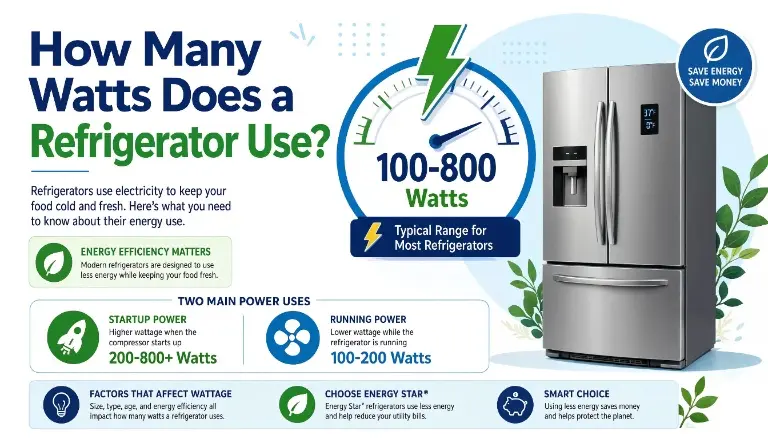
Most refrigerators use between 100 and 800 watts of electricity, depending on their type, size, and age. That’s a wide range for a single appliance. The reason it’s so wide is that the number printed on your fridge’s label isn’t the same as what it actually draws hour to hour.
Before you can estimate your electric bill, size a generator, or plan a solar system around your fridge, it helps to know which “watts” number you’re actually looking at. Here’s a complete guide to understand which number actually matters for your bill.
Most Refrigerators Use 100-800 Watts
A typical home refrigerator draws 100 to 800 watts, with most full-size units falling somewhere in the 300-600 watt range. That range is wide on purpose. A compact mini fridge and a large French door refrigerator with an ice maker are both “refrigerators,” but they pull very different amounts of power.
Three things drive most of the spread: type and size (bigger units with more features draw more), age (older units are often meaningfully less efficient than current Energy Star models), and region (wattage figures based on real measurements can run lower than U.S. label-based ranges, partly due to differences in standard voltage and how the number was calculated).
None of that tells you your actual electric bill, though — for that, you need kilowatt-hours (kWh), not watts. That label number and what your fridge actually draws day to day are two different things, worth untangling first.
| Specification | Stated Wattage | Running Wattage |
| Measurement Definition | Peak power draw during active cooling | Average power consumption over 24 hours |
| Power Range | 300 – 800 Watts | 100 – 267 Watts |
| Duty Cycle Dependency | Independent of duty cycle | Dependent on 80% to 90% active compressor cycle |
| System Load Impact | Represents maximum momentary load | Determines total daily kilowatt-hours (kWh) |
How Do Hardware Variables Impact Actual Refrigerator Power Draw?
According to appliance electrical testing protocols in 2026, inline power meters provide exact power usage measurements.
| Note |
| A power meter records total kilowatt-hours over a continuous 24-hour baseline period. |
Refrigerator duty cycles increase based on interior load volume, ambient kitchen temperatures, and door opening frequency. Explicit stated wattage vs. running wattage comparisons dictate accurate residential electrical load calculations. Total household load calculations ensure safe electrical system upgrades. Nedes.us executes EV charger installation. We do not provide chargers but only install them. Accurate baseline meter readings determine exactly how many watts does a refrigerator use.
How to Calculate Your Refrigerator’s Exact Wattage
If your fridge’s label only lists volts and amps instead of watts, the formula is simple:
Volts × Amps = Watts
You’ll find this information on the EnergyGuide label (usually just inside the fridge door or on the interior wall) or on the manufacturer’s nameplate.
Here’s a fully worked example, carried through every step:
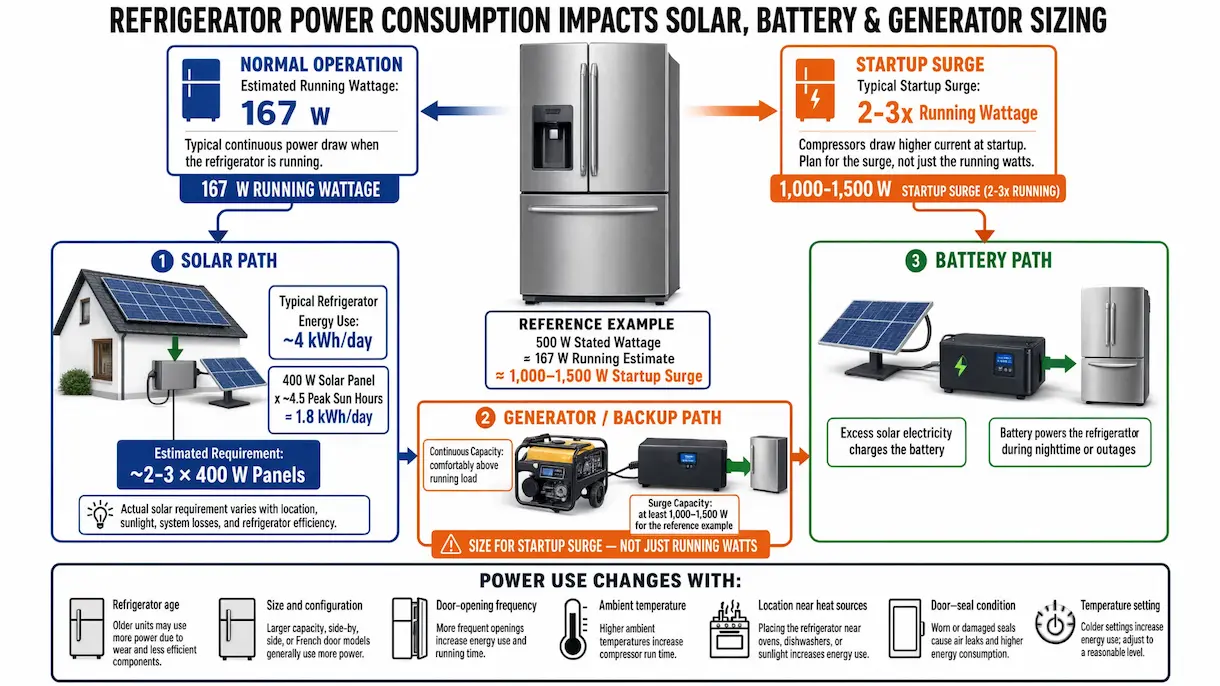
- Stated wattage: 500 W (from the label, or calculated as volts × amps)
- Estimated running wattage: 500 W ÷ 3 = 167 W
- Daily energy use: 167 W × 24 hours ÷ 1,000 = 4 kWh/day
- Monthly energy use: 4 kWh × 30 days = 120 kWh/month
- Annual energy use: 4 kWh × 365 days = 1,463 kWh/year
That third step (multiplying by 24 hours before converting to kWh) is easy to skip, and skipping it produces a badly understated annual figure. It’s worth double-checking any refrigerator wattage calculator or article against this full chain before trusting its numbers.
Different refrigerator types land in very different parts of the overall wattage range, so here’s the breakdown.
Refrigerator Wattage by Type and Size
| Refrigerator Type | Typical Wattage Range |
| Mini/compact (under 10 cu ft) | 50-100 W |
| Top-freezer (standard) | 300-500 W |
| Bottom-freezer | 350-600 W |
| Side-by-side | 400-800 W |
| French door | 500-800 W |
| Large capacity (28+ cu ft) | 600-800+ W |
Side-by-side and French door models tend to run at the higher end of the range for two reasons: they simply cool more volume, and they’re more likely to include higher-draw extras like built-in ice makers and water dispensers.
Mini and compact fridges sit at the opposite end. Smaller volume to cool means a much smaller compressor and a correspondingly lower draw. With a wattage range in hand, here’s how to turn that into what actually shows up on your bill.
How Many kWh Does a Refrigerator Use? (Day, Month, Year)
Using the 167 W running-wattage example from above, here’s what a typical full-size refrigerator uses over different time periods:
| Time Period | Energy Used |
| 1 day | 4 kWh |
| 1 week | 28 kWh |
| 1 month | ~120 kWh |
| 1 year | ~1,463 kWh |
Every figure in this table is derived directly from the same 167 W running-wattage estimate, using the full calculation chain from the section above, including the 24-hours-per-day step.
If your own fridge’s stated wattage is higher or lower than 500 W, you can rerun the same formula with your number to get your own table. Once you know the kWh, the dollar cost is one more step.
How Much Does It Cost to Run a Refrigerator?
To convert energy use into a dollar figure, multiply your kWh by your electricity rate:
kWh × Electricity Rate = Cost
At the U.S. national average residential rate of roughly $0.17 per kWh (Energy Information Administration data, current as of this writing), the reference fridge from the examples above costs approximately:
| Period | Cost (at $0.17/kWh) |
| Monthly | ~$20.40 |
| Annually | ~$249 |
Your actual cost will vary meaningfully by state (electricity rates range from roughly $0.10/kWh to well over $0.25/kWh depending on where you live) so treat the figures above as a national baseline and check a recent bill for your own exact per-kWh rate. Always verify the electricity rate you’re using is current; rates have risen substantially over the past several years, so a rate figure that’s more than a year or two old will understate your real cost.
Regular running cost is one thing, but a fridge also briefly demands far more power the moment it starts up.
Starting (Surge) Watts & Why It Matters for Generators and Solar
Every figure above describes running watts. This is the electricity your fridge draws in wattage while it’s operating normally. But when the compressor first kicks on, it briefly pulls much more power than that: typically 2 to 3 times its running wattage, for just a second or two, as the motor overcomes initial resistance.
This surge barely registers on your monthly electric bill, since it lasts only moments. But it matters enormously if you’re sizing equipment that has to supply power to the fridge. It includes a generator, a battery backup system, or a solar inverter.
Equipment sized only for running watts can fail to start the compressor at all, even though it would handle the fridge just fine once running. That surge number is exactly what you need before sizing a generator, battery, or solar system for a fridge.
How Many Solar Panels or How Big a Generator Does a Refrigerator Need?
A refrigerator is a heavy-duty home appliance that needs enormous watts to start-up even though it reduces the electricity usage later on. Here’s a complete overview of number of solar panels and generator size needed for a refrigerator to function ideally.
For Solar
Take your fridge’s daily kWh figure (4 kWh in our running example) and divide by your local daily solar production per panel. A single 400 W panel in a location with around 4.5 peak sun hours per day produces roughly 1.8 kWh. So, covering a 4 kWh/day fridge would take about 2-3 panels of that size, with a little headroom for cloudy days and system losses. Larger, less efficient fridges, or locations with fewer peak sun hours, will need more.
For Generators Or Battery Backup
Size the equipment to comfortably handle the starting watts from the section above, not just the running watts. For a fridge with a 500 W running estimate, a startup surge of 1,000-1,500 W is reasonable to plan for.
So, look for a solar generator or inverter rated at least that high on its surge capacity, not just its continuous rating. Undersizing for the surge, rather than the ongoing draw, is the most common mistake in refrigerator backup-power planning.
Beyond equipment sizing, a handful of real-world factors change how much power your specific fridge actually draws.
What Affects Refrigerator Power Consumption?
Refrigerator performance is not the only thing that changes with time. Its electricity consumption can also keep varying with passing time. Here’s the list of factors that impact a refrigerator’s power consumption:
● Age
Refrigerators more than 10-15 years old can use meaningfully more energy than a current Energy Star-certified model of the same size.
● Size And Type
Larger units and side-by-side/French door configurations draw more, as shown in the table above.
● Location
A fridge placed near a heat source (oven, direct sunlight) or in a poorly ventilated spot has to work harder to stay cool.
● Usage Habits
Frequent or prolonged door-opening, and running the fridge nearly empty, both increase compressor workload.
● Door Seal Condition
Worn or cracked gaskets let cold air escape, forcing the compressor to run more often.
● Temperature Setting
Setting the fridge colder than necessary increases energy use disproportionately.
Several of those factors are also the easiest ones to fix, which is where real savings come from.
How to Reduce Your Refrigerator’s Energy Use
1. Set The Right Temperature
Aim for 35-38°F in the fridge and 0-5°F in the freezer. It is colder than that wastes energy without a food-safety benefit.
2. Clean The Condenser Coil
Every six months or so, clean the condenser coil. Dust-covered coils make the compressor work harder.
3. Check Your Door Seals
If a dollar bill slides out easily when closed in the door, the gasket may need replacing.
4. Give It Breathing Room
Keep a few inches of clearance around the unit so heat can dissipate properly.
5. Minimize Door-Opening Tim
Let hot food cool before placing it inside.
6. Consider Upgrading.
Upgrading a unit that’s 15+ years old is the best approach to reduce the electricity usage of a refrigerator. The efficiency gap versus a current Energy Star model is often large
Get a Free 15-min Consultation To Find Out What Solar Can Do For Every Appliance In Your Home!
Get a personalized, no-obligation estimate based on your actual energy use.
The Bottom Line
Understanding how many watts your refrigerator uses is the first step toward accurately calculating your household energy consumption. Whether you want to lower your monthly electric bill or size a reliable backup system, knowing these exact numbers empowers better decisions. Ready to transition to renewable energy? Book a free 15-minute consultation session and know more about our expert solar installation services online today.
Frequently Asked Questions
How many watts does a mini fridge use?
Mini and compact refrigerators typically use 50-100 watts, substantially less than full-size units. Energy Star-certified compact models tend to land at the lower end of that range.
How many kWh does a refrigerator use per day?
A typical full-size refrigerator uses roughly 3-6 kWh per day, depending on its size and efficiency, with a common reference figure of about 4 kWh/day for a mid-size unit running at an estimated 167 W average.
How many solar panels does it take to run a refrigerator?
Most refrigerators need roughly 2-3 standard 400 W solar panels to cover their daily energy use, based on a typical 4 kWh/day draw and average peak sun hours. Larger or older, less efficient fridges may need more.
Do bigger refrigerators use more watts?
Generally, yes. Larger units have to cool more interior volume, and bigger configurations like side-by-side and French door models are also more likely to include higher-draw features such as ice makers, pushing their typical wattage higher than compact or standard top-freezer models.
How can I find my refrigerator’s exact wattage?
Check the EnergyGuide label (usually inside the fridge, on a shelf or the door lining) or the manufacturer’s nameplate for volts and amps, then multiply them together. For a precise, measured reading instead of a label-based estimate, a plug-in power meter left on the fridge for 24 hours will show you actual usage.
What size generator do I need to run a refrigerator?
Size the generator for the refrigerator’s starting watts, not just its running watts — typically 2-3 times the running wattage for a second or two at startup. A generator that only covers running watts may fail to start the compressor even though it could power the fridge once it’s already running.