
How Do Solar Panels Actually Work?
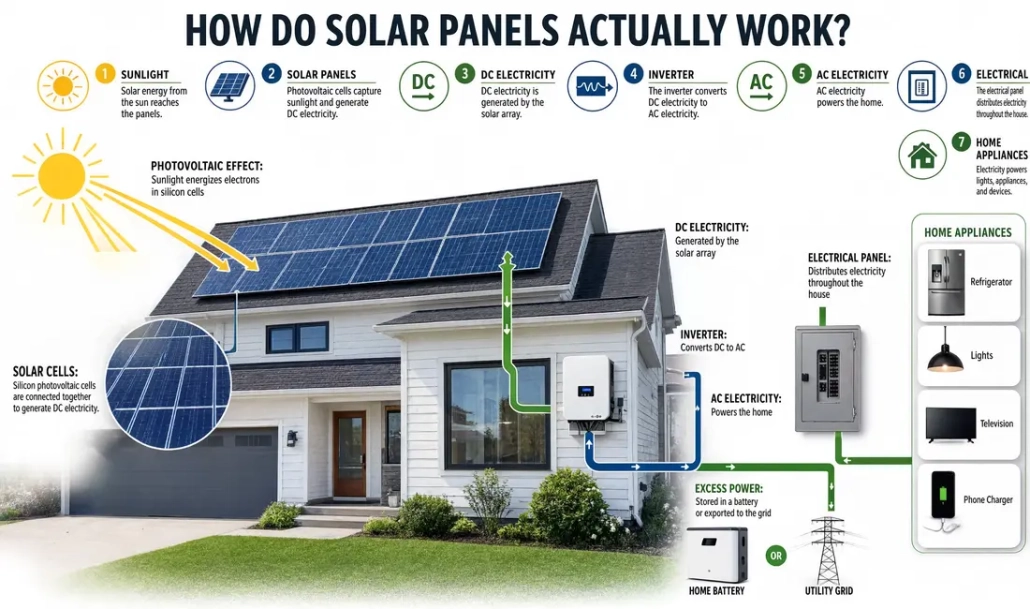
Solar panels work by converting sunlight directly into electricity through a process called the photovoltaic effect. Sunlight striking a solar cell knocks electrons loose from atoms inside the cell, and an internal electric field sets those electrons moving in a single direction, producing an electric current.
That current then travels through an inverter, which converts it into the type of electricity your home actually uses, before flowing through your electrical panel to power everything from your refrigerator to your phone charger.
That’s the one-sentence version! However, if you’ve ever wondered exactly what’s happening inside a panel, why you need an inverter at all, or what occurs when your system makes more power than your house needs, this guide walks through the complete process, step by step, from sunlight to wall outlet.
Quick Answer: Solar Panels Convert Sunlight Into Electricity via the Photovoltaic Effect
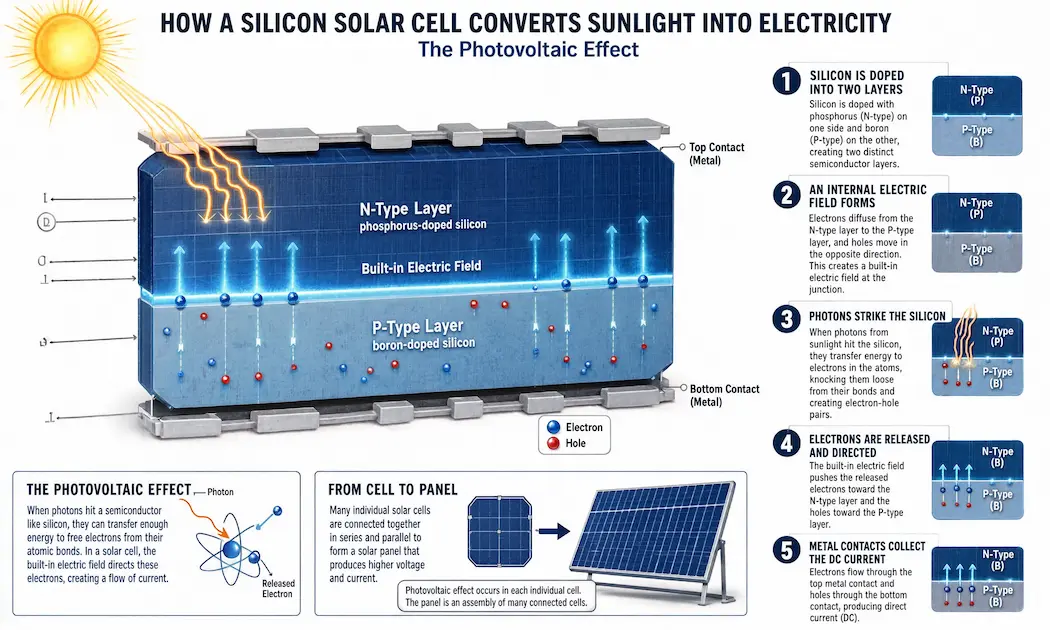
The photovoltaic effect is the property of certain materials, called semiconductors, that lets them generate an electrical current when exposed to light. Solar panels are built from cells made of one of these semiconductor materials, almost always silicon, layered and treated in a specific way to create an electric field inside the cell. When photons of sunlight hit that field, they knock electrons loose and set them flowing, and that flow of electrons is electricity.
The rest of this guide covers three stages that build on each other:
- Cell-level generation. How an individual solar cell turns light into a small electric current
- DC-to-AC conversion. The way an inverter turns that current into something your home can actually use
- Whole-system distribution: Tackles how that electricity gets from your roof to your outlets, and what happens to any of it you don’t use right away
Each stage depends on the one before it, so it helps to start with where the electricity actually comes from. Learn more about why your solar panels stop working in our detailed guide.
What Is the Photovoltaic Effect? (History and Definition)
If you’ve searched around for who actually invented solar panels, you’ve probably noticed different sources credit different people. That’s because “inventing solar power” isn’t really one moment. It’s three separate milestones, and each one answers a slightly different version of the question.
The Earliest Introduction To Photovoltaic Effect
Edmond Becquerel discovered the underlying photovoltaic effect in 1839, at age 19, while experimenting with metal electrodes in a conducting solution. He noticed the setup produced more electricity when exposed to light. That was the scientific discovery: certain materials generate current when light hits them.
The First Patented Solar Cell
Russell Ohl patented a practical, modern-style silicon solar cell in 1941. This was the first version that resembled what’s actually inside a panel today, a treated silicon wafer capable of producing usable current.
Start of Practical Photovoltaic Technology
Daryl Chapin, Calvin Fuller, and Gerald Pearson, working at Bell Labs, built on that in 1954, developing the first silicon solar cell efficient enough to power everyday electrical equipment rather than just laboratory instruments. This is usually considered the birth of practical photovoltaic technology, and it’s the direct ancestor of the cells in a panel on a roof today.
So depending on what you mean, the honest answer is: Becquerel discovered the effect, Ohl built the first practical cell, and the Bell Labs team made it genuinely useful. All three answers are correct.
What Are Solar Panels Made Of?
A typical solar panel is a fairly simple stack of a few key materials, each doing a specific job. Here are the primary ones:
1. Silicon solar cells
The working part of the panel, arranged in a grid and wired together. Most residential panels use either:
- Monocrystalline cells (cut from a single silicon crystal, more efficient, more expensive)
- Polycrystalline cells (made from silicon fragments, historically cheaper, though monocrystalline has become the dominant residential choice as prices have converged).
If you’re comparing the two for a purchase decision, our full monocrystalline vs polycrystalline comparison breaks down the tradeoffs.
2. Glass Casing
It is a protective, weather-resistant cover over the cells. With time the glass keeps getting better, enhancing the protection for inner photovoltaic cells.
3. Back sheet and insulation layer
It protects against heat buildup and moisture underneath the glass, both of which reduce a panel’s output over time.
4. Anti-reflective coating
In the most advanced solar panels, this coating is applied to the cell surface so more sunlight is absorbed instead of bouncing off before it can be converted.
5. Wiring
The wiring is the only thing that connects the individual cells and carries the current out of the panel toward the rest of the system.
None of these materials generate electricity on their own. It’s the silicon cells, specifically how they’re treated during manufacturing, that make the whole thing work.
How a Solar Cell Turns Sunlight Into Electricity (Step by Step)
Here’s exactly what happens inside a single solar cell, from sunlight hitting the surface to electricity flowing out:
1. Silicon is “doped” into two layers
One layer is treated with phosphorus, giving it extra electrons (the negative side). The other is treated with boron, leaving it short on electrons (the positive side).
2. Electric Field Created
Where the two layers meet, the imbalance between them forms a built-in electric field, similar in principle to what happens inside a battery.
3. Photons hit the cell and knock electrons loose
Sunlight arrives as photons, tiny packets of energy. When a photon with enough energy strikes the silicon, it dislodges an electron from its atom.
4. The electric field sets those electrons in motion
Rather than drifting randomly, the loosened electrons are pushed by the field to flow in one consistent direction.
5. Metal contacts capture t|he current
Thin metal contacts on the cell’s surface collect this flow of electrons and route it into the panel’s wiring, producing direct current (DC) electricity.
That’s the entire mechanism at the cell level. One cell only produces a small amount of power, which is why panels wire dozens of cells together, and why a full system uses many panels wired into an array.
Book Your Free Consultation Now
From DC to AC: What a Solar Inverter Does
The electricity coming off your panels is direct current, meaning it flows in one steady direction, the same way electricity flows out of a battery. The problem is that homes, and the electrical grid itself, run on alternating current (AC), which reverses direction rapidly (50 to 60 times per second in most grids). Your panels can’t power your home directly. That conversion job belongs to the inverter.
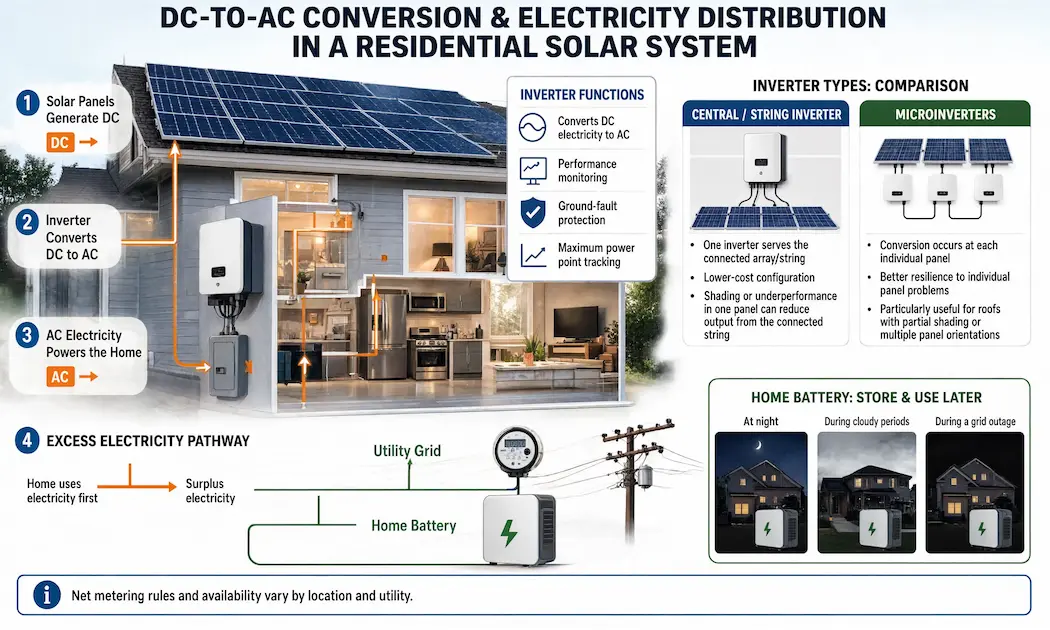
An inverter’s core function is converting DC electricity from your panels into usable AC electricity. Beyond that single job, inverters typically also handle a few supporting functions: ground fault protection (a safety feature that shuts things down if there’s a wiring fault), performance monitoring (tracking voltage, current, and total energy production), and maximum power point tracking (continuously adjusting to squeeze the most output out of the panels under changing light conditions).
Central Inverters vs Microinverters
There are two common ways to set up this conversion, and the choice has real consequences for how your system performs.
Central (Or String) Inverters
This type of inverter converts DC to AC for your entire array at once. All your panels feed into one inverter, usually mounted on an exterior wall. This is typically the lower-cost option, but it has a meaningful downside: if one panel is shaded, dirty, or underperforming, it can drag down the output of the whole string connected to it.
Microinverters
They flip that setup around, converting DC to AC at each individual panel rather than for the whole system. If one panel has a problem, the rest keep performing normally. This resilience comes at a higher equipment cost, but for roofs with partial shading or panels facing multiple directions, it often pays for itself in extra production.
How a Complete Home Solar System Works
Put the cell-level mechanism and the inverter together, and here’s the full pipeline, from sunlight to a working outlet:
- Sunlight hits the panels on your roof.
- Each panel generates DC electricity through the photovoltaic effect described above.
- DC electricity flows to the inverter (or inverters, if you’re using microinverters).
- The inverter converts DC to AC electricity.
- AC electricity flows to your home’s electrical panel (the breaker box), the same entry point your utility-supplied electricity normally uses.
- Electricity is distributed throughout your home, powering outlets and appliances exactly the way grid electricity would. Nothing about how you use the power changes.
This is the complete process. If your system is producing more electricity than your home is using at any given moment, which happens often in the middle of a sunny day, that surplus has to go somewhere, and that’s the next question worth answering.
What Happens to Excess Solar Electricity?
Most homes don’t use electricity at a perfectly steady rate, and most solar systems don’t produce at a perfectly steady rate either, so there’s frequently a mismatch between what your panels are making and what your house needs right now. There are two main ways that extra electricity gets used.
Exported To The Grid
In a standard grid-tied system, surplus electricity automatically flows back out to the utility grid. In areas with Solar net metering, your utility credits you for that exported power, effectively letting you “bank” daytime surplus against nighttime or cloudy-day usage. Net metering rules and availability vary significantly by location and utility, so it’s worth checking what applies where you live.
Stored In A Home Battery
Instead of (or in addition to) exporting to the grid, a battery lets you store surplus solar power on-site and draw on it later, at night, during a cloudy stretch, or during a grid outage when export isn’t an option anyway. Many systems use both: export what the battery doesn’t need, and hold back enough to cover typical evening usage. If you’re weighing whether a battery makes sense for your situation, that’s a big enough decision to deserve its own dedicated look.
Do Solar Panels Work at Night or on Cloudy Days?
At night, no. Solar panels need light, not heat, to generate current, and without sunlight there’s no photovoltaic effect happening at all. This is exactly why grid connection or battery storage matters for a typical home system: something has to cover nighttime usage, since the panels themselves go dormant after sunset.
On cloudy days, yes, just at reduced output. Panels don’t need direct, unobstructed sunlight to work. They still generate electricity from diffuse light that passes through cloud cover, just meaningfully less than they would under a clear sky. The exact reduction depends on how thick the cloud cover is, but it’s a real, ongoing drop in production rather than a full stop.
Other Solar Cell Technologies
Nearly all residential solar panels use silicon cells, but it’s worth knowing a couple of other technologies exist, since you may come across the terms.
Thin-Film Cells
They are a category of lightweight, often flexible solar cells made from materials other than standard crystalline silicon (including cadmium telluride and amorphous silicon, among others). They’re less common on residential rooftops but show up in specialty and portable applications.
Perovskite And Tandem Cells
These cells represent one of the more active areas of current solar research. Perovskite is a class of engineered materials that can be layered on top of a standard silicon cell to capture a wider portion of the light spectrum than silicon alone, pushing efficiency well beyond what a conventional panel achieves. Manufacturers have posted tandem-cell efficiency records well above the 20–23% typical of standard commercial silicon panels, though these advanced cells are still primarily a research and early-commercialization technology rather than something on most rooftops today.
For a full breakdown of the mainstream choice most homeowners actually face today, see our monocrystalline vs. polycrystalline comparison.
Solar PV vs. Solar Thermal: What’s the Difference?
It’s easy to lump these together since both use “the sun” as their energy source, but they’re genuinely different technologies solving different problems.
Solar PV (what this entire guide has covered) generates electricity through the photovoltaic effect described above.
Solar thermal panels don’t generate electricity at all. They simply capture heat directly from sunlight to warm water or air, most commonly for a home’s hot water system. There’s no photovoltaic effect involved, no electron flow, just direct heat transfer.
At a larger scale, concentrated solar power (CSP) takes a related but distinct approach: mirrors focus sunlight onto a receiver to generate intense heat, which then drives a steam turbine to produce electricity. CSP is used almost exclusively in utility-scale power plants, not in homes.
Understanding this mechanism, cell to inverter to outlet, is really the foundation for every other solar decision you’ll make. Once you know how the system works, questions like how many panels you’d actually need, how much energy a single panel produces, or what a system would cost start to make a lot more sense.
See what solar could look like on your own roof. A personalized estimate from our solar installation company factors in your home’s actual sun exposure, roof layout, and electricity usage, no generic assumptions. Get your free solar estimate!
Frequently Asked Questions
What is the photovoltaic effect?
The photovoltaic effect is the property of certain semiconductor materials, most commonly silicon, that lets them generate an electric current when exposed to light. It’s the basic physical process behind every solar panel, discovered by Edmond Becquerel in 1839.
What does a solar inverter do?
A solar inverter converts the direct current (DC) electricity your panels produce into alternating current (AC) electricity, the type your home’s outlets and the electrical grid actually use. It also typically handles safety monitoring and performance tracking.
Who invented the solar panel?
There isn’t one single inventor. Edmond Becquerel discovered the underlying photovoltaic effect in 1839. Russell Ohl patented the first practical silicon solar cell in 1941. Daryl Chapin, Calvin Fuller, and Gerald Pearson at Bell Labs developed the first silicon cell efficient enough for everyday use in 1954. Each answer is correct depending on exactly what you’re asking.
What’s the difference between solar panels and solar thermal panels?
Solar (PV) panels generate electricity through the photovoltaic effect. Solar thermal panels don’t generate electricity at all; they capture heat directly from sunlight to warm water or air, most often for a home’s hot water supply.
How is a solar cell different from a solar panel?
A solar cell is the individual unit that converts light into a small amount of electricity. A solar panel is many cells wired together, which is necessary because a single cell alone produces far too little power to be useful on its own.