
SRECs in Washington, D.C., Maryland, and Pennsylvania in 2026
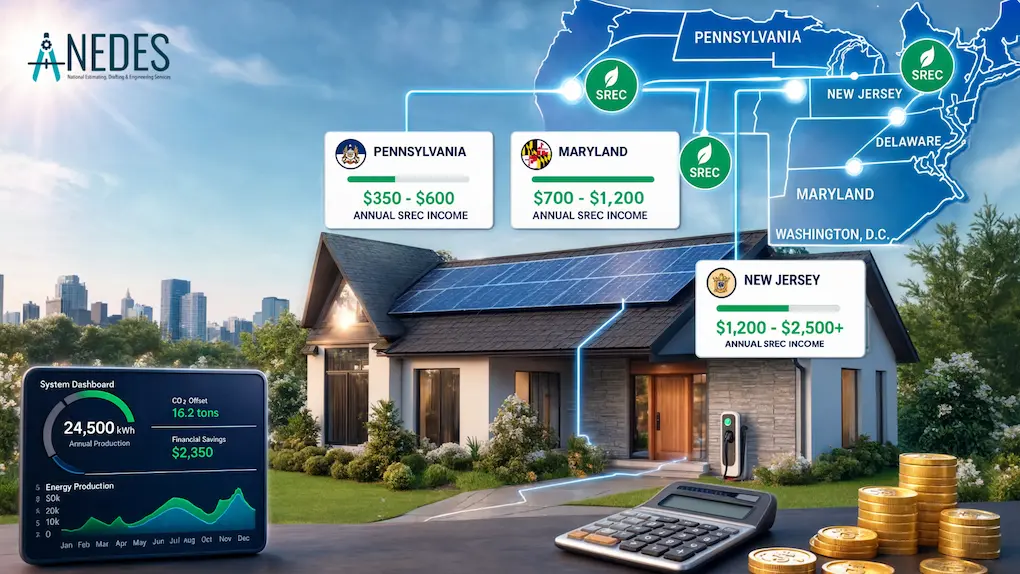
A homeowner in Washington, D.C., with an 8 kW system earns $2,800–$4,250 per year in Solar Renewable Energy Credit (SREC) income for up to 15 years. A homeowner in Maryland with the same system earns $540–$900 per year. And a homeowner in southeastern Pennsylvania earns $250–$480 per year.
All three states enjoy the same solar technology with the same sunlight. The difference is entirely determined by which state’s SREC market the system participates in. Let’s get that, along with how SRECs work, what each state pays, and how to start earning.
What Is a Solar Renewable Energy Credit (SREC)?
A Solar Renewable Energy Credit (SREC) is a tradable certificate issued automatically when a solar system generates 1,000 kilowatt-hours (kWh) of electricity, representing the clean-energy value of that production separately from the electricity itself.
How Solar Systems Generate SRECs: kWh, MWh, and Certificate Issuance?
A kilowatt-hour (kWh) is a unit of energy equal to 1,000 watts used for one hour. A megawatt-hour (MWh) equals 1,000 kWh. When a solar system produces 1,000 kWh, two separate assets are created simultaneously. The electricity flows into the home or to the grid and earns net metering credits on the utility bill.
The SREC is issued to the homeowner’s account in PJM-GATS, which is the PJM Generation Attribute Tracking System. This regional registry issues and tracks solar certificates in the Mid-Atlantic. These two assets are valued separately and are earned from the same solar production.
Why Do SRECs Exist?
SRECs exist because states with Renewable Portfolio Standards (RPS) require utility companies to source a specified percentage of their electricity from solar each year. An RPS is a state law mandating that a defined share of electricity sold by utilities comes from renewable sources.
Utilities that fail to meet the solar requirement must purchase SRECs from homeowners and businesses or pay a state fine called the Alternative Compliance Payment (ACP). The ACP is the price ceiling for SRECs: utilities pay no more for an SREC than it costs to pay the fine instead. According to the Database of State Incentives for Renewables and Efficiency, the ACP is $45/SREC in Maryland through 2026 and approximately double the average SREC price in Pennsylvania.
Who Qualifies to Earn SRECs?
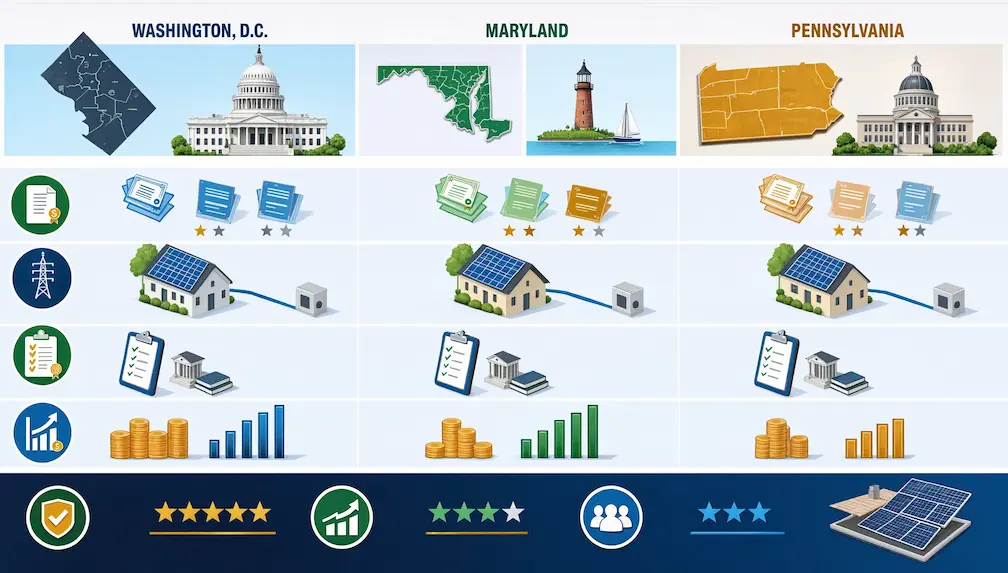
Only the owner of the solar system qualifies to earn SRECs, which means the homeowners who financed with a solar loan or paid cash own the system and receive the credits.
Leases and PPAs Forfeit Your SRECs
Homeowners who finance through a solar lease or PPA do not own the system and receive no SRECs. Understanding how a lease, cash purchase, and PPA differ matters here; under any third-party ownership arrangement, the leasing company owns the panels and receives every SREC generated.
How Much Does SREC Income Leasing Cost You?
In Washington, D.C., where SRECs trade at $350–$425 each as of Xpansiv Managed Solutions, a homeowner who leases instead of owns an 8 kW system forgoes $3,500–$4,250 per year in SREC income. Over a 15-year SREC eligibility period, that totals $52,500–$63,750 in foregone income; it is an amount that exceeds the typical cost of a residential solar installation.
SREC Eligibility Rules by State: Washington DC, Pennsylvania, and Maryland
Additional eligibility requirements apply across all three markets.
- DC caps participating systems at 5 MW. Maryland requires systems of 5 MW or less with a revenue-grade production meter.
- Pennsylvania requires registration with the Pennsylvania AEPS administrator and PJM-GATS. Only photovoltaic (PV) solar systems qualify in Pennsylvania; solar thermal systems do not generate SRECs. Registration timing matters critically:
- Maryland does not issue SRECs retroactively, so a system interconnected in November 2024 that is not registered until February 2025 permanently loses two months of income.
How Does the DC SREC Market Work?
Washington, D.C., operates the most valuable residential SREC market in the United States in 2026, with SRECs trading at $350–$425 per credit; it is 4-7x higher than Maryland and 10-15x higher than Pennsylvania.
DC’s 100% Renewable Goal Driving SREC Demand
DC’s Renewable Portfolio Standard requires 100% renewable electricity by 2032, with a 15% solar carve-out, which means 15% of all electricity sold in DC must come specifically from solar. According to the DC Public Service Commission, the DC ACP is set at $440/MWh in 2026.
Only solar systems located within the 68-square-mile District of Columbia or on specific DC Pepco distribution feeder lines extending into Maryland qualify for DC SRECs, permanently capping supply. DC SRECs also carry a 5-year useful life from the date of generation, the longest window in the Mid-Atlantic region, according to DSIRE.
Why Will DC SREC Prices Drop After 2028?
The DC ACP declines from $400/MWh in the 2024–2028 period to $300/MWh in 2029–2041, creating structural downward pressure on SREC prices after 2028. Homeowners who lock in multi-year forward contracts before 2029, selling SRECs at today’s prices for 3–5 years, protect against that price drop. Homeowners who sell on the spot market will follow prices down as the ACP falls.
Can Maryland Homeowners Qualify for DC SREC Rates?
Maryland homeowners whose properties connect to a Pepco distribution feeder line running into DC may qualify for the DC SREC market with a difference of approximately $3,000–$3,500 per year for a typical 8 kW system.
Which Maryland Communities Qualify?
According to Xpansiv Managed Solutions, feeder lines run through parts of Montgomery County and Prince George’s County, including Chevy Chase, Bethesda, Silver Spring, Takoma Park, and College Park.
Whether a specific address qualifies is determined by the electrical distribution connection, not the mailing address or zip code. Feeder eligibility verification is the single most financially consequential pre-installation check available to homeowners in the DC-Maryland border area.
How Does Maryland’s SREC Market Work in 2026?
Maryland’s SREC market is undersupplied in 2026, with prices of $60–$90 per credit exceeding the $45/SREC Alternative Compliance Payment. It is the healthiest market condition for residential solar owners in several years.
Maryland’s SREC Program History and RPS Requirements
Maryland has operated an SREC market since 2008 under an RPS requiring utilities to source an increasing share of electricity from solar, reaching 14.5% by 2030. The Brighter Tomorrow Act, signed on May 9, 2024, created a new incentive category that directly benefits residential solar installations: the Certified SREC.
What Is a Certified SREC Under the Brighter Tomorrow Act?
A Certified SREC is a Maryland SREC worth 1.5 times the value of a standard SREC, created by the Brighter Tomorrow Act (Senate Bill 783, signed May 9, 2024), available for rooftop systems of 5 MW or less placed in service between July 1, 2024 and January 1, 2028. If a standard SREC sells for $70, a Certified SREC earns $105.
For a system generating 10 SRECs per year, the 1.5x multiplier adds $350 per year in additional income. The window closing on January 1, 2028, represents a fixed financial deadline; systems installed after that date receive standard SRECs at 1x value. According to the Maryland PSC Brighter Tomorrow Act Implementation Guidance, Maryland SRECs now carry a 5-year useful life, extended from the previous 3-year window.
Three Requirements to Qualify for a Certified SREC
Three conditions must all be met to qualify for Certified SREC status:
- Generating capacity of 5 MW or less (all residential systems qualify)
- Placed in service between July 1, 2024 and January 1, 2028
- Located on a rooftop, ground-mounted systems do not qualify for the multiplier.
| System Size | SRECs/Year | Standard SREC Income | Certified SREC Income (1.5x) |
| 6 kW | 7 SRECs | $420–$630/yr | $630–$945/yr |
| 8 kW | 9–10 SRECs | $540–$900/yr | $810–$1,350/yr |
| 10 kW | 11–12 SRECs | $660–$1,080/yr | $990–$1,620/yr |
| 12 kW | 13–14 SRECs | $780–$1,260/yr | $1,170–$1,890/yr |
How Does Pennsylvania’s SREC Market Work in 2026?
Pennsylvania’s SREC market is the weakest of the three Mid-Atlantic markets in 2026, with credits trading at $25–$40 each due to a solar carve-out of approximately 0.5% under the Alternative Energy Portfolio Standards Act (AEPS).
Why Pennsylvania’s Solar Carve-Out Keeps SREC Demand Low?
The AEPS is Pennsylvania’s renewable energy law, requiring a defined percentage of electricity sold in the state to come from alternative energy sources, including solar. A 0.5% solar carve-out generates limited utility demand relative to Maryland and DC.
From 2010 to 2017, the problem was compounded by out-of-state solar systems selling SRECs into the Pennsylvania market, causing a massive oversupply. According to SRECTrade’s market analysis, in-state PA SREC prices fell from over $300 in the mid-2000s to as low as $4 per SREC by summer 2017. Governor Wolf signed Act 40 in October 2017, closing Pennsylvania to out-of-state SREC imports. In-state prices recovered toward $40 by 2021 as the market rebalanced.
Pennsylvania SREC Earnings and Market Conditions in 2026
This year, Pennsylvania SRECs trade at $25–$40 per credit according to Flett Exchange. A 10 kW system generating 10–12 SRECs per year produces $250–$480 per year. Pennsylvania SRECs carry a 3-year useful life, which is the shortest in the region.
Pennsylvania State Senate Bill 501, introduced in 2021, increased the state’s solar carve-out from 0.5% to 5.5% by 2026. As of June 2026, that bill has not passed. Homeowners who install solar before any legislative reform takes effect participate in any improved market conditions without additional action.
How Do Pennsylvania, Maryland, and DC SRECs Compare Side by Side?
DC SRECs generate 8–17x more annual income than Pennsylvania SRECs for the same system size, with Maryland falling in the middle at 2–4x Pennsylvania’s income levels.
| Metric | Pennsylvania | Maryland | Washington DC |
| 2026 SREC Price | $25–$40/credit | $60–$90/credit (Certified: up to $135) | $350–$425/credit |
| Annual Income (10 kW) | $250–$480/yr | $600–$1,620/yr | $3,500–$4,250/yr |
| SREC Useful Life | 3 years | 5 years | 5 years |
| Solar Carve-Out | ~0.5% (AEPS) | 14.5% by 2030 | 15% by 2041 |
| ACP | ~2x avg SREC price | $45/SREC through 2026 | $440/MWh (2026) |
| SREC Eligibility | No fixed end | 15 years from interconnection | 15 years from interconnection |
| Special Program | None (reform pending) | Certified SREC 1.5x (2024–2028) | ACP phase-down to $300 in 2029 |
| Leased systems earn SRECs? | No | No | No |
Should SRECs Be Sold Spot or Through a Forward Contract?
In DC, locking in a forward contract before the 2029 ACP phase-down is the stronger strategy. In Maryland, both approaches are viable under current undersupply conditions. And in Pennsylvania, forward contracts provide certainty in a historically volatile market.
Spot Sales vs Forward Contracts
A spot market sale means an SREC broker sells each credit at the current market price when it is generated. A forward contract locks in a fixed price per SREC for a defined period, typically 3–10 years, regardless of where the spot market moves.
Best SREC Selling Strategy by State in 2026
In DC, locking in $350–$380 per SREC for 5 years before the ACP drops from $400 to $300 in 2029 protects the most income. In Maryland, aggregators offer 5–10-year fixed-rate contracts in the $65–$80/SREC range according to Xpansiv Managed Solutions; it is a reasonable floor while the market remains undersupplied. In Pennsylvania, forward contracts at $30–$35/SREC provide income certainty in a market with a documented history of oversupply collapses.
Avoid Upfront SREC Buyouts From Solar Installers
Some solar installers offer to purchase a homeowner’s SRECs upfront in exchange for a discount on the system installation price. According to 2025 studies, upfront SREC buyout offers frequently undervalue long-term SREC income, particularly in DC, where locking in a forward contract independently often yields $10,000–$15,000 more than an upfront installer buyout over the same period. An independent SREC aggregator provides a market-rate valuation and manages sales without a conflict of interest.
Is SREC Income Taxable?
SREC income is taxable at the federal level as ordinary income in all three states. Maryland and DC do not impose state income tax on SREC income. Pennsylvania taxes SREC income as ordinary income at the state level.
How does the IRS Tax SREC Earnings?
The IRS classifies SREC income as ordinary income because it constitutes proceeds from the sale of a financial asset generated by a homeowner’s property. A DC homeowner earning $4,000 per year in SREC income may owe $800–$1,400 per year in combined federal income and self-employment taxes, depending on their bracket and filing status. Consulting a tax professional familiar with renewable energy income before the first SREC sale is the correct sequence.
SRECs vs Net Metering in Terms of Tax Treatment
One structural tax distinction applies to the 2 income streams solar produces. Net metering credits are a reduction in utility expenses and are generally not classified as taxable income. SREC proceeds are cash receipts from the sale of a certificate and are classified as taxable income. Projections that treat them identically understate net SREC income after taxes.
How Do SRECs Change the Solar Payback Period?
SREC income significantly reduces the solar payback period, and when you factor in what solar panels actually cost in 2026, the numbers get even more compelling. For a 10 kW system, payback ranges from 14–16 years in Pennsylvania to 8–10 years in Maryland to just 4–6 years in DC.
| Slot | Pennsylvania | Maryland (Certified SREC) | Washington DC |
| Installed Cost | $28,000 | $28,000 | $28,000 |
| Annual Bill Savings | $1,600/yr | $1,800/yr | $2,000/yr |
| Annual SREC Income | $350/yr | $1,350/yr | $4,000/yr |
| Combined Annual Value | $1,950/yr | $3,150/yr | $6,000/yr |
| Simple Payback Period | 14–16 years | 8–10 years | 4–6 years |
| 15-Year Total Return | ~$1,250 | ~$19,250 | ~$62,000 |
Is Solar Worth It in 2026?
Homeowners asking if solar is worth it in 2026 will find that the answer varies sharply by location. The DC payback math looks fundamentally different from Pennsylvania’s, and stacking SREC income on top of available solar rebates and incentives makes the case even stronger. Even within the Mid-Atlantic, a single eligibility check for a Pepco feeder line can change a 10-year payback into a 5-year one.
How Does a Homeowner Register and Start Selling SRECs?
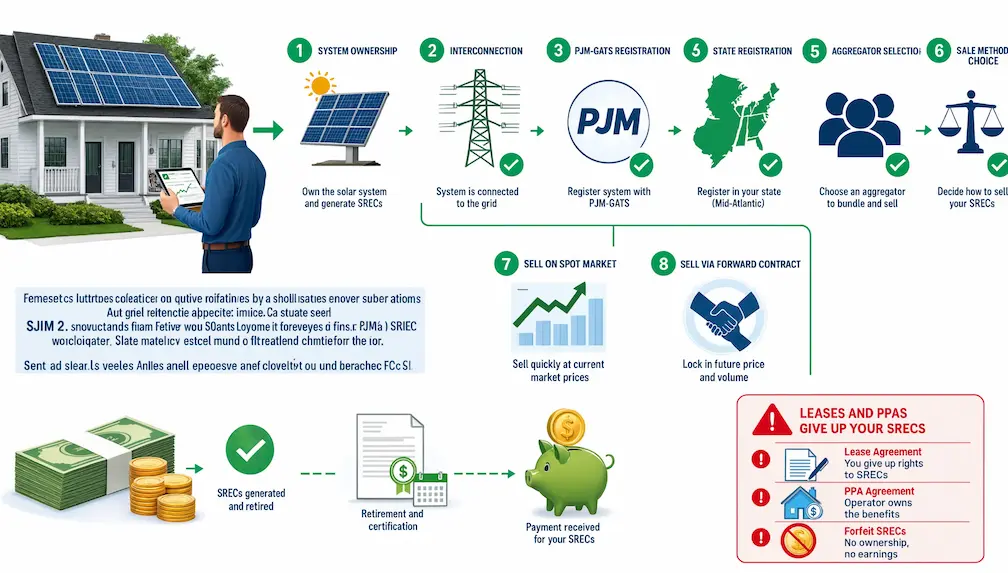
SREC registration in Maryland, Pennsylvania, and DC follows 5 steps: interconnection, PJM-GATS registration, state-level registration, aggregator selection, and sale method selection. Delays at any step result in permanently lost income that cannot be recovered retroactively.
1. Interconnect the system.
SREC eligibility in Maryland begins at the interconnection date. In Pennsylvania, eligibility begins on the date the registration application is approved by the PA AEPS administrator.
2. Register with PJM-GATS.
Your solar installation team or aggregator handles this registration. In Pennsylvania, homeowners also register separately with the Pennsylvania AEPS administrator. In Maryland, registration occurs with the Maryland Public Service Commission. In DC, registration occurs with the DC Public Service Commission.
3. Select an SREC aggregator.
An SREC aggregator is a company that manages registration, tracks production, and handles SREC sales on behalf of homeowners. Aggregators charge 5–15% of SREC proceeds in exchange for managing all administrative functions.
4. Select spot market or forward contract.
Choose between selling SRECs at current market prices through a spot sale or locking in a fixed price for 3–10 years through a forward contract with an aggregator.
5. Receive payments.
Most aggregators pay quarterly. The aggregator agreement specifies the payment cadence and method.
Note: One critical timing detail applies to Pennsylvania specifically. According to DSIRE, the PA AEPS registration process takes up to 4 months to complete. SRECs are not issued retroactively for the period before application approval. Submitting registration immediately after interconnection is the correct sequence.
What Happens to SRECs When a Solar Home Is Sold?
SRECs generated before a home sale belong to the seller; SRECs generated after a home sale belong to the buyer. Unsold SRECs in the seller’s account at closing remain the seller’s property until they expire: 3 years in Pennsylvania, 5 years in Maryland and DC. The aggregator account must be updated with new ownership information at closing.
SRECs, Home Value, and Roof Work Considerations
According to Zillow Research, homes with owned solar panels sell for approximately 4.1% more on average. In DC and Maryland, buyers increasingly factor future SREC income into purchase decisions. For homeowners who later need to modify their system for a roof replacement or home addition, solar unmount and reinstall services preserve SREC eligibility without interrupting the registration or aggregator relationship, provided the system returns to service without a change in ownership structure.
FAQs
Can I earn SRECs from a community solar subscription?
No. Community solar subscribers purchase electricity credits, not system ownership. Only the registered owner of the physical solar installation qualifies to receive SRECs in all three states.
What happens to my SRECs if my system stops working temporarily?
Your SREC registration and aggregator account remain active. SRECs are only issued when the system produces electricity, so a period of downtime simply means fewer credits are generated during that period. No eligibility is lost, and no re-registration is required when the system returns to service.
Are SRECs affected if I add more panels to my existing system?
New panels added to an existing system can generate additional SRECs, but the expansion may require a new or amended PJM-GATS registration, depending on your state’s rules.
Can a nonprofit or church earn SRECs from rooftop solar?
Yes. Nonprofits and religious organizations that own their solar system qualify for SRECs like any other system owner. Tax-exempt status affects income treatment, not SREC eligibility itself.
How long does it take to receive my first SREC payment after installation?
Typically 3–6 months. The timeline includes interconnection approval, PJM-GATS registration, and your first 1,000 kWh of production. In Pennsylvania, add up to 4 months for PA AEPS registration approval. Selecting an aggregator before or immediately after installation eliminates avoidable delays.
Conclusion
Washington, D.C., Maryland, and Pennsylvania share the same solar technology and nearly the same sunlight, but SREC income separates them completely. A DC homeowner with an owned 8 kW system can recover the full cost of installation through SREC income alone over 15 years. A Maryland homeowner installing before January 2028 captures the Certified SREC multiplier before that window closes permanently. A Pennsylvania homeowner participates in a recovering market that could reprice sharply if Senate Bill 501 eventually passes.
Three decisions determine how much SREC income a homeowner actually captures: owning rather than leasing, registering immediately after interconnection, and choosing between spot sales and a forward contract before the DC ACP phase-down in 2029.
NEDES handles every step, from system sizing and installation to PJM-GATS registration and aggregator onboarding, across all three markets. If you’re within a Pepco feeder line zone, that single eligibility check could be worth $3,000 per year.