
Battery Leasing in 2026: How to Add Home Battery Storage Without Paying Full Price Upfront
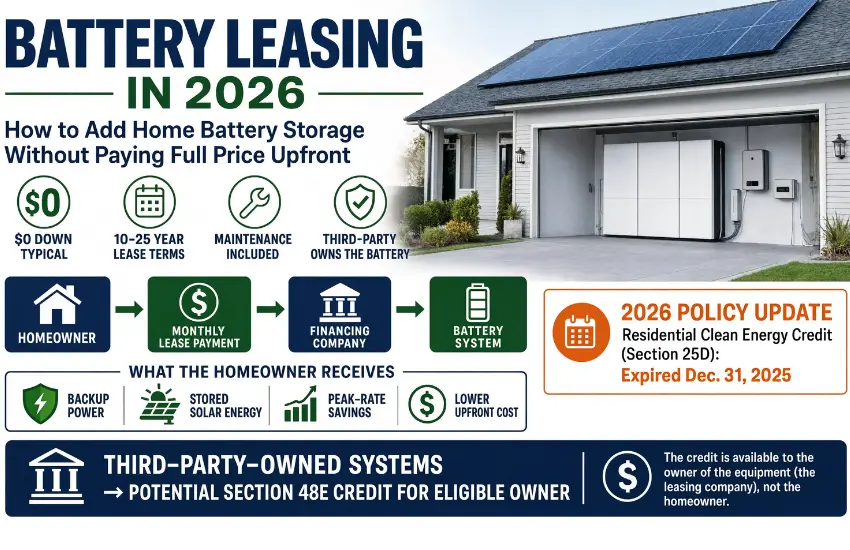
Battery leasing turned from a niche financing footnote into one of the fastest-growing ways homeowners add a home battery in 2026. So what is battery leasing, exactly? Battery leasing is a financing arrangement where a third-party company owns the battery installed at your home, and you pay a fixed monthly fee to use the electricity it stores. You never own the hardware. You never touch a maintenance invoice. You just plug into the savings.
The timing is not a coincidence. The 30% federal Residential Clean Energy Credit under Section 25D expired for cash and loan purchases on December 31, 2025, under the One Big Beautiful Bill Act. That single change reshuffled the entire battery-financing conversation, and battery leasing walked through the door it opened.
This guide breaks down how battery leasing works, what it costs, how it compares to buying, and what the rules look like in Virginia, Pennsylvania, Texas, Delaware, and Washington, D.C. NEDES offers battery leasing as one of several financing paths for Tesla Powerwall and other home battery systems, alongside cash purchase and loan options, across every one of those markets.
What Is Battery Leasing?
A battery lease is a contract in which a financing company purchases, installs, and owns a home battery system, and the homeowner pays a predictable monthly fee for the right to use its stored electricity.
The structure mirrors a solar lease. A third-party owner installs the equipment on your property, monitors it remotely, replaces failed components at their expense, and collects a flat monthly payment from you in return. You get backup power during outages, lower exposure to peak utility rates, and a hedge against rising electricity prices, all without a five-figure check on installation day.
Battery leasing differs from a battery loan in one critical way: ownership. With a loan, you own the battery from day one and build equity in it. With a lease, the finance company owns the battery for the full contract term, typically 10 to 25 years, and you are effectively renting stored electricity the same way you might rent an appliance.
Why Is Battery Leasing Trending in 2026?
Battery leasing is trending in 2026 because it is now the only path left to the 30% federal tax credit for most households buying a home battery.
Homeowners who buy a battery with cash or a loan in 2026 receive zero federal tax credit, because Section 25D expired at the end of 2025. Third-party owned systems tell a different story. Under Section 48E, the commercial Investment Tax Credit, a leasing company that owns the battery on your roof or garage wall can still claim 30% of the project cost, provided the project begins construction by July 4, 2026, or is placed in service by December 31, 2027. That credit gets baked into your monthly lease payment as a lower rate, not handed to you directly, but the savings still reach your bill.
According to Aurora Solar’s 2026 industry snapshot, 65% of solar sales teams expect third-party ownership, which includes battery leasing bundled with solar, to make up most of their 2026 projects, up from 44% the year before. That is not a marginal shift. It is a structural rewrite of how Americans finance energy storage.
A second driver sits behind the tax-credit story: grid stress. More frequent extreme-weather outages, rising time-of-use rate spreads, and data-center-driven demand growth have pushed homeowners to treat a battery as insurance, not a luxury. Leasing removes the single biggest barrier to that insurance: a $10,000 to $16,000 upfront bill.
Manufacturers have noticed the shift too. SunPower announced a national battery storage initiative in January 2026, partnering with Enphase and a consumer financing platform specifically to pair premium battery hardware with flexible, low-barrier financing. That kind of manufacturer-level push rarely happens around a financing product unless demand data justifies it, and battery leasing is the product sitting at the center of that push.
If you are still confused whether to lease or buy your solar panel systems, explore our detailed guide to make an infomed decision.
How Does Battery Leasing Actually Work?
A battery lease follows a predictable sequence from signature to activation. NEDES walks every customer through the same five steps, whether the goal is a standalone Tesla Powerwall or a battery paired with a new solar array.
- Site assessment: An engineer reviews your electrical panel, roof or ground space, and utility rate structure to size the right battery.
- Contract terms: You review the monthly payment, contract length, annual escalator (if any), and buyout options before signing anything.
- Installation: The leasing company’s certified crew installs and commissions the battery, typically within one to three days on site.
- Interconnection: The utility inspects and approves the system for parallel operation, a step that can take one to six weeks depending on jurisdiction.
- Monthly service: You pay a fixed fee; the provider handles all monitoring, firmware updates, and warranty repairs for the full term.
| Not Sure Which Financing Path Fits Your Home?
Book a free, no-pressure 15-minute consultation with a NEDES energy advisor. We’ll walk through cash, loan, and battery leasing side by side for your specific roof and rate plan. |
Battery Leasing vs. Buying vs. Loan: Which Actually Saves More?
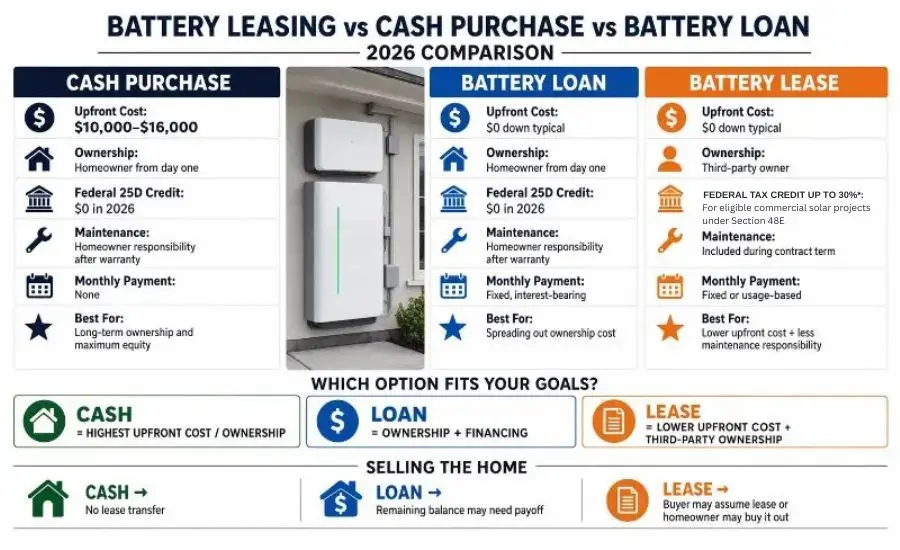
The right structure depends on your tax situation, your timeline in the home, and how much cash you want tied up in one asset. The table below lines up the three paths side by side for a typical 13.5 kWh residential battery in 2026.
| Factor | Cash Purchase | Battery Loan | Battery Lease |
| Upfront cost | $10,000–$16,000 | $0 down (typical) | $0 down (typical) |
| Federal tax credit | $0 (25D expired 2025) | $0 (25D expired 2025) | Up to 30% via Section 48E, passed through as a lower rate |
| Ownership | Homeowner, day one | Homeowner, day one | Third-party owner for the lease term |
| Maintenance & repairs | Homeowner’s responsibility after warranty | Homeowner’s responsibility after warranty | Included for the full contract term |
| Monthly payment | None | Fixed, interest-bearing | Fixed (or usage-based on a battery PPA) |
| Home sale impact | Adds equity, no transfer needed | Loan balance may need payoff | Buyer must assume lease or you buy it out |
Cash purchase still delivers the highest lifetime return for homeowners who can absorb the upfront cost and plan to stay in the home for a decade or more. A battery loan is the middle path: you keep ownership and eventually stop paying, but you also absorb 100% of the maintenance risk once the manufacturer’s warranty runs out. Battery leasing wins on day-one affordability and on access to a tax credit that direct buyers can no longer claim. It gives up long-term equity in exchange for zero maintenance risk and a lower barrier to entry.
What Does NEDES Include In A Battery Leasing Package?
NEDES structures battery leasing as one financing lane alongside cash and loan purchase, and it is available for every battery brand the company installs, including the Tesla Powerwall 3.
A Tesla Powerwall 3 stores 13.5 kWh of usable capacity and delivers 11.5 kW of continuous output, which is roughly double the output ceiling of most competing home batteries. As a Tesla-certified installer, NEDES configures every leased or purchased Powerwall for time-of-use optimization, shifting stored solar power to the hours when utility rates peak, and for whole-home outage backup sized to essential circuits.
Battery leasing through NEDES is not limited to new installations. The company’s related services fold directly into a leased or owned battery system, so a single point of contact handles the entire storage lifecycle:
- Battery and inverter installation, sized to your panel capacity and utility interconnection limits.
- System add-on panels and inverter upgrades for homeowners expanding an existing array before adding storage.
- Solar panel unmount and remount service, so a roof replacement never voids a battery lease or a panel warranty.
- Tesla Powerwall certified installation and time-of-use programming for leased or purchased units.
- 24/7 customer support for the life of the system, regardless of financing structure.
NEDES also carries an insurance-backed lifetime warranty through Align Solar Protection on top of standard equipment coverage, an added layer of protection that matters most for homeowners who eventually buy out a lease and take on ownership themselves. Because a battery lease can run for two decades, working with an installer that has a long-term regional presence, rather than a national telemarketing outfit that may not answer the phone in year twelve, is worth weighing as heavily as the monthly rate itself.
Is Battery Leasing Regulated By The Government?
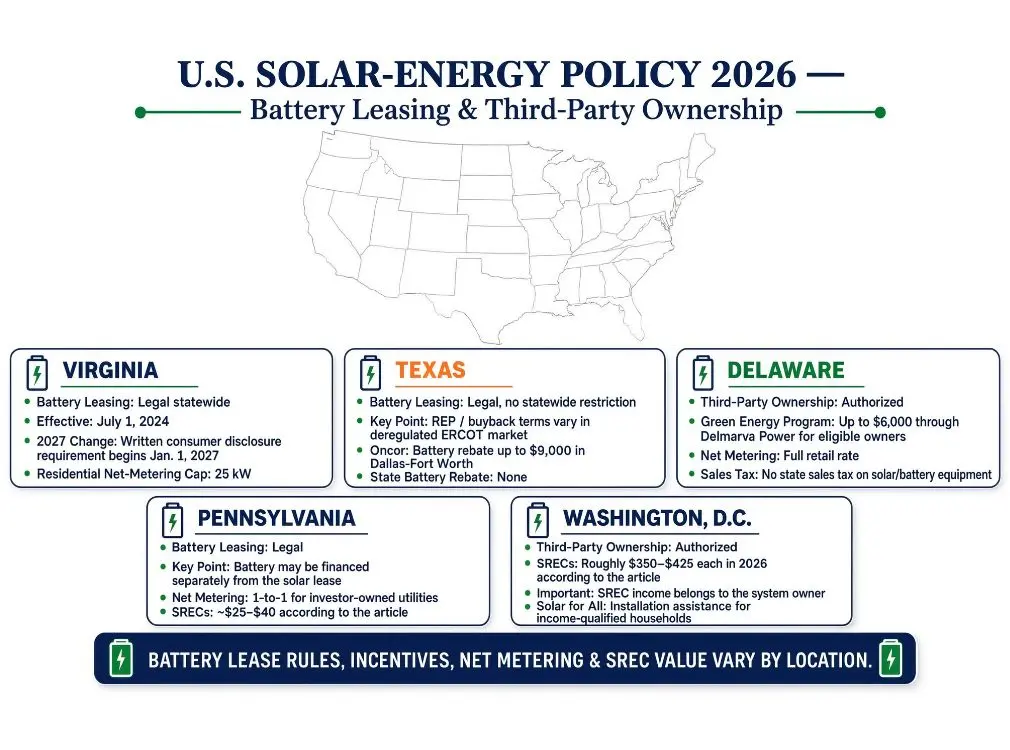
Battery leasing is regulated at the state level, not the federal level, and the rules governing third-party ownership vary widely from state to state. The federal government’s role is limited to tax treatment: Section 48E determines who can claim the 30% credit, and the U.S. Treasury’s Foreign Entity of Concern (FEOC) rules determine which battery components qualify.
Everything else, including whether a leasing company can even operate in your state, who regulates consumer contracts, and what disclosures a lease must include, is decided by state legislatures and public utility commissions. According to the U.S. Environmental Protection Agency, at least 28 states plus Washington, D.C. and Puerto Rico currently authorize third-party solar and storage ownership in some form. The five markets below, where NEDES operates directly, each handle it differently.
Battery Leasing Regulations by State in 2026
Virginia
Virginia legalized third-party solar and battery leasing statewide through House Bill 1062 and Senate Bill 271, effective July 1, 2024, ending years of utility-territory restrictions on rooftop leasing.
- Statewide legal since July 1, 2024; no utility-territory restrictions on rooftop battery leasing.
- Senate Bill 823 (2026) requires a written consumer disclosure form for every sale, lease, or PPA, signed before the contract, enforced by the Board for Contractors starting January 1, 2027.
- Companion Energy Storage Reform bill (SB 448/HB 895) raises statewide battery storage targets and pushes localities toward consistent safety ordinances.
- Residential systems, including battery additions, are capped at 25 kW under Virginia’s net-metering statute.
Pennsylvania
Pennsylvania permits solar and battery leasing, but with one structural quirk that trips up out-of-state comparisons: most PA lease partners bundle solar into the lease and finance the battery separately.
- Battery leasing is legal; most lease partners still finance the battery on a separate loan or lease from the solar contract itself.
- Public Utility Commission stays neutral on storage ownership, declining to prescribe a preferred model in its official policy statement.
- Every investor-owned utility offers mandatory 1-to-1 net metering.
- SRECs trade in the $25–$40 range, but a leasing company keeps that income for the contract term, not the homeowner.
Texas
Texas has no statewide law restricting solar or battery leasing, and the deregulated ERCOT market actually makes leasing easier to structure than in single-utility states.
- No statewide restriction on solar or battery leasing; Retail Electric Providers compete on buyback rates instead of one monopoly utility setting the terms.
- No state battery rebate and no state income tax credit, making the Section 48E pass-through inside a lease the single largest 2026 incentive available.
- Oncor offers a battery-specific rebate up to $9,000 in Dallas-Fort Worth, stackable with a leased or owned system.
- Texas’s 100% property tax exemption (Tax Code §11.27) applies to a leased system’s assessed value the same way it applies to an owned one.
Delaware
Delaware is one of the states the EPA lists as fully authorizing both solar leases and Power Purchase Agreements, with no special license required beyond standard contractor registration.
- Fully authorized third-party ownership state per the U.S. EPA’s TPO map. That means leases and PPAs are both allowed.
- Green Energy Program rebate (up to $6,000 through Delmarva Power) goes only to system owners, not lessees.
- Full retail-rate net metering applies regardless of who owns the battery.
- Zero state sales tax on solar or battery equipment, which lowers the total project cost a leasing company finances, and your monthly rate.
Washington, D.C.
The District explicitly permits third-party ownership and runs the most valuable SREC market of the five jurisdictions covered here.
- Explicitly authorized TPO jurisdiction, named directly in the U.S. EPA’s third-party ownership list.
- SRECs trade between roughly $350–$425 each in 2026. But that income belongs to whoever owns the system, so a leasing company captures it on a leased battery.
- Solar for All covers installation outright for income-qualified households through the DC Sustainable Energy Utility (FY2026 waitlist currently active).
- Pepco credits exports at full retail rate for systems under 100 kW, regardless of financing structure.
Quick-glance summary of all five markets as of 2026:
| State / District | Third-Party Leasing Status | 2026 Development to Know |
| Virginia | Legal statewide since July 1, 2024 | SB 823 mandates a written consumer disclosure form starting January 1, 2027 |
| Pennsylvania | Legal; PUC neutral on storage ownership | Battery often financed separately from the solar lease itself |
| Texas | Legal; no statewide restriction | Deregulated ERCOT market widens REP and buyback options for leased systems |
| Delaware | Legal; EPA-listed TPO state | Green Energy Program rebate limited to system owners, not lessees |
| Washington, D.C. | Legal; EPA-listed TPO jurisdiction | High-value SRECs ($350–$425) accrue to the system owner, not the lessee |
What Should You Check Before Signing A Battery Lease?
A battery lease contract should answer six questions clearly before you sign anything.
- Escalator clause: Does the monthly payment increase every year, and by how much?
- Contract length: Most battery leases run 10 to 25 years. Confirm the exact term in writing.
- Performance guarantee: What happens if the battery underperforms its stated capacity or cycles?
- Home-sale provisions: Can a buyer assume the lease, and what does a buyout cost if they can’t or won’t?
- Maintenance scope: Confirm firmware updates, monitoring, and full component replacement are included at no extra charge.
- FEOC compliance: Ask whether the battery components meet Foreign Entity of Concern sourcing rules, since noncompliant equipment can jeopardize the Section 48E credit the lease pricing depends on.
Solar United Neighbors, a national consumer advocacy group, recommends reading the escalator schedule line by line rather than trusting the first-year payment figure, since a monthly rate that looks attractive in year one can climb meaningfully by year ten under a 2 to 4% annual escalator.
Is Battery Leasing Right For You?
A short conversation with a licensed installer, ideally one who can quote cash, loan, and lease pricing side by side, will settle the question faster than any online calculator. NEDES provides all three structures on the same visit, with written, itemized pricing before a contract is ever signed.
Ready To See Real Numbers For Your Home?
Get a free, written, itemized quote comparing cash, loan, and battery leasing for a Tesla Powerwall or comparable system, sized to your roof and utility rate. No pressure, no obligation.
Think about it the way you’d think about a car. Buying outright costs more on day one but ends in ownership. A loan splits the difference. A lease keeps the monthly number low and hands maintenance headaches to someone else, in exchange for never quite calling the battery yours. None of those choices is objectively wrong. The right one is simply the one that matches how long you plan to stay, how much cash you want parked in a garage wall, and how much you value not thinking about a warranty claim at 2 a.m. during a blackout.
Frequently Asked Questions About Battery Leasing
Can You Lease A Battery Without Also Leasing Solar Panels?
Yes, standalone battery leases exist, though they remain less common than solar-plus-battery leases in 2026. A standalone battery lease works well for homeowners who already own their solar array outright and simply want to add storage without disturbing that existing equity.
Does Battery Leasing Qualify For The Federal Tax Credit In 2026?
Not directly for the homeowner, but indirectly, yes. The leasing company, as the system owner, claims the 30% Section 48E credit and is expected to reflect that savings in a lower monthly rate, since that is the entire economic incentive built into third-party ownership after Section 25D expired.
What Happens To A Battery Lease If I Sell My Home?
The new owner typically has two options: assume the remaining lease term, or you buy out the contract before closing. Most lease agreements spell out a fair-market-value buyout formula, and some buyers are willing to assume a lease with an attractive rate as part of the purchase negotiation.
Is A Battery Lease Better Than A Solar Loan For A Battery?
It depends on your priorities. A loan builds equity and eventually reaches a $0 monthly payment, while a lease never ends without a buyout, but a lease shifts 100% of maintenance and performance risk to the provider and captures the 30% federal credit indirectly, something a loan purchase cannot do in 2026.
How Long Do Battery Lease Contracts Typically Run?
Most residential battery leases run between 10 and 25 years, matching the typical warranty life of the battery itself. Shorter contracts exist but are less common, since the leasing company needs enough term length to recover its installation cost through monthly payments.
Does NEDES Offer Battery Leasing For The Tesla Powerwall?
Yes, NEDES offers battery leasing as a financing option for the Tesla Powerwall and other home battery systems, alongside cash and loan purchase. As a Tesla-certified installer operating in Virginia, Pennsylvania, Texas, Delaware, and Washington, D.C., NEDES can quote and compare all three financing paths for a Powerwall or comparable battery during a single consultation.