
Virginia Solar Permitting Guide 2026: Building Permits, Electrical Permits, and Interconnection Approval
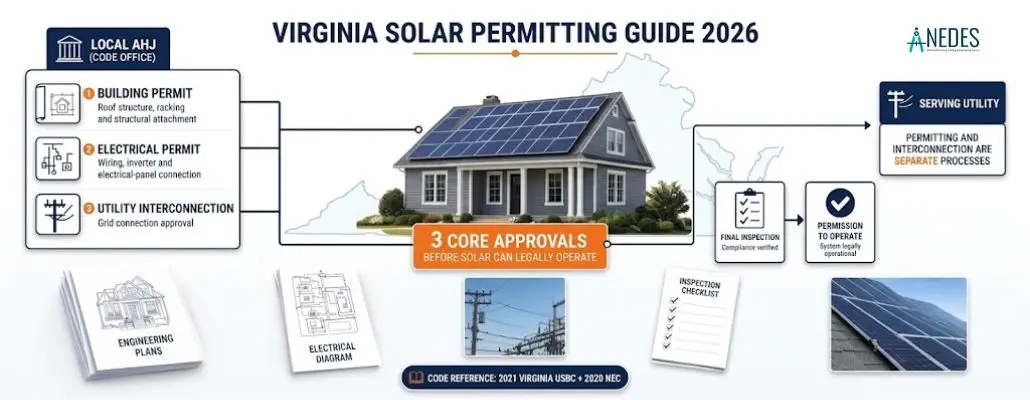
Virginia solar permitting process in 2026 runs through three separate approvals: a local building permit, a local electrical permit, and a utility interconnection request. Remember that a different authority issues each one.A locality’s building department controls the first two approvals under the 2021 Virginia Uniform Statewide Building Code. Dominion Energy, Appalachian Power, or an electric cooperative controls the third.Costly permitting delays cancel roughly 15% of Virginia solar projects, according to 2026 legislative testimony from the nonprofit Permit Power. This guide walks through every stage of the current Virginia solar permitting process, from code requirements and contractor licensing through inspection and utility sign-off.
Virginia Solar Permitting at a Glance
Five distinct approvals make up a typical Virginia solar project. The table below shows who issues each one and what it confirms before the next step can begin.
| Step | Who Issues It | What It Confirms |
| Building Permit | Local AHJ | Roof or ground-mount structure meets the USBC |
| Electrical Permit | Local AHJ | Wiring and equipment meet the 2020 NEC |
| Utility Interconnection Request | Dominion Energy, Appalachian Power, or a cooperative | System is safe to connect to the grid |
| Final Inspection | Local AHJ | Completed work matches the approved plan set |
| Permission to Operate (PTO) | Serving utility | System can legally be switched on |
What Is the Virginia Solar Permitting Process?
The Virginia solar permitting process is the sequence of building, electrical, and utility approvals a solar installation must clear before it can legally generate power.
An Authority Having Jurisdiction, or AHJ, is the local government office, typically a county or city building department, responsible for reviewing construction plans and issuing permits within its boundaries. Virginia enforces a single statewide building code, but each AHJ still sets its own submission portal, review queue, and documentation checklist.
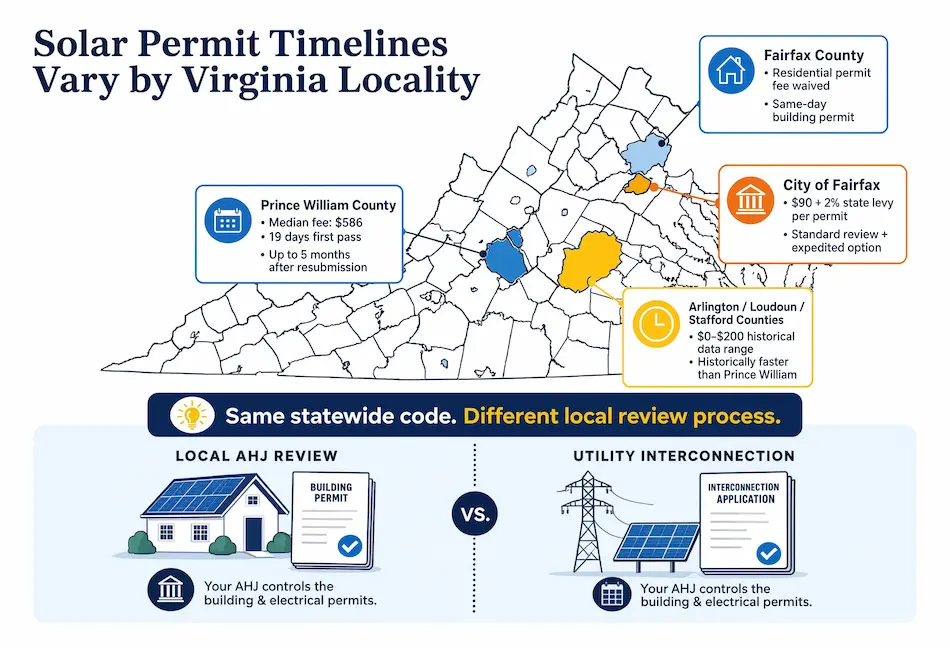
A homeowner in Fairfax County and a homeowner in Prince William County follow the same code, yet they can see very different review timelines. The code and the local review process are two separate layers, and both have to clear before a system can be installed.
How Does the Virginia Uniform Statewide Building Code Apply to Solar?
The Virginia Uniform Statewide Building Code, or USBC, is the single construction code that governs every building project in the Commonwealth, including rooftop and ground-mounted solar arrays. The current USBC cycle, effective since January 18, 2024, adopts the 2021 International Building Code family alongside the 2020 National Electrical Code (P&W Solar, 2026).
A locality cannot substitute an older or unrelated code cycle, though individual AHJs still control their own procedures and required documentation. Coastal jurisdictions carry an added structural layer: homes in Hampton Roads and other coastal flood zones face higher wind-load design values under the USBC, so a rooftop array in Virginia Beach or Norfolk typically needs a structural calculation that an inland system in Roanoke does not.
Rooftop vs. Ground-Mount Solar Permitting: What’s Different
Both installation types need a building permit and an electrical permit, but the review focus shifts depending on where the array sits.
| Factor | Rooftop System | Ground-Mount System |
| Primary structural review | Roof rafter or truss load capacity | Footing depth and frost line |
| Common added requirement | Re-roofing or flashing detail | Zoning setback from property lines |
| Fire code focus | Rapid-shutdown labeling, roof access pathways | Perimeter clearance and access for fire equipment |
| Typical extra review step | Coastal wind-load calculation (Hampton Roads) | HOA or zoning administrator sign-off |
Typical Solar Permitting Timeline, Start to Finish
A full Virginia solar project moves through five stages between contract signing and Permission to Operate. Actual dates shift by AHJ and utility, but the sequence itself stays the same everywhere in the Commonwealth.
- Stage 1: Site assessment and plan set preparation, typically 1-2 weeks
- Stage 2: Building and electrical permit submission and review, ranging from same-day to several months depending on the AHJ
- Stage 3: Installation and physical construction, usually 1-3 days for a residential rooftop system
- Stage 4: Final building and electrical inspection, scheduled after installation and typically completed within 1-2 weeks of request
- Stage 5: Utility interconnection review and Permission to Operate, commonly 2-6 weeks after the inspected system and permit copies are submitted
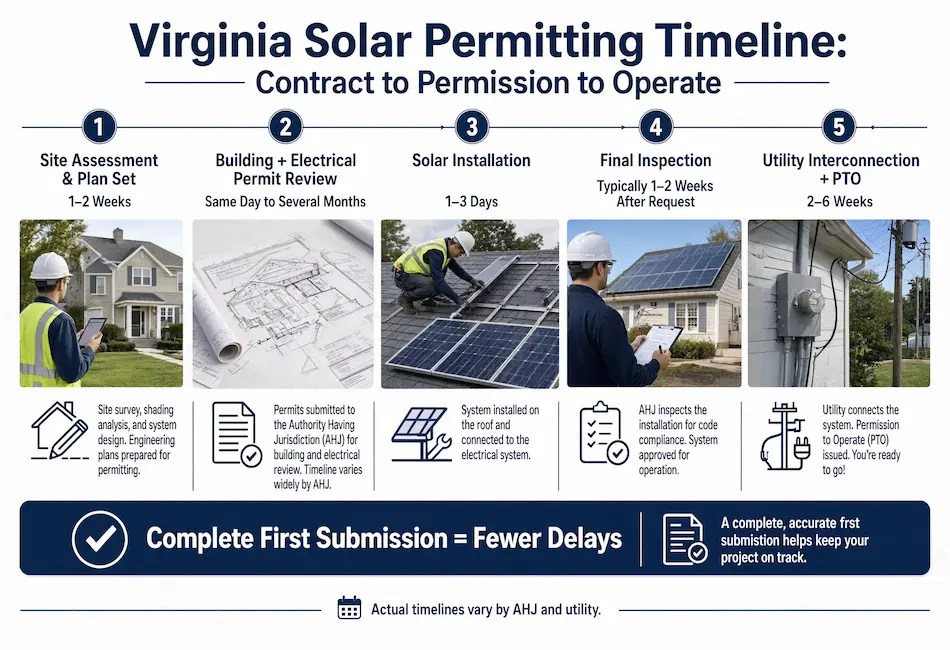
Permit review is the stage most likely to stretch a project timeline, which is why a complete first submission matters more than any other single factor.
How Long Does Solar Permitting Take in Virginia?
Solar permitting timelines in Virginia range from same-day approval to several months, and the gap depends almost entirely on which AHJ reviews the application.
Fairfax County waives its residential solar permit fee entirely and issues same-day building permits, a track record that earned the county a SolSmart Gold designation in 2026 for streamlined solar permitting. The independent City of Fairfax charges $90 plus a 2% state levy for each of its building and electrical permits and offers an Expedited Plan Review Program for qualifying projects.
Prince William County presents a longer path: a 2023 Energy News Network analysis of federal Solar Trace data found the county’s median solar permitting fee at $586, more than double the $0 to $200 range charged by four neighboring counties, with first-pass approvals averaging 19 days and resubmission cases stretching to five months.
| Locality | Permit Fee | Typical Timeline |
| Fairfax County | Waived (residential) | Same-day building permit |
| City of Fairfax | $90 + 2% state levy, per permit | Standard review; expedited option available |
| Prince William County | Median $586 | 19 days (first pass); up to 5 months (resubmission) |
| Arlington, Loudoun, Stafford Counties | $0-$200 (2023 data) | Faster than Prince William historically |
Virginia’s New Smart Solar Permitting Platform
The Commonwealth Smart Solar Permitting Platform is a statewide automated review tool created by House Bill 590 and Senate Bill 382 in 2026 that is designed to instantly issue permits for code-compliant residential solar systems. The Virginia Department of Energy must establish and launch the platform by July 1, 2027, under new Code of Virginia § 45.2-1735. Every Virginia locality must accept the state platform, or an equivalent local automated system, by January 1, 2028.
The platform will process applications covering rooftop photovoltaic panels, energy storage systems, and main electrical panel upgrades in a single automated review. Compared with the current AHJ-by-AHJ process, where identical systems can clear review in 19 days in one county and five months in a neighboring one, the automated platform is built to issue a compliant permit the same day it is submitted.
Book Your Free 15-Minute Consultation
Not sure which permitting path applies to your roof, your utility territory, or your county’s current review queue? Book a free 15-minute consultation with a NEDES permitting specialist before you submit anything.
Do You Need a Licensed Contractor to Pull a Solar Permit in Virginia?
Yes. Virginia requires a solar installer to hold a Class A, B, or C contractor license issued by the Department of Professional and Occupational Regulation (DPOR) Board for Contractors before pulling a residential or commercial solar permit. Virginia licenses contractors at the business level rather than the individual level, a structure that differs from states that certify individual solar installers directly.
The license class sets the maximum contract and annual project value the business may legally perform, while a separate specialty designation determines whether that license actually covers photovoltaic work. A homeowner should confirm both the license class and the specialty before signing a contract, since a valid Virginia contractor license without the correct specialty cannot legally pull a solar permit.
| License Class | Single-Project Limit | Minimum Net Worth |
| Class A | $120,000 or more | $45,000 |
| Class B | $10,000 up to $120,000 | $15,000 |
| Class C | Up to $10,000 | No minimum set |
Permit Application Documents Checklist
Most Virginia AHJs ask for the same core package for a residential solar permit, though a few localities add extra items. Assembling every item below before submission avoids the single most common cause of first-round rejection. Contact our solar panel installation company to get more insights on the complete checklist.
- Signed and sealed site plan or plot plan showing the array location
- Single-line electrical diagram covering panels, inverter, and disconnects
- Manufacturer specification sheets for panels, inverters, and racking
- Structural attachment or wind-load calculation for the racking system
- Proof of the contractor’s DPOR license class and specialty
- Homeowner’s insurance documentation (required by some utilities before interconnection)
- HOA approval letter or architectural review sign-off, where applicable
Utility Interconnection: Dominion Energy and Appalachian Power Approval Levels
Interconnection is the utility’s formal authorization to connect a customer-owned solar system to the electric grid, and it is a separate step from the building and electrical permits issued by the AHJ. Dominion Energy and Appalachian Power both sort interconnection requests into three tiers set by Chapter 314 of the Virginia Administrative Code.
| Level | System Capacity | Application Fee |
| Level 1 | Up to 500 kW | $100 |
| Level 2 | Up to 2 MW (not Level 1 eligible) | $1,000 |
| Level 3 | Above Level 2 thresholds | $1,000 |
Most residential rooftop systems fall under the Level 1 process. A complete interconnection request needs site control documentation, a single-line diagram, equipment specifications, and a site map, largely the same core documents an AHJ requires for the electrical permit.
Utilities generally withhold Permission to Operate until the customer submits copies of the approved building and electrical permits alongside the interconnection paperwork. Sequencing the three approvals correctly, permits first, then interconnection, saves weeks on a typical project.
Electric Cooperatives: A Different Interconnection Path
A Virginia homeowner served by an electric cooperative rather than Dominion Energy or Appalachian Power follows a separate interconnection process set by that cooperative’s own board, not by the State Corporation Commission’s investor-owned utility rules.
- BARC Electric Cooperative sets its own net metering and interconnection application, separate from the Dominion and Appalachian Power forms
- Rappahannock Electric Cooperative reviews interconnection requests through its own member services process
- Northern Neck Electric Cooperative and A&N Electric Cooperative each maintain independent interconnection rules and community solar programs
A homeowner in cooperative territory should confirm the cooperative’s own application form and fee schedule before assuming the Dominion Level 1, 2, or 3 process applies. Local building and electrical permitting still runs through the same AHJ and USBC rules regardless of which utility or cooperative serves the property.
Historic Districts and Overlay Zoning Review
A property inside a locally designated historic district often needs an added layer of review before the building permit issues. An architectural review board typically evaluates panel visibility from a public street rather than the system’s electrical design.
- Alexandria’s Old and Historic District and similar designations in Fredericksburg and Richmond route solar applications through a design review step
- Ground-mounted arrays and rear-roof placement generally clear historic review faster than a street-facing rooftop array
- A property in a separate zoning overlay, such as an airport height overlay, may face additional setback or height review before the building permit issues
Confirming historic district or overlay zoning status with the local planning office before finalizing a system layout avoids a design change late in the permitting process.
Battery Storage and Panel Upgrade Permitting in 2026
A battery energy storage system, or ESS, generally needs its own building and electrical permit review, separate from the solar array it pairs with, because it introduces its own fire code and clearance requirements.
- Indoor battery installations typically require minimum clearance from doors, windows, and habitable rooms under the fire code adopted alongside the USBC
- Outdoor pad-mounted batteries follow separate setback rules from property lines and structures
- A main electrical panel upgrade needed to support a larger system requires its own electrical permit, evaluated for service capacity under the 2020 NEC
- Virginia’s Smart Solar Permitting Platform, once launched, is designed to process battery storage and panel-upgrade permits in the same automated review as the solar array itself
Confirming battery placement and any required panel upgrade before submitting the building permit application prevents a second, separate review cycle later in the project.
HOA Rules and Virginia’s Solar Access Law
Virginia law prohibits a homeowners association from banning solar panels outright unless the recorded declaration itself contains that prohibition. This protection is codified at Virginia Code §§ 55.1-1820.1 and 55.1-1951.1 for property owners’ associations and condominiums, effective October 1, 2022. Board-adopted rules or bylaws alone cannot create a ban; only the recorded declaration can.
An HOA may still impose reasonable restrictions on the size, place, and manner of a solar installation. A restriction stops being reasonable once it raises installation costs more than 5% above the original proposal or cuts expected energy production by more than 10%.
A homeowner disputing a restriction needs documentation from a solar specialist certified by the North American Board of Certified Energy Practitioners (NABCEP) and licensed in Virginia. An HOA retains full authority to prohibit solar equipment on common elements and shared common areas, regardless of what the declaration says about individually owned property.
Request a Free Site Inspection
HOA restrictions, roof condition, and coastal wind-load rules all affect what a permit application needs to include. Request a free site inspection, and NEDES will document your roof, shading, and structure before a single form gets submitted.
What Happens During the Solar Inspection Process?
A final inspection follows permit issuance and physical installation, and it is the step that converts an approved permit into a legally operating system.
- The building inspector checks structural attachment, flashing, and roof penetrations against the approved plan set.
- The electrical inspector verifies rapid-shutdown compliance, grounding, conductor sizing, and disconnect placement under the 2020 NEC.
- A passed inspection produces a signed inspection record that becomes part of the utility interconnection package.
- A failed inspection generates a correction notice, and the installer must resolve every listed item before scheduling a re-inspection.
Only after both permits close out and the utility issues Permission to Operate can the system legally switch on and begin generating power.
Common Permitting Delays and How to Prevent Them
- Incomplete single-line diagrams cause more first-round rejections than any other single document, based on installer feedback compiled by GreenLancer in 2026.
- Missing site control documentation stalls utility interconnection review even when the building and electrical permits are already approved.
- A missing structural wind-load calculation in coastal AHJs adds one to two full review cycles when it is not submitted with the initial application.
- A mismatch between a contractor’s DPOR license specialty and the scope of work triggers an automatic hold in most jurisdictions.
- Battery storage or panel-upgrade paperwork submitted after, rather than with, the original solar application often forces a separate review cycle.
Submitting a complete, jurisdiction-specific package on the first attempt remains the single most reliable way to avoid the delays that account for roughly 15% of canceled Virginia solar projects.
Ready to Start Your Virginia Solar Permit Application?
NEDES manages every stage of the Virginia solar permitting process for homeowners and businesses across Dominion Energy and Appalachian Power territory, from the building and electrical permit package through utility interconnection and final Permission to Operate. For the incentive and net-metering side of a Virginia solar project, see NEDES’s companion guide to Virginia solar incentives and net metering.
Get a free, itemized quote from NEDES that accounts for your county’s permitting timeline, your utility’s interconnection level, and any HOA or coastal wind-load requirements specific to your property.
Frequently Asked Questions
Can I install solar panels without a permit in Virginia?
No. Every grid-connected solar installation in Virginia needs a building permit and an electrical permit from the local AHJ, regardless of system size, before the utility will approve interconnection.
Who is the Authority Having Jurisdiction for my property?
The AHJ is almost always the building department of the city or county where the property sits. An independent city, such as the City of Fairfax, has its own AHJ separate from the surrounding county.
Does a small rooftop system still need an electrical permit?
Yes. Virginia does not exempt small residential systems from the electrical permit requirement, since the 2020 NEC provisions for rapid shutdown and grounding apply regardless of system size.
How much does a solar permit cost in Virginia?
Fees vary by locality. Fairfax County waives its residential solar permit fee, the City of Fairfax charges $90 plus a 2% state levy per permit, and Prince William County’s median fee runs $586, so confirming the fee schedule with the specific AHJ is worthwhile before budgeting a project.
What happens if my HOA denies my solar application?
An HOA cannot deny an application outright unless its recorded declaration contains an explicit solar prohibition. A homeowner can challenge an unreasonable restriction with documentation from a NABCEP-certified solar specialist under Virginia Code §§ 55.1-1820.1 and 55.1-1951.1.
Do I need a separate permit for a battery storage system?
Yes, in most jurisdictions. A battery energy storage system typically needs its own building and electrical permit review because it carries separate fire code clearance and disconnect requirements from the solar array itself.
Can I start construction before my permit is approved?
No. Installing a system before the AHJ issues the building and electrical permits exposes the homeowner to stop-work orders, fines, and a forced re-inspection of completed work, and it can delay utility interconnection further than waiting for approval in the first place.