
Maryland Solar Access Program (MSAP)
The Maryland Solar Access Program (MSAP) is a state-funded solar grant that pays up to $7,500 to income-eligible Maryland homeowners who install a new solar photovoltaic (PV) system.
What is the Maryland Solar Access Program, who qualifies, and how does the application process work in 2026? This article answers each question with figures from the Maryland Energy Administration (MEA) and current Maryland market data.
What is the Maryland Solar Access Program (MSAP)?
The Maryland Solar Access Program is a grant of $750 per kilowatt (kW) of installed solar DC capacity, with a maximum of $7,500, administered by the MEA for income-eligible Maryland homeowners.
The Maryland General Assembly created MSAP through the Brighter Tomorrow Act of 2024 (Chapter 595, Senate Bill 783), signed by Governor Wes Moore on May 9, 2024. According to the MEA (2024), the program is codified in §9-2016 of the State Government Article of the Annotated Code of Maryland. The MEA funds MSAP through Maryland’s Strategic Energy Investment Fund (SEIF), a dedicated state clean energy account.
MSAP FY2027: Apply by May 31, 2027 or Until Funds Run Out
MSAP replaced the previous $1,000 Residential Clean Energy Rebate, which ended at the conclusion of FY2025. According to the MEA FY26 program page, the FY2026 budget of $12,000,000 was fully reserved before the April 2026 portal closed. According to the MEA Notice of Intent, the FY2027 program is confirmed with an anticipated deadline of 3:00 PM Eastern Time, May 31, 2027, or until funds are exhausted — whichever comes first.
Who Qualifies for the Maryland Solar Access Program?
An MSAP applicant qualifies by meeting four conditions:
- Household gross income at or below 150% of the statewide Maryland median income
- Ownership of the property as a primary residence (see property conditions below)
- Selection of an MEA-approved contractor offering residential solar installation services in Maryland.
- Installation of a new solar PV system on a Maryland residential property
A solar photovoltaic (PV) system is an installation of panels that convert sunlight directly into electricity using semiconductor cells.
What is the MSAP Income Limit by Household Size?
According to the MEA FY26 Funding Opportunity Announcement 2026, a four-person household qualifies with an annual gross income below approximately $130,950.
MEA calculates limits annually using data from the Maryland Department of Housing and Community Development (DHCD). Verify FY27 figures at energy.maryland.gov when the FY27 announcement is published.
| Household Size | Approx. FY26 Income Limit (150% AMI) | Max Grant |
| 1 person | ~$91,700 | $7,500 |
| 2 persons | ~$104,800 | $7,500 |
| 3 persons | ~$117,900 | $7,500 |
| 4 persons | ~$130,950 | $7,500 |
| 5 persons | ~$141,450 | $7,500 |
| 6 persons | ~$151,900 | $7,500 |
What Income Sources Count Toward the MSAP Limit?
According to the Maryland DHCD, MSAP uses gross household income from all household members to determine eligibility. This includes wages, salaries, tips, self-employment income, Social Security payments, pensions, dividends, interest income, rental income, and lottery winnings.
What is excluded? DHCD excludes capital gains, gifts, loans, tax refunds, college scholarships, and child support payments. A homeowner with modest wages and a one-time capital gain does not count that gain toward the limit. A homeowner with significant rental or dividend income counts those sources in full.
Note: MEA uses the most recent 12-month income period.
What Property Conditions Apply?
MEA requires the property to be owned by the applicant, serve as the primary residence, be a residential structure in Maryland, and host a new solar PV installation — not an expansion of an existing system.
What is excluded? A system that previously received funding through the Residential Energy Equity Program is permanently ineligible. Systems on boats, campers, trailers, or mobile vehicles are explicitly excluded.
Note: Manufactured homes on permanent foundations are not clearly addressed in program documentation; applicants in this category can contact MEA directly before proceeding.
How Much is the MSAP Grant?
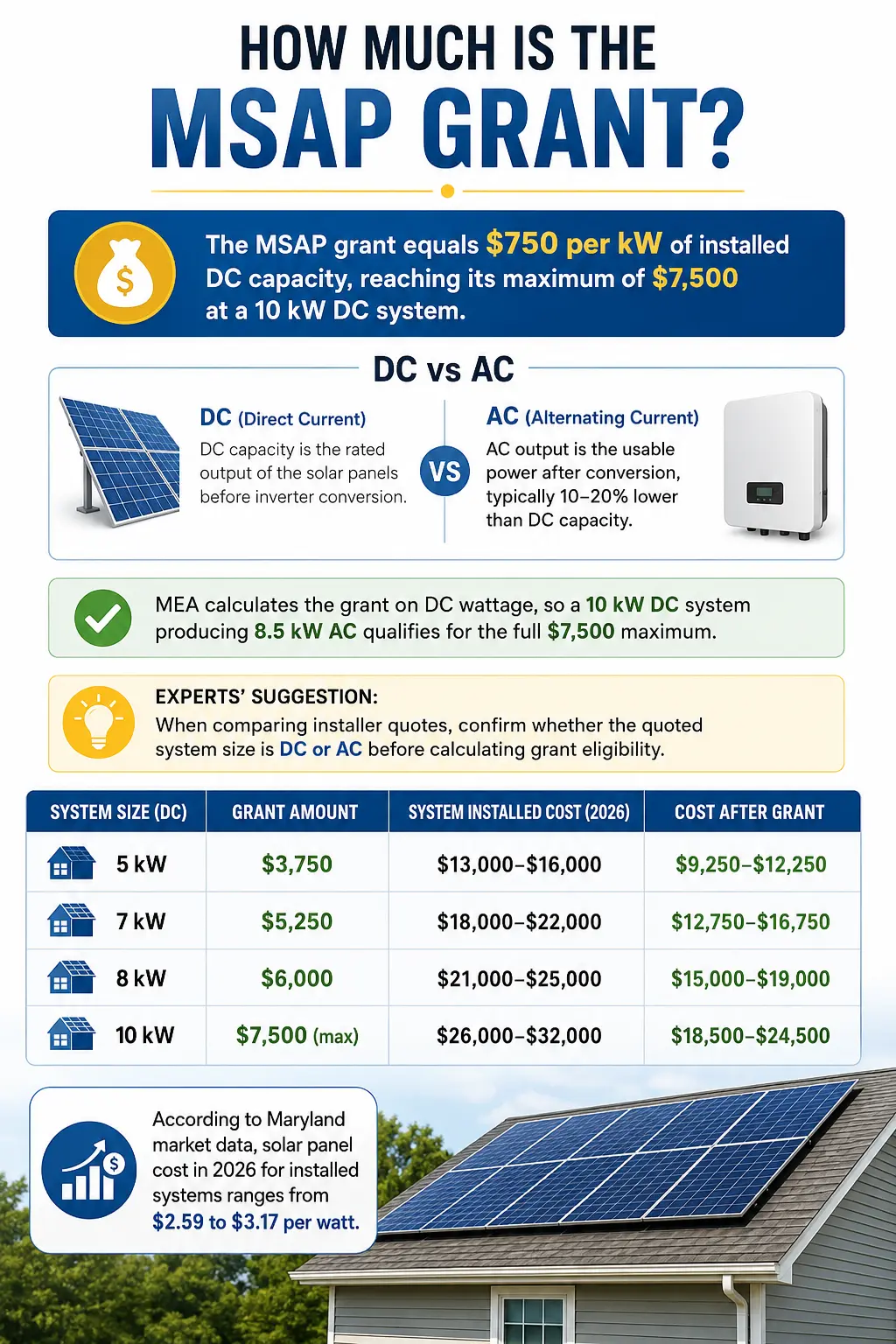
The MSAP grant equals $750 per kW of installed DC capacity, reaching its maximum of $7,500 at a 10 kW DC system.
First, get DC vs AC. DC (direct current) capacity is the rated output of the solar panels before inverter conversion. AC (alternating current) output is the usable power after conversion, typically 10–20% lower than DC capacity. MEA calculates the grant on DC wattage, so a 10 kW DC system producing 8.5 kW AC qualifies for the full $7,500 maximum.
Experts’ Suggestion: When comparing installer quotes, confirm whether the quoted system size is DC or AC before calculating grant eligibility.
| System Size (DC) | Grant Amount | System Installed Cost (2026) | Cost After Grant |
| 5 kW | $3,750 | $13,000–$16,000 | $9,250–$12,250 |
| 7 kW | $5,250 | $18,000–$22,000 | $12,750–$16,750 |
| 8 kW | $6,000 | $21,000–$25,000 | $15,000–$19,000 |
| 10 kW | $7,500 (max) | $26,000–$32,000 | $18,500–$24,500 |
According to Maryland market data, solar panel cost in 2026 for installed systems ranges from $2.59 to $3.17 per watt.
What is the 10 kW Solar System Payback in Maryland?
For a 10 kW system, the payback period with MSAP falls to approximately 7–9 years, compared to 10–12 years without the grant.
Note: This estimate is based on average Maryland electricity rates of $0.14/kWh (U.S. Energy Information Administration, 2026).
How Does the MSAP Application Process Work?
The MSAP application follows two mandatory sequential steps: a Reservation of Funds before installation and a Completion Certificate after installation.
Step 1: Reserve Your Funds (Before Installation)
Applicants submit a Reservation of Funds application through the My MEA portal, using a signed contract dated on or after the program opening date.
MEA processes applications on a first-come, first-served basis; unsigned quotes are not accepted. Upon approval, MEA issues a Reservation Certificate. The applicant then has 180 calendar days from the Certificate’s Effective Date to install and interconnect the system. Extension requests require submission no later than day 150. Installing before the Reservation Certificate is issued disqualifies the application permanently.
Step 2: Submit the Completion Certificate (After Installation)
After the system is installed, interconnected, and operational, the applicant submits a Completion Certificate through the same My MEA portal account used in Step 1.
MEA reviews the submission and disburses the grant upon approval. Incomplete or incorrect submissions receive standby status. The applicant has 14 calendar days to submit corrections before MEA may reject the application.
How Does MSAP Interact With SREC Income?
A Solar Renewable Energy Certificate (SREC) is a tradable credit representing one megawatt-hour (MWh) of solar electricity generated. Maryland homeowners who own their system earn one SREC for each 1,000 kWh their panels produce.
Maryland utilities buy SRECs to meet the state’s Renewable Portfolio Standard (RPS) solar carve-out. According to Flett Exchange, Maryland SREC prices range from $60 to $90 per certificate. A 10 kW system generates approximately 10–12 SRECs per year, producing $600–$1,080 in annual income at current prices.
The Brighter Tomorrow Act of 2024 created a Certified SREC 1.5x multiplier for systems placed in service between July 2024 and January 2028. A homeowner with the multiplier earns $900–$1,620 per year on a 10 kW system — $300–$540 more annually than without it — over 15 years, for a total of $13,500–$20,250.
Homeowners who lease or use a PPA receive no SREC income; the leasing company retains SREC ownership for the full contract duration.
How to Get Registered with SREC?
Homeowners register their system in PJM’s Generation Attribute Tracking System (GATS) to earn and sell SRECs. What is GATS? GATS is the regional platform that records solar generation and issues certificates.
Registration requires completion within a specific timeframe after interconnection; missing this window forfeits SREC eligibility for that period. Most homeowners use an SREC aggregator or broker who manages GATS registration and market sales for a fee of 5–15% of SREC revenue. Direct sales require the homeowner to manage registration and locate buyers independently.
What Other Maryland Solar Incentives Combine with MSAP?
MSAP combines with the Certified SREC 1.5x multiplier, the RCES battery grant, Maryland’s 6% sales tax exemption, the property tax exemption, net metering credits, and applicable county grants — all stackable for qualifying homeowners.
Net metering is a utility billing arrangement in which homeowners earn credit at the full retail electricity rate for excess solar power sent to the grid. Maryland law currently requires utilities to offer net metering to all solar system owners. However, homeowners should keep an eye on any change in net metering policy that could affect future credits.
According to the MEA, homeowners looking into battery storage or other system add-on services can turn to the Residential and Commercial Energy Storage (RCES) Grant Program, which pays 30% of battery storage cost or $5,000 maximum for residential installations.
According to Zillow Research, owned solar adds an average 4.1% premium to home sale value — a useful benchmark for solar worth in 2026. On a $450,000 Maryland home, that equals $18,450 in added equity, independent of SREC income or utility savings.
| Incentive | Value | Stackable with MSAP? |
| MSAP Grant | $750/kW, max $7,500 | Base program |
| Certified SREC 1.5x Multiplier | 1.5× SREC value for 15 years | Yes |
| Maryland SREC Income | $60–$90/SREC, ~10–12/year | Yes |
| RCES Battery Grant | 30% of the cost or $5,000 max | Yes |
| Sales Tax Exemption | ~6% of equipment cost | Yes — automatic |
| Property Tax Exemption | Varies by county | Yes |
| Net Metering Credits | Full retail rate bill credit | Yes |
What County Programs Are Set On Top of MSAP?
Prince George’s County, Montgomery County, Anne Arundel County, Baltimore County, and Harford County each offer independent solar incentives with separate income thresholds and funding windows.
Prince George’s County pays up to $10,000 for households below 60% of county Area Median Income (AMI) and up to $5,000 for market-rate applicants. The county income threshold (60% AMI) differs from the MSAP threshold (150% AMI); qualifying for one does not guarantee qualifying for the other at the highest tier.
According to Palmetto, Montgomery County offers a 30-year solar loan through the Montgomery County Green Bank. This loan carries 0% interest for the first 10 years for homes in Equity Emphasis Areas. Additionally, Anne Arundel, Baltimore, and Harford counties each offer one-time property tax credits; contact each county tax authority for current amounts and application procedures.
How Does Financing Choice Affect MSAP Grant Value?
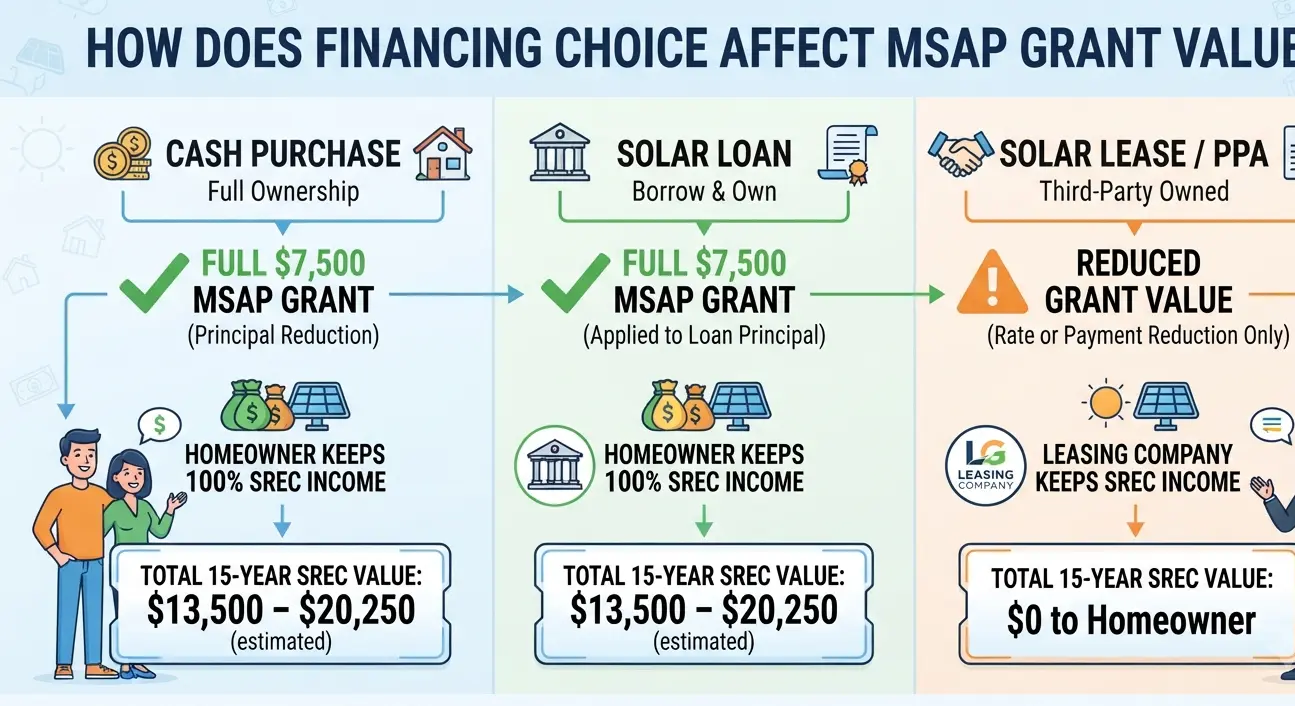
You have three options: solar lease, cash purchase, and PPA. A cash purchase and a solar loan both deliver the full $7,500 MSAP grant and 100% of SREC income to the homeowner; a lease or PPA reduces total value because the leasing company retains SREC ownership.
A solar loan is a financing arrangement in which the homeowner borrows the full system cost, owns the system from installation, and repays the loan over time. MEA applies the MSAP grant as a lump-sum principal reduction after installation. A power purchase agreement (PPA) is a financing arrangement in which a third party owns the solar system. The homeowner buys the electricity at a fixed per-kWh rate, and MEA passes the grant through as a rate reduction only.
| Financing Type | MSAP Grant Applied | SREC Income | 15-Year SREC Value (10 kW, with multiplier) |
| Cash purchase | Principal payment reduction | Homeowner keeps 100% | $13,500–$20,250 |
| Solar loan | Loan principal reduction | Homeowner keeps 100% | $13,500–$20,250 |
| Lease / PPA | Rate or payment reduction | The leasing company keeps | $0 to homeowner |
What Warranty and Contractor Standards Does MSAP Require?
Every MSAP-funded installation carries a mandatory 10-year workmanship warranty, a 25-year solar module material warranty reflecting the lifespan of solar equipment installed today, and a 10-year inverter warranty, enforced through the MEA Consumer Protection Policy.
First, get what an inverter is. An inverter is a device that converts DC electricity from the solar panels into AC electricity for home use. MEA requires all participating contractors to hold an active Maryland Home Improvement Contractor (MHIC) license and a NABCEP (North American Board of Certified Energy Practitioners) certification. Equipment must meet UL 1703 or IEC 61730 safety certification standards.
According to the MEA FY26 Consumer Protection Policy 2026, complaints about contractor violations go to the Maryland Attorney General’s Consumer Protection Division; MEA’s enforcement response is contractor removal from the participating list. MEA does not investigate individual disputes or repair installations. All MSAP contracts must include a dispute resolution process — verify this clause before signing.
For PPA contracts, MEA enforces a maximum 25-year term, a maximum 3% annual escalator, a minimum 25% below-utility pricing for 0% escalator PPAs, and a production guarantee that prohibits charging customers when the system underperforms.
What Incentives Apply to Maryland Homeowners Who Do Not Qualify for MSAP?
Maryland homeowners above the 150% median income threshold have access to several solar incentives. These include the Certified SREC 1.5x multiplier, standard SREC income, the 6% sales tax exemption, and the property tax exemption. They can also access the RCES battery grant, net metering credits, and community solar subscriptions.
Community solar allows renters, condo owners, and homeowners with unsuitable roofs to subscribe to a share of an off-site solar array and receive utility bill credits. According to Palmetto, Maryland’s permanent Community Solar Program, effective January 1, 2025, guarantees low-to-moderate-income subscribers at least 10% savings off the bill credit value. Starting January 1, 2026, the program uses consolidated billing with a 1% monthly administrative fee. Community solar generates no SREC income for the subscriber; a homeowner with a viable roof and an owned system earns significantly higher lifetime returns.
What Does the full Maryland Solar Access Program Incentive Stack Deliver in 2026?
The Maryland Solar Access Program, combined with SREC income, the Certified SREC 1.5x multiplier, the 6% sales tax exemption, and applicable county grants, reduces the net cost of a 10 kW solar installation by $30,000–$45,000 over 15 years for a qualifying Maryland homeowner.
The $7,500 MSAP grant, the automatic sales tax exemption ($1,560–$1,920 on a typical system), SREC income with the multiplier ($13,500–$20,250 over 15 years), and up to $10,000 in Prince George’s County grant funding combine into the strongest upfront solar incentive structure available in Maryland in 2026. The federal 30% Residential Clean Energy Credit expired on December 31, 2025, per IRS guidance — state programs now form the complete incentive stack. According to the MEA Notice of Intent (2026), FY27 funding opens in summer or fall 2026; homeowners with a signed contract and verified income on Day 1 secure reservations ahead of the queue.
Still Have Some Points to Discuss About MD MSAP? Contact NEDES!
NEDES is an MEA-approved participating contractor that manages the full MSAP process — income eligibility verification, contractor agreement, Reservation of Funds application, and Completion Certificate submission.
The leading solar company holds an active MHIC license and NABCEP certification and delivers all MEA-required warranties on every installation. The free MSAP eligibility consultation covers the DHCD-compliant income calculation, a full incentive stack estimate across MSAP, SREC income, county programs, and tax exemptions, and a signed solar proposal ready for Day 1 of the FY27 portal opening.
Contact NEDES for a free MSAP eligibility consultation before the FY27 portal opens!
Frequently Asked Questions About the Maryland Solar Access Program (MSAP)
Can a new homeowner apply for MSAP without a prior tax return at that address?
MEA requires proof of primary residence, but accepted documents for new homeowners — utility bills, deeds, or tax records — vary by application. Applicants who have recently purchased should contact MEA at [email protected] to confirm acceptable documentation before applying.
Does MSAP cover a solar system on a detached garage on the same property?
MEA documentation does not specifically address systems on detached accessory structures. Applicants confirm eligibility with MEA before signing a contractor agreement.
Which 12 months does MEA use if my income fluctuates year to year?
MEA uses the most recent 12-month income period. Applicants with irregular or seasonal income should contact MEA to confirm the correct documentation format before submitting.
Can an MSAP Reservation Certificate transfer if I sell my home before installation?
Reservation Certificates are issued to a specific applicant and property; MEA guidelines do not clearly address transferability upon sale. Applicants contact MEA before completing a property transaction to avoid permanent forfeiture.
What happens if my system underperforms under a PPA?
Under an MEA-enforced MSAP PPA, the contractor bears the production shortfall, and the homeowner is not charged for electricity the system fails to produce. Violations go to the Maryland Attorney General’s Consumer Protection Division.