
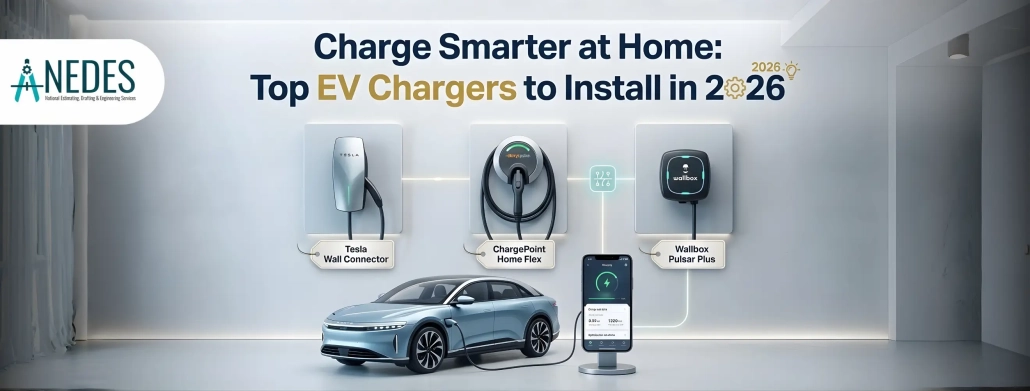
Charge Smarter at Home: Top EV Chargers to Install in 2026
What Is The Best Home EV Charger In 2026?
The choice of the best EV charger depends on your driving range needs, the features you need, and your budget. We picked the top 6 brands to be Tesla, ChargePoint, Emporia, Grizzl-E, EVIQO, and Lectron. Each offers distinct charging capacity, output, and durability. Here’s a comparison:
1. Tesla Universal Wall Connector
Tesla is the top choice among EV charging experts. Tesla Universal Wall Connector offers a 4-year warranty, which is a year longer than other EV chargers. Along with that, it provides a built-in universal connector for both Tesla and non-Tesla electric vehicles. You don’t have to choose between J1772 or NACS connectors. Tesla combines both connectors into a single unit, making it the best home EV charger in 2026.
It has the capacity to deliver up to 48 amps of current, making it suitable for fast and secure charging. Not just that! The Tesla Universal Wall Connector can be connected to the Tesla App. This brings in several features, allowing you to monitor performance, schedule charging sessions, and control access to those who are authorized to use the EV charger.
As per the cost, the Tesla Universal Wall Connector is a bit more expensive than any other EV charger, ranging from about $600. You can purchase a Tesla Universal Wall Connector at Walmart online at a discounted price of $575. This price is justified due to the long lifespan, sleek design, and compatibility with homeowners owning multiple EVs. Whether you have a Tesla, Ford, or Hyundai, one charger works for all.
Connect with a Tesla Powerwall-certified installer and get a charging setup that fits your EV needs.
Features
- Cost: $600
- Power output: 12/16/24/32/40/48 amps (Up to 11.4 KW)
- Connector: Both J1772 and NACS (integrated)
- Outdoor Rating: NEMA 3R
- Cord Length: 24 ft
- Installation: Hardwired only
Pros
- Modern design
- Protected from rain, dust, and basic outdoor conditions.
- Integrates with the Tesla app
- Power sharing for multiple EVs
Cons
- Best features apply to Tesla Only
- Lacks cost tracking
- Lacks scheduling features like day-specific scheduling and split sessions
2. ChargePoint Home Flex
The ChargePoint Home Flex is one of the fastest EV chargers for home with a power capacity up to 50 amps. It allows you to choose between J1772 or NACS connectors. This EV charger can be installed through a single unit hardwire installation or plug-in connection. Plug-in connections mean you can plug it into any 240V outlet. This provides flexibility, allowing you to carry the residential EV charging station wherever you want.
As compared to the Tesla Universal Wall Connector, it has a 3-year warranty limited to only certain exchangeable parts. The ChargePoint Home Flex charger can be connected with the same app that provides data for the EV company’s public unit. This allows you to track the number of EPA miles used or added after the car has been charged.
It costs around $549-$599, bringing in strong performance, durability, and features for EV owners. On CityElectric Supply, you can get ChargePoint Home Flex at a steal deal of $534.99.
The cord has a built-in notch at the top, which allows you to neatly wrap the charging cable, while many other cables require an external device to manage the cord.
Features
- Installation Type and Cost: $549 for hardwired, $599 for plug-in
- Power output: 16/24/32/40/48/50 amps (Up to 12 kW)
- Connector: Either J1772 or NACS
- Outdoor Rating: NEMA 3R
- Cord Length: 23 ft
Pros
- Access control and remote monitoring
- Effective cost tracking
- All EVs can be connected
Cons
- High price
- Low outdoor rating
- Requires a high-voltage outlet to charge
3. Emporia Pro
The Emporia Pro brings the premium load management technology. This EV charger tracks your home electrical usage and adjusts the power capacity to prevent overload. Some other chargers offer similar features, but companies often charge extra for this. The Emporia Pro uses the Emporia Vue 3 home energy monitor for the purpose of monitoring home energy use.
Emporia Pro is suitable for older homes with limited power capacity. The latest model of the Emporia Classic brings a more affordable price at $429. However, this version eliminates the load management system, while still being highly regarded in the industry.
It offers solar charging too. Allowing vehicles to charge from the extra power generated by the rooftop solar panels. Instead of sending extra power to the grid, the hardware redirects the power directly to your car.
Features
- Cost: $599
- Power output: 6-48 amps (Up to 11.5 kW)
- Connector: Either J1772 or NACS
- Outdoor Rating: NEMA 3R
- Cord Length: 25 ft
- Installation: Hardwired or plugged-in Installation
Pros
- Quality tracking app
- Load balancing technology
- Slim charging cable
Cons
- App features require a stable wi-fi connection
- More effort is needed to install
4. Grizzl-E Ultimate 48A
Grizzl-E Ultimate 48A comes 4th in the list of the best home EV charger in 2026. It provides one of the most affordable charging options. It has a power output of 48 amps, making it a suitable choice for faster home charging. It is UL and Energy Star certified.
Just like other EV chargers, it offers you to connect with a J1772 or NACS connector, making it usable for most EVs. The cables are heavy but durable. This makes the Grizzl-e Ultimate 48A durable against extreme temperatures. It can bear temperatures of -22°F to 122°F, reducing the risks of overheating or melting.
One of the key drawbacks of Grizzl-E Ultimate 48A is that it provides hardwired installation only and not the plug-in feature. It is still far more economical for cars that need high power charging, delivering long-term value for its customers.
Features
- Cost: $479.99
- Power output: 16-48 amps (Up to 11.5 kW)
- Connector: Either J1772 or NACS
- Outdoor Rating: NEMA 4/IP67
- Cord Length: 24 ft
- Installation: Hardwired Installation only
Pros
- Seamless power sharing among two EVs
- Can bear high temperatures
- Durable aluminium casing
- Competitive pricing range
Cons
- Difficult to use the app
- Heavy cables
- Hard to install
- Need a proper internet connection to operate the app
5. Lectron V-BOX Wi-fi
This Level 2 EV charger in the USA enables both wi-fi and Bluetooth connectivity with the app. It provides a sleep design with a V-shaped LED status indicator. The plug-in set consists of a NEMA 14-50 pigtail for quick 40amp max output.
Lectron Level 2 (Wi-fi) comes with a J hook, which allows you to organize the cords and protect them from damage. Moreover, it is ETL verified. This means it meets the same safety standard as UL. It is also FCC and Energy Star certified, which prevents harmful radio frequencies.
Lectron V-Box Wi-fi is highly cost-effective. The cost depends on the type of connector. Lectron V-Box Wi-fi J1772 connector costs $369.99, while the NACS connector is priced at $406.99. Walmart and Amazon offer a far lower price tag of $280 only.
The charger app lacks several features, such as cost tracking, load management, and voice control. However, long-term durability, charging speed, and cord strength make Lectron Level 2 (WiFi Version) one of the top choices for EV charging.
Features
- Cost: $369.99 – $406.99
- Power output: 8-40 amps (Up to 9.6 kW)
- Connector: Either J1772 or NACS
- Outdoor Rating: IP65 control unit, NEMA 3R charging handle
- Cord Length: 16 ft
- Installation: Hardwired or plugged-in Installation
Pros
- Affordable prices
- Can be carried
- Usable in rain and snow
Cons
- App lacks features
- Lacks LCD screen
- Short cables
6. EVIQO Evipower Gen2
The reason for scoring EVIQO Evipower Gen2 last is due to a lack of features, like plugged-in installation only, and offering only the J1772 connector. While the first-generation EVIQO model had both J1772 and NACS connectors, they might add compatibility for both in future models.
The cost tag is similar to that of a Tesla EV residential EV charging station, which is about $499. Even though it is priced higher, there is a sale, which allows you to buy the J1772 connector at $398.99 and the NACS charger at $419. This makes it even more affordable than Grizzl-E. It is preferable to wait for the additional upgrades and configuration to purchase it due to a lack of compatibility with all EVs.
EVIQO Evipower Gen2 has a metal/aluminium patch latch, making it highly durable. Moreover, the cables are fully rubberized for easy grip. The wi-fi antenna is also advanced, making connections more stable even in garages or deep basements.
Features
- Cost: $499
- Power output: 6-40 amps (Up to 9.6 kW)
- Connector: J1772 only
- Outdoor Rating: NEMA 4/IP66
- Cord Length: 25 ft
- Installation: Plugged-in Installation
Pros
- Better motherboard protection
- Seamless installation
- Durable cables
Cons
- App struggles with scheduling
- Lacks a thermal sensor for overheating detection
- Heavy cables
How Do We Find The Best EV Charger For Home Installation
To identify the best home EV charger in 2026, you need to analyze several features like power output, car charging needs, app features, durability, and price. Well, let’s understand the different aspects so that you can make a suitable.
Performance
The power output of an EV charger is measured in amps. The greater the power output, the faster your car will be charged. Fast charging can wear the battery over time due to overheating; therefore, charging slowly overnight preserves battery health. Most EV chargers offer a range of 40 amp to 50 amp of power output, which is 9.6 kW to 12kW
Cable Length
20 to 25ft is the suitable cable length for chargers to easily reach every point in your garage or basement. Emporia Pro offers a cable length of 25 ft, which is the longest among all. While some chargers may also allow you to have additional length, a 25 ft cable length is preferred because longer cables reduce voltage and power output.
Connector Type
The connector type affects charging speed, convenience of use, and compatibility. NACS (North American Charging Standard) was the standard for Tesla. However, more charging brands are also incorporating such connectors. NACS supports faster and more efficient charging than J1772.
Warranty Lifespan
Warranty lifespan must also be considered. The Level 2 EV charger in the USA with the highest warranty is Tesla, with a warranty period of 4 years. Most other chargers offer a 3-year warranty covering certain defective parts only.
Nedes partners with Align Solar Protection, which means our clients will get lifetime insurance for any damage, defects, or issues in the EV charger they purchase. Consult our EV charging experts now as we help find the best option for your EV needs.
Price Range
The price ranges from $280 to $600 to purchase a charger. However, the price increases when the installation cost is added. The installation cost varies depending on your location and labor charges. The EV charger installation cost can vary between $800 to $3000.
States like Pennsylvania, Virginia, and Texas will have lower EV charger installation costs than areas like California or New York, due to high labor wages, permitting, and living standards.
| Charger Name | Cost | Power Output | Connector | Outdoor Rating | Cord Length | Installation |
|---|---|---|---|---|---|---|
| Tesla Universal Wall Connector | $600 | 12–48 amps (Up to 11.4 kW) | J1772 & NACS | NEMA 3R | 24 ft | Hardwired |
| ChargePoint Home Flex | $549 | 16–50 amps (Up to 12 kW) | J1772 or NACS | NEMA 3R | 23 ft | Hardwired / Plug-in |
| Emporia Pro | $599 | 6–48 amps (Up to 11.5 kW) | J1772 or NACS | NEMA 3R | 25 ft | Hardwired / Plug-in |
| Grizzl-E Ultimate 48A | $479.99 | 16–48 amps (Up to 11.5 kW) | J1772 or NACS | NEMA 4 / IP67 | 24 ft | Hardwired |
| Lectron V-BOX WiFi | $280 | 8–40 amps (Up to 9.6 kW) | J1772 or NACS | IP65 / NEMA 3R | 16 ft | Hardwired / Plug-in |
| EVIQO Evipower Gen2 | $599 | 6–40 amps (Up to 9.6 kW) | J1772 only | NEMA 4 / IP66 | 25 ft | Plug-in |
Note: Other Tesla home charger alternatives include FLO Home X3. FLO Home X3 consists of both NACS and J1772 connectors and is manufactured by FLO (AddÉnergie Technologies Inc.) It is not a top consumer choice due to its high cost tag of $699 and fewer features. It misses out on charging schedules, remote locking, and real-time status from the app.
EV Charging Station Rebates In The Usa
Several rates are offered in the USA for residential, commercial, and public purposes by the state and federal governments. EV charging station rebates in the USA can be applied to level 1, level 2, and direct current (DC) fast chargers. Most popular is the federal 30C tax credit, which allows businesses to save up to $100,000, and homeowners can receive $1000 as a credit for hardware and installation. Other rebates and local utility programs can save you up to $250 to $35,000.
Virginia homeowners enjoy a major advantage when installing a Level 2 EV charger in 2026. With lower labor rates, faster permitting, and generous local utility rebates, you can set up a full residential EV charging station at a noticeably lower cost than in states like California or New York. Most Virginia residents save between $1,400 and $2,300 while easily stacking benefits with the federal $1,000 tax credit.
Final Words: Making The Best Solar Charging Choice
For most EV users, the Tesla Universal Wall Connector offers top-notch features to be regarded as the best home EV charger in 2026. It is fast, durable, feature-rich, and brings the best value for money.
Are you looking for EV charger installation near me? Consulting our EV installation experts will help you make the perfect choice in the U.S. From getting estimates from your local electricians to applying for a rebate program, our package assists you completely with EV charger installation.
FAQs
What to choose from the Gen 3 Wall Connector or the Tesla Universal Wall charger?
The Tesla Universal Wall Connector is best for household electric vehicles, whether Tesla or non-Tesla. The Gen 3 Wall connector is ideal only for Tesla EVs. Both offer similar power output (48amp), 11.5 kW, and app control. However, the Tesla Universal Wall charger is best for homeowners owning multiple EVs.
Which is the best home EV charger in 2026?
Tesla Universal Wall Connector is the best home charger for EVs. It provides a power output of 48 amps, a 24 ft long cable, and is compatible with both Tesla and non-Tesla vehicles.
What is the fastest EV charger for home installation?
Tesla Universal Wall Connector is the fastest charger offering 11.5 kW (48A) of charging capacity. It is versatile, fast, and compatible with non-Tesla vehicles, too. While other chargers like ChargePoint Home Flex and Grizzl-E Ultimate 48A also offer a similar output range.
Can a 50kw charger be used at home?
A 50kW charger has high power consumption, making it extremely hard to install at home. These chargers can be installed in commercial charging stations and can charge your vehicle up to 80% in 40 minutes.
Which EV Charger lasts the longest?
Generally, EV chargers have a lifespan of 6-7 years. While some homeowners have reported chargers like Tesla Universal Wall Connector, ChargePoint Home Flex, and more to last considerably longer, up to 10-20 years.