
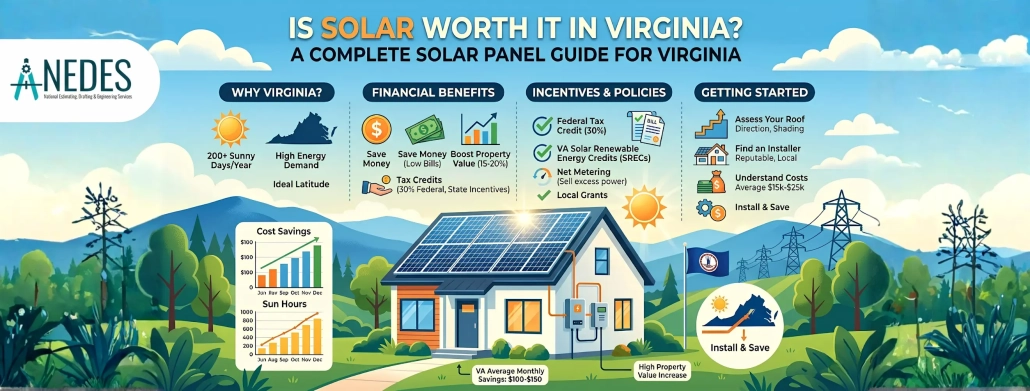
Is Solar Worth It In Virginia? A Complete Solar Panel Guide For Virginia
You keep seeing those ads. The ones promising government-funded, zero-cost solar programs in Virginia. Let’s get something straight right off the bat, free solar doesn’t exist! It is a marketing gimmick. But if you own a home here, you are probably tired of opening your Dominion or Appalachian Power bill every month just to see another rate hike. That pain points directly to the biggest question on every homeowner’s mind right now: is solar worth it?
The short answer is yes. The long answer involves a lot of math, your specific roof angle, and whether you actually want to own your power.
We install solar panels every day. Our team sees the real numbers. That means you won’t see the same fluff or sales garbage in this guide. You want to know if off-grid solar systems make financial sense in the Old Dominion. This guide rips the lid off the actual numbers. We are going to break down the hard data on solar vs electricity cost, expose the hidden fees, and show you exactly what you can expect to pay this year.
Are Solar Panels Worth It?
If you live in a house surrounded by eighty-foot oak trees that cast shadows over your roof from dawn until dusk, no. Keep your money. Solar won’t work for you.
But what if you have a decent patch of unshaded roof facing south, east, or west? Then are solar panels worth it becomes an entirely different conversation. The average Virginia homeowner burns through a 900 to 1500 kWh/month of electricity during the brutal, humid summers and unpredictable winters.
When you ask do solar panels save money, you have to look at the utility alternative. Dominion Energy rates aren’t dropping and cconsidering the inflation, they never will. By installing a system, you are essentially pre-paying for the next 25 years of your electricity at a fixed, locked-in rate. You swap a variable, forever liability (your utility bill) for a fixed asset (your solar array).
|
Need A Free Site Inspection? |
|
If you are wondering about your specific roof, stop guessing. We offer a completely free site inspection or free consultation session to map your roof using satellite imaging and physical checks. We will tell you flat out if your home is a good candidate or a terrible one. |
Solar Panel Cost 2026: Let’s Talk Hard Numbers
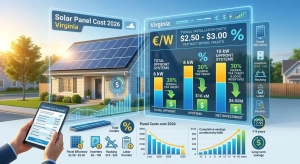
People get major sticker shock when they look at solar. It is a major home renovation. Let’s look at the actual solar panel cost 2026 data for Virginia. Right now, the average cost per watt in the state hovers right around $2.50 to $3.00 before any tax credits are applied.
What does that mean for your wallet? A typical Virginia home needs a roughly an 8 kilowatt (kW) to 10 kW system to offset its energy usage.
Here is a breakdown of the average solar installation cost based on system size. Keep in mind these are gross numbers without massive federal tax credit (terminated in 2026)
| System Size | Average Gross Cost (Before Incentives) | Estimated Net Cost (After 30% Federal Credit) |
| 6 kW | $15,000 – $18,000 | $10,500 – $12,600 |
| 8 kW | $20,000 – $24,000 | $14,000 – $16,800 |
| 10 kW | $25,000 – $30,000 | $17,500 – $21,000 |
| 12 kW | $30,000 – $36,000 | $21,000 – $25,200 |
Note: Your specific equipment choices, roof complexity, and main electrical panel condition can shift these numbers.
When analyzing solar panel cost vs savings, you cannot just look at the upfront price tag. You have to subtract the incentives that the government is essentially throwing at you to modernize the grid.
Virginia Solar Incentives and Tax Breaks
Virginia is quietly becoming one of the best states in the country for solar financial returns. You just have to know how to claim the money.
Virginia Net Metering
Virginia law requires major utility companies to offer one-to-one retail net metering. This is huge for your solar panel savings. When your panels produce more power than your house is using on a sunny Tuesday afternoon, that excess electricity gets pushed backward through your meter and onto the grid. Your utility company credits your account for every single kilowatt-hour (kWh) at the full retail rate. At night, when your panels are asleep, you pull those credits back.
SRECs (Solar Renewable Energy Certificates)
This is where Virginia gets interesting. Every time your system generates 1,000 kWh (1 Megawatt-hour) of electricity, you earn one SREC. Utility companies are legally mandated to produce a certain amount of green energy. If they fall short, they have to buy SRECs from homeowners like you. This means your roof doesn’t just save you money on your bill. It actually generates cash. Depending on market rates, an average Virginia home can pull in an extra $300 to $800 a year just by selling their SRECs.
Property Tax Exemption
Adding a $25,000 solar system to your home increases its appraisal value. In a normal world, your local tax assessor would immediately hike your property taxes. But Virginia offers a solar property tax exemption. Some counties exempt 100% of the added value, while others use a tiered system. Either way, you get the home equity bump without the tax penalty.
ROI and Payback
How quickly does this stuff actually pay for itself? Your solar payback period is the amount of time it takes for your cumulative energy savings (and SREC income) to equal your initial net investment. In Virginia, the average payback period right now is sitting between 7 and 9 years.
Let’s run a quick, realistic scenario for a 10 kW system.
- Gross Cost: $26,000
- 30% Tax Credit: -$7,800
- Net Cost: $18,200
If your current power bill averages $200 a month, that is $2,400 a year you are bleeding to the utility company. Assuming a conservative 3% annual rate hike from Dominion, your utility costs over the next 25 years would exceed $85,000.
By eliminating that bill, your solar return on investment becomes massive. You spend $18,200 once. You avoid paying $85,000 over the lifespan of the system. That is why wealth advisors treat residential solar as an aggressive, tax-advantaged financial product rather than just a home improvement project.
The Real Solar Energy Pros and Cons
Nothing is perfect. We aren’t going to pretend solar is a magic bullet without drawbacks. You need to weigh the solar energy advantages and disadvantages before signing anything.
The Pros:
- Instant Bill Reduction: From the day the system is turned on, your utility bill plummets.
- Protection Against Inflation: Utility rates are tied to natural gas prices and grid maintenance costs. Your solar payment (if financed) is fixed.
- Increased Property Value: Homes with owned solar panels sell faster and for more money than homes without them.
- Total Environmental Impact: You are legitimately cutting tons of carbon emissions out of the atmosphere every year.
The Cons:
- High Upfront Cost: Even with financing, you are taking on a significant chunk of debt or parting with serious cash.
- It Doesn’t Work Off-Grid (Without a Battery): Standard solar panels shut down during a grid blackout. This is a safety mechanism so your panels don’t electrocute utility workers trying to fix the lines.
- Moving Penalties: If you sell your house within the first two or three years of installing solar, you might not recoup the full cost of the system. Solar is a long-term play.
Dealing With Power Outages: The Battery Question
Let’s address that grid blackout issue. Severe storms rip through Virginia every year. Trees fall. Lines snap. If you want your house to stay running when the neighborhood goes dark, standard panels aren’t enough. You need energy storage.
Adding a battery completely changes the scope of your solar panel benefits. Instead of sending your excess daytime power back to Dominion Energy, you dump it into your battery. When the grid fails, your house instantly isolates itself and runs entirely off your stored power. Your fridge stays cold. Your lights stay on.
Because we care about reliability and heavy-duty performance, we are a proud affiliation partner with Tesla powerwall certified installer networks. The Tesla Powerwall 3 is currently dominating the market for a reason. It handles massive surge loads, meaning it can actually kickstart your heavy HVAC compressor during a summer outage, which is something most cheaper batteries simply cannot do.
Furthermore, battery storage also qualifies for that same 30% federal tax credit, making it significantly more affordable to bundle it with your initial installation.
Book Your Free Consultation Now
What About Solar Panel Efficiency Over Time?
A common myth is that solar panels break down and become useless after a decade. That is outdated information from the 1990s.
Modern Tier-1 monocrystalline panels are incredibly durable. However, solar panel efficiency over time does degrade slightly. It is known as the degradation rate. Most high-quality panels today degrade at about 0.5% per year.
What does that look like in reality?
- Year 1: 100% power output.
- Year 10: ~95% power output.
- Year 25: ~85% power output.
Even after a quarter of a century, your system will still be churning out heavy amounts of electricity. Most premium manufacturers back this up with a 25-year linear performance warranty. If a panel’s output drops below a guaranteed threshold (usually 85%), they replace it. Period. You are completely insulated from equipment failure.
The Financing Minefield: How You Actually Pay For This
You know the equipment lasts. You see the math on the solar payback period. But how do you actually write the check? This is where the solar industry gets a little murky, and where homeowners make their biggest, most expensive mistakes.
There are three ways to get panels on your roof in 2026. Two of them build wealth. One of them is a trap. Let’s look at the breakdown.
1. Cash Purchase (The King of ROI)
If you have the liquidity, pay cash. End of story. Paying cash eliminates dealer fees and interest rates entirely. Your solar return on investment hits its absolute maximum potential here. You capture the full 30% federal solar tax credit, you own the SRECs, and every drop of sunlight translates directly into home equity and bank account savings.
2. Solar Loans (The Smart Leverage)
Most people don’t have $25,000 sitting idle. That is totally fine. Solar specific loans are designed to mimic your current utility bill. The goal is simple. You want your monthly loan payment to be equal to or less than your old Dominion Energy bill.
- The Catch: Watch out for “dealer fees.” Some national lenders offer ridiculously low interest rates (like 1.99%) but bury a massive 25% dealer fee into the principal. A local installer will usually offer a “same-as-cash” loan option with a slightly higher interest rate but zero hidden fees. Do the math. The zero-fee loan almost always wins.
3. Leases and PPAs (The Financial Trap)
Power Purchase Agreements (PPAs) are those “free solar” ads you see on Facebook. Do not click them. Here is how they work. A massive out-of-state corporation slaps panels on your roof for zero dollars down. But you don’t own the panels. They do. They just sell you the electricity the panels generate at a slightly lower rate than the utility company.
Why is this bad? First, the corporation steals your 30% tax credit. Second, they take all your Virginia SREC money. Third, they bake an “escalator” clause into your contract, meaning your solar payment goes up by 3% every single year. Finally, try selling a house with a leased solar system. Buyers hate inheriting third-party contracts. It kills real estate deals. If you want true solar panel savings, own your system.
What About My HOA? The Virginia Law You Need to Know
We hear this daily. “I want to cut my solar vs electricity cost, but my Homeowners Association will never allow panels on the front of my house.”
They might try to stop you. But they probably can’t.
Virginia has some of the strongest solar rights laws in the country. Under the Virginia Solar Rights Act (Code of Virginia § 67-701), an HOA cannot broadly prohibit you from installing a solar array. They can establish “reasonable restrictions” regarding the size or placement of the system, but there is a massive legal loophole protecting you. If their restrictions increase the solar installation cost by more than 5%, or decrease the system’s energy production by more than 10%, their rules are legally void.
You have the power. Not the neighborhood architectural review board.
We deal with HOAs constantly. Part of our free site inspection or free consultation session includes a comprehensive review of your specific HOA bylaws. We draft the engineering mockups. We submit the paperwork. We fight that battle for you, ensuring your system design maximizes your solar panel benefits without violating state law.
The Roof Reality Check: Don’t Make This $15,000 Mistake
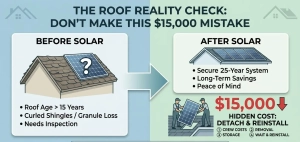
Do not put a 25-year asset on a 5-year roof. It sounds like common sense, but aggressive salespeople push homeowners into this trap all the time.
If your asphalt shingles are curling, losing their granules, or are over 15 years old, you need a roof replacement before going solar. If you ignore this, you will have to pay a crew thousands of dollars to detach your solar array, store it, wait for the roofers to finish, and then reinstall the panels. It completely wrecks your solar panel cost vs savings ratio.
Here is a quick checklist for roof readiness:
- Age: Asphalt roofs should have at least 10-15 years of solid life left. Metal roofs are almost always good to go.
- Structure: We inspect your trusses and rafters. Solar panels weigh about 40 pounds each. Your roof needs to handle the dead load, plus potential Virginia snow accumulation.
- Angle and Azimuth: South-facing roofs are the gold standard for North America. East and west are perfectly fine, though they might require one or two extra panels to hit your energy goals. True north-facing roofs are usually a dealbreaker.
National Giants vs. Local Boots on the Ground
The solar industry has a dirty little secret. The massive national brands, the ones with the slick television commercials—rarely install your panels. They are sales organizations. They sell you a contract and then subcontract the actual physical labor to the lowest local bidder.
When you ask do solar panels save money, the answer depends heavily on who does the wiring.
When a transient subcontractor drills 60 holes into your roof, and something leaks three years later, who do you call? The subcontractor is out of business. The national brand puts you on hold for three hours and blames the subcontractor. You are stuck.
This is why local expertise matters. You need a company that understands Virginia’s specific building codes. You need an installer who knows how Fairfax County inspectors operate versus the inspectors down in Richmond or Virginia Beach.
Local companies rely on local reputation. We don’t use subcontractors. Our master electricians and roofers are on our payroll. When we pair that local accountability with top-tier equipment (like acting as an affiliation partner with Tesla powerwall certified installer networks), you get a system that actually performs exactly how the spreadsheet said it would.
Surviving Virginia Weather: Hurricanes, Snow, and Humidity
People worry about the weather. It makes sense. You are bolting thousands of dollars of glass to the top of your house. What happens when a Nor’easter rolls through?
Let’s weigh the environmental solar energy pros and cons.
Wind and Hurricanes
Top-tier panels are engineered to withstand wind uplift speeds of over 140 mph. The racking systems are literally lagged directly into your roof’s structural rafters. In the event of a catastrophic storm, the panels actually protect the shingles underneath them from flying debris.
Snow
Panels get hot. They are dark glass angled toward the sun. When it snows in Virginia, your panels will usually be the first thing on your property to melt off. The snow simply slides off the frictionless glass. Do you lose a day or two of production during a heavy blizzard? Yes. But energy modeling software already accounts for regional weather data when calculating your yearly output.
Summer Heat and Humidity
Here is a weird scientific fact. Solar panels actually lose a tiny fraction of their efficiency when they get extremely hot. They prefer bright, crisp, freezing cold winter days. However, Virginia summers are long. The sheer volume of daylight hours during July and August completely overrides the minor heat-related efficiency drop. Your system will bank massive amounts of net-metering credits during the summer to carry you through the dark days of December.
The Real Timeline
Patience is required. A quality solar installation is a major construction project heavily regulated by utility monopolies and local governments. Anyone promising to have your panels running in two weeks is lying to you.
Here is the realistic 2026 timeline for a Virginia installation:
- Site Survey & Engineering (1-2 Weeks): We measure your roof structure, inspect your main electrical panel, and draft the structural blueprints.
- Permitting (2-6 Weeks): This is the bottleneck. We submit the plans to your local city or county building department. Some counties approve them in days. Others take over a month.
- Installation (1-2 Days): The actual physical work is incredibly fast. Our crews arrive in the morning and are usually cleaning up the job site by mid-afternoon the next day.
- City Inspection (1-2 Weeks): A local building inspector has to physically come out and sign off on the safety of the electrical work.
- Utility Interconnection (PTO) (2-4 Weeks): Permission to Operate. Dominion Energy or your local co-op has to swap your old meter for a bi-directional smart meter. Only then can you officially turn the system on.
Total timeline? Expect 6 to 12 weeks from the day you sign the contract to the day you stop paying for grid power.
The Final Verdict: Is It Right For You?
Let’s strip away the hype. Evaluate your situation objectively. If your roof is covered in shade, or if you are planning to move to Florida in 18 months, do not buy solar panels. Put your money in an index fund.
But if you plan on living in your home for the next five to ten years. If you have a decent roof. If you are exhausted by utility rate hikes that outpace inflation every single year. Then looking at the solar panel cost 2026 data proves that this isn’t just an environmental statement anymore. It is a ruthless, calculated financial maneuver.
You are locking in your energy costs for the next quarter-century. You are generating SREC income. You are leveraging federal tax money to upgrade your own private property.
The math works, the technology is bulletproof, and the state laws are entirely in your favor. Stop renting your electricity. It is time to own it!