
Prince George’s County runs almost 500 square miles. NEDES designs around whichever utility actually serves your address, files through the county’s Department of Permitting, Inspections and Enforcement, and builds every quote on Prince George’s County’s real, current climate targets; not the outdated figures still floating around some competitor pages in this market.
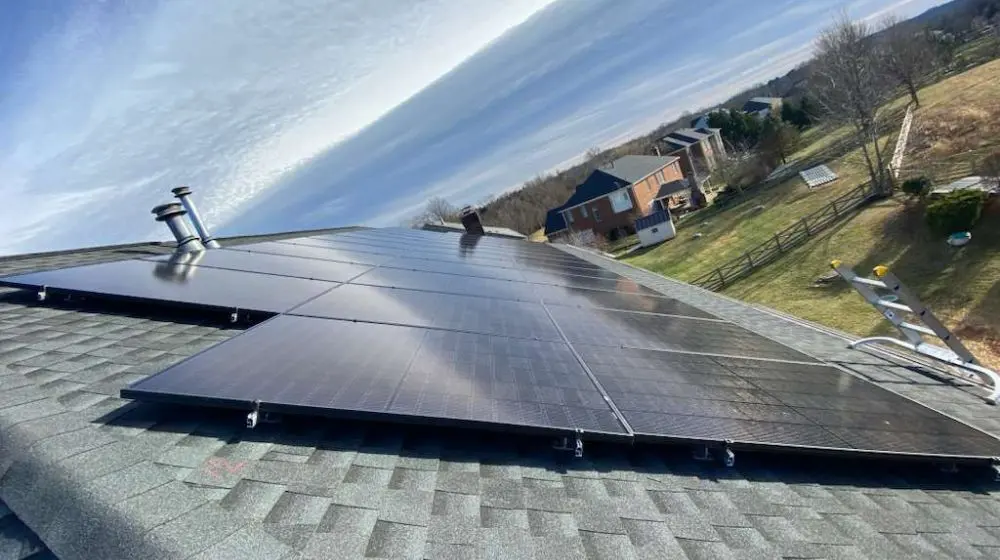
The Numbers Behind Going Solar in Prince George’s County
Ronald Reagan Washington National Airport and Joint Base Andrews both sit close enough to Prince George’s County to anchor a defensible PVWatts estimate, and NREL’s TMY3 data for the area puts the county at roughly 4.5 peak sun hours per day on average across the year. A 9 kW system at that output generates somewhere around 11,750 kWh annually after typical losses; enough to fully offset most county households running 10,500–12,000 kWh a year, which is close to the regional norm for a single-family home.
Pepco‘s Rate Case Just Landed, and It’s Not Small
In November 2025, Pepco filed a new rate case proposing distribution rate increases of 15% for summer rates and 33% for winter rates, a weighted increase of roughly 23% overall if approved by the Maryland Public Service Commission. According to the Maryland Office of People’s Counsel, that filing would bring Pepco’s cumulative distribution rate increase to roughly 132% since 2016; an extraordinary run-up for a regulated utility.
The Federal Credit: The Part Every Page Should Say Plainly
The 30% federal Residential Clean Energy Credit, Section 25D, expired for any system placed in service after December 31, 2025, under the One Big Beautiful Bill Act. A Prince George’s County homeowner buying with cash or a loan in 2026 gets no federal credit; full stop, no partial phase-down. The only route that still touches that 30% figure is a lease or PPA, where the third-party system owner claims the commercial Section 48E credit and typically passes part of the value through as a reduced monthly payment, rather than the homeowner claiming it directly.
Maryland‘s Property and Sales Tax Treatment; Not the Same Statute as Virginia’s
Maryland handles this differently than Virginia does, and it’s worth citing the actual Maryland statute rather than assuming the frameworks mirror each other. Maryland Tax-Property Article § 9-203 exempts the added value of solar equipment from real property tax assessment, statewide and automatic, for the life of the system. Separately, Tax-General Article § 11-230 exempts solar equipment from Maryland’s 6% state sales and use tax; on a $26,500 system, that’s roughly $1,590 saved before the invoice is even finalized.
Net Metering; More Generous Here Than Virginia’s Cap
Maryland’s net metering law, governed by the Public Service Commission, credits exported solar at full retail rate and allows systems sized up to 200% of the customer’s annual baseline usage; genuinely more generous than Virginia’s 150% cap, worth knowing if you’re comparing notes with someone across the D.C. line. Credits roll month to month, with the standard annual true-up in April; Maryland’s 2023 rollover election lets customers carry banked credit forward indefinitely instead of cashing out at a lower rate.
SRECs and the RPS Carve-Out Driving Demand
Maryland’s Renewable Portfolio Standard, under the Clean Energy Jobs Act of 2019, requires 50% of electricity sales from renewable sources by 2030, including a 14.5% in-state solar carve-out; confirmed directly against Maryland Public Service Commission and Maryland DNR sources. That carve-out is what sustains Solar Renewable Energy Certificate demand: every megawatt-hour your system produces earns one SREC, tracked through PJM’s GATS registry. Utilities that fall short of their RPS obligation pay an Alternative Compliance Payment, which functions as a market price ceiling on SREC value.
The County’s Actual Climate Target; Not the One a Competitor Page Is Still Using
Worth stating plainly: Prince George’s County’s current, official climate target is a 50% reduction in county-wide greenhouse gas emissions by 2030 (from 2005 levels), with a goal of carbon neutrality by 2050, established through County Council Resolution CR-007-2020 and finalized in the county’s Climate Action Plan in January 2022. That’s a different, more current figure than an outdated 2008-baseline target still circulating on at least one competitor’s page in this market; the current CAP supersedes it entirely. The county’s own Solarize Prince George’s program, connecting residents to vetted installers and competitive group pricing
The Five Kinds of Work We Handle, Verified Against Real Title and Property Records
Every project below is filed through Prince George’s County’s Department of Permitting, Inspections and Enforcement (DPIE), which processes rooftop solar applications through its ePermits system and has been building toward SolarAPP+ automated instant permitting after being named one of the state’s first grant recipients for that program in 2025.
Residential Rooftop Systems
We size against twelve months of actual utility usage, confirm whether your address falls in Pepco or SMECO territory, and check your property against the county's Energy Resiliency Community boundaries for potential grant eligibility before finalizing a quote.
Read More
Commercial and Ground-Mount Installations
For commercial and larger ground-mount systems, we verify legal title and lien status and confirm property-line compliance before design work begins; a due-diligence step that protects both the property owner and the project timeline, particularly relevant for county land parcels where boundary questions can otherwise surface mid-permit. Commercial systems retain full access to the 30% Section 48E federal credit through December 2027.
Read More
EV Charger Installs
Most Level 2 charger installs are electrical-permit-only. We check panel capacity for a dedicated circuit before scheduling; older housing stock inside the Beltway sometimes needs a subpanel upgrade first.
Read More
Adding Panels to an Existing Array
If usage has grown, we check inverter headroom and how close you sit to Maryland's 200%-of-baseline net metering cap before recommending expansion over replacement.
Read More
Removal and Reinstallation for Roof Work
We remove the array, store it on-site, and reinstall once roof work is complete, without disturbing the existing racking warranty.
Read More
Fast and Furious Installation
How a Prince George’s County Installation Actually Moves
Our Solar installation Maryland process starts with twelve months of actual electricity usage and utility-territory verification, then moves through Prince George’s County DPIE permitting, professional installation, county inspection, and Pepco or SMECO interconnection. NEDES manages each step through final approval so your system is designed, permitted, and connected according to applicable Maryland and local requirements.
Step One: Real Usage Data, Confirmed Utility Territory
We start with twelve months of your actual utility billing and confirm upfront whether your specific address sits in Pepco or SMECO territory; the county line isn’t the utility line here, and getting this wrong at the quote stage causes real delays later.
Step Two: DPIE Filing
Applications move through DPIE’s ePermits system. Prince George’s County was among the first Maryland jurisdictions awarded a state grant to implement SolarAPP+, automated instant permitting software the county is actively phasing in; a meaningful upgrade over the standard plan-review timeline still used in much of the state.
Step Three: Installation
Most residential installs take one to two days. A final county inspection is required before energization, which we schedule and attend.
Step Four: Utility Interconnection and PSC Registration
Once inspection clears, we file interconnection paperwork with Pepco or SMECO, plus PSC certification to register the system for SREC generation and net metering. Full retail credit activates on interconnection approval.
NEDES: The Leading Solar Company
What’s Actually Different Between Quotes
Most homeowners here compare a subcontracted crew from a lead-gen site, an installer bidding through a national marketplace, or a company that owns the entire process. Here’s where that shows up in practice; including a policy some competitors in this exact market explicitly refuse to offer.
| Features | Other Local Installers | NEDES |
|---|---|---|
| Warranty | 1–10 years (EnergySage marketplace standard) | 25 years |
| Response Time | Days to weeks | Under 24 hours |
| Monitoring | App, sometimes extra cost | Included, real-time |
| Financing | Cash or loan only | Cash, loan, or lease/PPA |
| Point of Contact | Often subcontracted crews | In-house, start to finish |
| Product Insurance | Rarely offered | Included, via Align Solar partnership |
A Few Recent Harford County Installations
9.1 kW, rooftop system
installed 2025
112 kW ground-mount system
on a working farm property, installed 2025
8.4 kW System
lease financing
Our Testimonials
Here’s What People Say About Our Installation Services
Check out the most recent reviews from our clients about solar panel solutions and EV charger installations:
Area Coverage
Where We Work, From the Beltway to the Patuxent
From the historic streets of Hyattsville to the growing commercial corridors around Bowie and the quieter farmland south toward Upper Marlboro, Prince George’s County covers a lot of ground; literally. Here’s where NEDES installs.
- Bowie
- Hyattsville
- College Park
- Laurel
- Upper Marlboro
- Largo
- Greenbelt
- Landover
- Clinton
- Accokeek
- Brandywine
- Fort Washington
What Homeowners Ask Us Most in Prince George’s County
What is Prince George‘s County’s Climate Action Plan, and how does residential solar support it?
The county’s current, official target is a 50% reduction in county-wide greenhouse gas emissions by 2030 from 2005 levels, with carbon neutrality by 2050, established under County Council Resolution CR-007-2020 and finalized in January 2022. Distributed residential solar is one of the concrete levers the plan counts toward that target.
How does Maryland’s SREC program work, and how much can a typical system earn?
Every megawatt-hour your system produces earns one SREC, sold on the open market through PJM’s GATS registry. A typical 9 kW residential system in this region earns roughly 11–12 SRECs a year, worth several hundred dollars in additional income beyond electric bill savings; this only accrues to whoever owns the system, not a lessee.
What‘s the difference between Maryland’s net metering cap and Virginia’s?
Maryland allows systems sized up to 200% of a customer’s annual baseline usage; Virginia caps at 150%. For homeowners comparing notes with someone across the D.C. line, that’s a real, material difference in how large a system can be sized while still earning full retail credit on every exported kWh.
Does going solar affect my property taxes in Prince George’s County?
No increase. Maryland Tax-Property Article § 9-203 exempts the added value of solar equipment from real property tax assessment statewide, automatically, for the life of the system; no application required.
Do solar panels work on cloudy days in Maryland?
Yes, just at reduced output. A panel on an overcast day typically still produces 10–25% of its clear-sky output, since panels respond to diffuse light as well as direct sun; one reason we size systems against a full year of usage data rather than a single sunny afternoon.
Start With a Free 15-Minute Conversation
An NEDES energy consultant confirms whether your address falls under Pepco or SMECO, checks your eligibility for the county’s Solar Energy Grant, and walks through real numbers on financing given the current federal credit rules and Pepco’s pending rate case.

