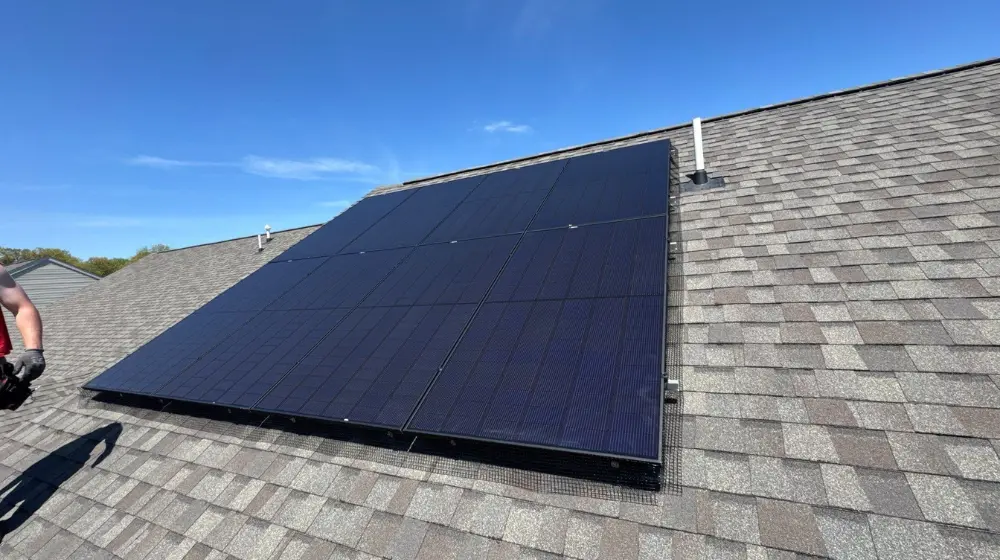
Baltimore County doesn’t have one housing type; it has several, packed close together. NEDES treats those as three different design problems in our Baltimore solar installation services. The experts handle the county’s permitting office and BGE’s interconnection paperwork so you don’t have to learn either system from scratch.
Why Baltimore County Is Actually a Decent Place to Go Solar
Start with the sun itself. NREL’s PVWatts tool, run against BWI Thurgood Marshall’s long-term weather data (about 15 miles south of Towson, the closest station with a deep enough record to be useful), puts Baltimore County at roughly 4.5 peak sun hours a day on an annual basis. Summer stretches that to 5.2–5.5 hours; the depths of winter can dip to 2.9-3.2.
An 8.4 kW system (a common size for a mid-sized rowhouse or townhome here) nets out to roughly 10,800 kWh of production a year. For comparison, the EIA’s 2024 Maryland electricity profile shows the average household burning through about 929 kWh a month, or 11,150 kWh annually. It is close enough that an 8.4 kW system covers most of a typical bill outright.

BGE’s Delivery Rates Have Basically Doubled Since 2012
It’s the Maryland Office of People’s Counsel’s own finding, based on BGE’s distribution-rate history since the utility’s 2012 acquisition by Exelon. The most recent multi-year rate plan (PSC Order No. 90948) added roughly $4.08 a month to the average residential electric bill in 2024, with a final, smaller step of about $1.07 a month effective January 1, 2026. BGE isn’t slowing down, either: in mid-2026 the utility filed a new case, Docket No. 9888, asking regulators for another $156 million, which would translate to roughly $8 more per month for a typical household.
The Federal Credit Is Gone
IRC §25D, the 30% Residential Clean Energy Credit, expired for any system where money changed hands after December 31, 2025. If you’re buying with cash or financing through a loan in 2026, that credit simply isn’t part of the math anymore, no matter what a sales sheet claims. It hasn’t disappeared entirely, though. Homeowners who go the lease or PPA route still benefit indirectly, since the company that owns the system can claim a related commercial credit under Section 48E and typically prices that into a lower monthly payment. NEDES offers cash, loan, and lease/PPA options in Baltimore County.
Maryland Still Won’t Tax You Twice for Going Solar
Two separate exemptions survived the federal changes untouched. First, under Maryland Tax-Property Code § 7-242, a certified solar energy system is excluded from your home’s assessed value for local property tax purposes; install a $25,000 system and your Baltimore County property tax bill doesn’t move. Second, the state’s 6% sales and use tax doesn’t apply to qualifying solar equipment, per Comptroller guidance, which knocks roughly $1,300–$1,700 off an average residential system before any other incentive is factored in.
SRECs, Explained Without the Jargon
Every time your system generates 1,000 kWh, Maryland’s SREC market hands you one tradable certificate, registered through PJM-GATS, that utilities buy to satisfy the state’s renewable-energy mandate. Standard SRECs are trading around $40–$45 in 2026. If your system is under 20 kW and went in between July 2024 and January 2028, the Brighter Tomorrow Act bumps that up with a 1.5x “Certified BT” multiplier, pushing the effective price closer to $57.50.
Maryland Solar Access: Real Grant Money, If You Qualify
The Maryland Solar Access Program, created under the same 2024 Brighter Tomorrow Act, pays income-qualified households $750 per kilowatt of installed capacity, capped at $7,500. Funding runs in cycles set by the Maryland Energy Administration, and availability has fluctuated through 2026, so the right move is confirming current status and eligibility at the time you apply rather than assuming a figure quoted months ago still holds.
BGE Net Metering, and Why Waiting Might Cost You
Maryland’s net metering law credits every exported kWh at the full retail rate (not a discounted wholesale rate) and BGE rolls unused credits forward monthly until your personal true-up date, which lands on the anniversary of your interconnection approval rather than a fixed calendar date the way some utilities handle it. Whatever surplus remains at that anniversary settles at BGE’s avoided-cost rate, roughly 5–6 cents per kWh, well below the 17–19 cents you’d earn during the year.
The Systems We Install Across Baltimore County
Five system types, five separate permit packages through the county’s Department of Permits, Approvals and Inspections, and one crew that handles all of them start to finish.
Residential Solar Installation Baltimore County
Rooftop systems for detached homes, rowhouses, and townhomes alike, each sized off real BGE billing history rather than a generic estimate. Book a free 15-minute consultation session with construction estimators and get direct answers to your queries.
Read More
Commercial Solar Installation Baltimore County
Commercial systems move through a different track than residential rooftops. Projects above a certain size and complexity go through PAI's standard commercial plan review, and we design around BGE's General Service (GS) rate structure, since commercial customers are billed on demand charges as well as usage.
Read More
EV Charger Installation Baltimore County
Adding a Level 2 EV charger in Baltimore County is usually an electrical-permit-only project. We start by confirming your electrical panel has room for a new 240-volt, 40- to 50-amp circuit; homes with older or already-full panels sometimes need a subpanel or service upgrade before a charger can be added safely.
Read More
Add-On Panel Installation Baltimore County
If your household's BGE usage has grown since your original installation, we can expand an existing array rather than starting over. The first step is checking your inverter's remaining capacity and whether your system is already near Maryland's net metering cap, since that determines how much you can add and still get full retail credit for the extra production.
Read More
Remount Installation Baltimore County
Roof replacement is the most common reason for a remount in Baltimore County, and it's a project we see often given the age of housing stock in communities like Towson and Catonsville. We remove your panels and racking, store them on-site, and reinstall once your roofer completes the new roof.
Read More
Fast and Furious Installation
How a Baltimore County Installation Actually Goes, Step by Step
Three separate approvals have to line up before your system can legally turn on: a county building permit, a county electrical permit filed by a licensed master electrician, and BGE’s Permission to Operate. Here’s the order that actually happens.
We Confirm Jurisdiction, Utility, and Permit Path
First, we confirm BGE is your utility by checking a recent bill, since a handful of county addresses sit on other providers. Only after both are settled do we map out which permit path applies.
We File With PAI, Not a National Portal
Baltimore County’s Department of Permits, Approvals and Inspections handles solar exclusively through its own online applicant portal. Solar-specific instant permitting isn’t live here yet, but Maryland’s 2024 Brighter Tomorrow Act and 2026 Utility RELIEF Act both mandate statewide automated, same-day permitting.
Installation, Then the County’s Final Inspection
Most residential jobs are done in a day or two. Baltimore County requires a pass on final inspection before BGE will move forward with interconnection. The experts schedule it and stay on-site for it.
BGE Signs Off, Then You’re Live
Once the county signs off, we submit your interconnection application and BGE’s Permission to Operate request. BGE’s own published process puts this at roughly two to four weeks after final inspection in the typical case.
NEDES: The Leading Solar Company
Why Baltimore County Homeowners Choose NEDES
Here’s how we stack up against the two kinds of competitors you’ll run into in Baltimore County: subcontracted local crews sold through lead-generation sites, and installers who compete for your quote through national marketplaces like EnergySage.
| Factor | Other Local Installers | NEDES |
|---|---|---|
| Workmanship warranty | 1–10 years (EnergySage's marketplace standard) | 25 years |
| Response time on service calls | Days to weeks | Under 24 hours |
| Production monitoring | App, sometimes extra cost | Included, real-time |
| Financing options | Cash or loan only | Cash, loan, or lease/PPA |
| Point of contact | Often subcontracted crews | In-house, start to finish |
Our Baltimore County Solar Installation Portfolio
Representative examples built from this page’s own 2026 pricing, production, and incentive figures. It is a starting point for what your own numbers might look like, not a record of three specific completed addresses.
8.4 kW rooftop system
installed 2026
118 kW rooftop system
installed 2026
7.2 kW system
with full roof replacement
Client Reviews
What Our Baltimore County Customers Are Saying
Discover how we have helped families and businesses across Virginia, Maryland, Pennsylvania, and Texas achieve greater energy independence with trusted solar installation services.
Area Coverage
Communities We Serve Across Baltimore County
- Towson
- Catonsville
- Dundalk
- Essex
- Parkville
- Owings Mills
- Pikesville
- Cockeysville
- Perry Hall
- Lutherville-Timonium
FAQs
Does the federal tax credit still apply to solar in Maryland in 2026?
Not for a cash or loan purchase; the 30% residential credit expired December 31, 2025. A lease or PPA can still capture a related commercial credit through the company that owns the system, reflected in a lower monthly payment.
What’s the difference between installing solar in Baltimore County versus Baltimore City?
Different permitting departments, different review processes, and (in the City’s case) potential historic-preservation review that doesn’t apply in the County. The two governments don’t share permitting systems or timelines.
Is my rowhome or townhome a good candidate for solar?
Usually, yes. Flat or low-slope rowhouse roofs typically call for ballasted or flush-mount racking rather than the rail systems used on steeper suburban roofs, and we evaluate structural load and shading the same way regardless of roof type.
What is the Maryland Solar Access Program, and do I qualify?
It’s an income-qualified state grant paying $750 per kilowatt installed, up to $7,500. Eligibility depends on household income relative to the area median, and funding availability changes throughout the year, so current status is worth confirming at application time.
How does the SREC Brighter Tomorrow multiplier affect my long-term returns?
Systems under 20 kW installed between July 2024 and January 2028 earn Certified BT SRECs at a 1.5x multiplier over the standard rate, pushing typical pricing from around $40–$45 up toward $57.50 per certificate for that system’s production.
Get a Baltimore County Solar Quote in Minutes
An NEDES energy consultant reviews your actual BGE usage, walks through Baltimore County’s permit costs, and lays out real financing options side by side. It includes the ones that still touch a federal credit in 2026.